Horizontal Fertilizer Mixer Tank Residue: Common Causes and Practical Solutions
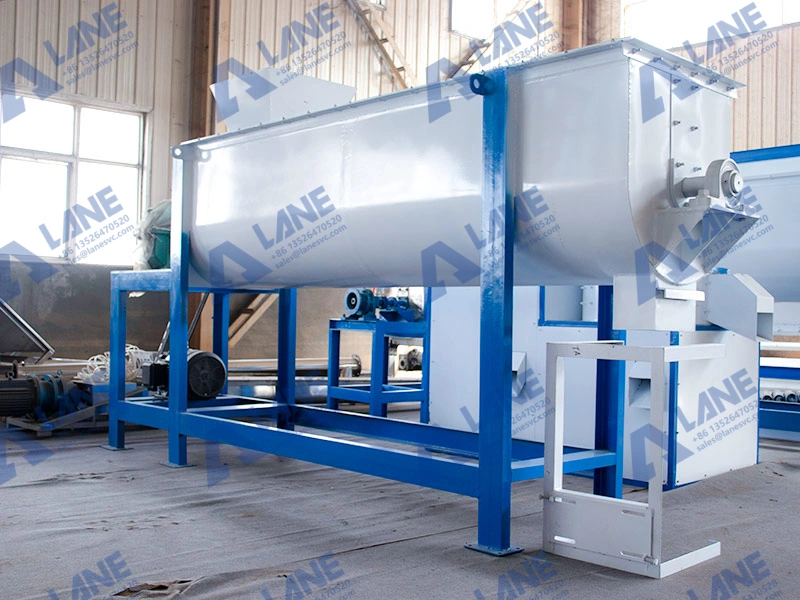
Horizontal fertilizer mixer tank residue is the production problem that is most easily overlooked and causes the most invisible loss in the production of organic fertilizer. After long-term stirring operation, the majority of fertilizer workshops will appear phenomena such as material sticking to the wall, blade hanging material, and material accumulation at the bottom of the warehouse.
High-moisture livestock and poultry manure, fermented compost, sticky auxiliary materials and other raw materials are very easy to adhere to the internal of the mixing equipment, directly contributing to horizontal fertilizer mixer tank residue. The residue layer that has not been cleaned for a long time will gradually cause a series of problems such as material waste, uneven mixing, batch cross-contamination, and declining effective capacity.
For production line managers, solving horizontal fertilizer mixer tank residue is the most direct and efficient optimization method to stabilize batch quality, reduce production losses, and improve raw material utilization.
Common Causes of Horizontal Fertilizer Mixer Tank Residue
There is very little material left in the mixer, which is caused by a sudden equipment failure. Most horizontal fertilizer mixer tank residue accumulation is the result of the combination of material properties, feeding operation habits, and defects in the internal structure of the equipment.
These minor problems will not affect the short-term startup operation, but in the continuous mass production conditions, they will aggravate the problem of sticking to the wall and accumulation of materials day after day, and eventually form a stubborn horizontal fertilizer mixer tank residue layer that is difficult to clean.
High Viscosity Organic Materials Stick to Tank Wall and Blades
Organic fertilizer raw materials generally contain organic colloids and stable water. During the stirring and turning process of wet manure and mature compost, they will continuously adhere to the metal contact surface, becoming a major source of horizontal fertilizer mixer tank residue.
Conventional rotary stirring cannot completely peel off the thin mucous membrane, and over time, it will form continuous horizontal fertilizer mixer tank residue accumulation inside the horizontal mixer.
Improper Material Proportion Enhances Overall Adhesion
The imbalance of dry powder auxiliary materials and wet manure raw materials will directly increase the viscosity of the whole batch of mixed materials. The proportion of wet material is too high, the material becomes soft and sticky overall, and the probability of horizontal fertilizer mixer tank residue increases significantly.
If workers use a fixed ratio for a long time and do not fine-tune the parameters according to the moisture of the raw materials, they will continue to increase the problem of horizontal fertilizer mixer tank residue in the drum.
Incorrect Feeding Sequence Causes Local Material Accumulation
Prioritizing a large amount of wet granular material at one time will form a concentrated adhesive area at the bottom of the warehouse. The subsequent input of dry powder auxiliary materials cannot completely wrap and dilute the wet material lumps.
If the undispersed wet material remains stationary for a long time, it will gradually form a thick horizontal fertilizer mixer tank residue area in the equipment blind spot.
Insufficient Mixing Time Leads to Incomplete Residue Removal
Many workshops blindly compress the mixing cycle in order to increase daily output. The number of stirring and turning is insufficient, and the corner materials cannot be fully stirred, exchanged, and mixed.
Raw materials in static dead corners cannot participate in complete mixing and discharge, and ultimately remain in the warehouse to form horizontal fertilizer mixer tank residue.
Hidden Production Losses Caused by Mixer Tank Residue
Most operators only observe the cleanliness of the surface after discharging, ignoring the trace horizontal fertilizer mixer tank residue in the weld, blade root, and gaps of the silo. These undetectable accumulations of materials will continue to cause hidden losses on the production line and are one of the main sources of waste of materials in the workshop.
- Residual Materials Cause Batch Cross-contamination
The horizontal fertilizer mixer tank residue of the previous batch will be mixed into the new batch of raw materials, changing the original nutrient ratio of the fertilizer. Old materials that have not been fully decomposed and have slightly deteriorated will directly affect the fermentation state and product stability of new materials.
Long-term batch mixing pollution caused by horizontal fertilizer mixer tank residue will cause the quality of finished fertilizer to be uneven, and the test data will fluctuate greatly.
- Hardened Residue Lumps Affect New Material Homogeneity
Residual lumps that have hardened cannot be broken or dispersed by conventional stirring force. Hard blocks fixed in the warehouse will block the normal flow and rotation of materials.
The new raw materials cannot achieve uniform blending, which ultimately leads to uneven texture and obvious differences in particle state in the finished fertilizer, all traceable to horizontal fertilizer mixer tank residue.
- Long-term Residue Decay Produces Unpleasant Odors
The retained material in the closed chamber will continue to absorb moisture, undergo secondary fermentation, and deteriorate, worsening horizontal fertilizer mixer tank residue issues.
The accumulation of deteriorated materials will produce a pungent smell, which will not only pollute the production environment in the workshop, but also cause the odor to exceed the standard in the storage stage of finished products, which will affect the quality of product delivery.
- Thick Residue Reduces Effective Mixing Volume and Production Capacity
The thickness of the horizontal fertilizer mixer tank residue layer continues to increase, which will continuously compress the actual effective mixing space of the horizontal mixer.
Under the premise that the feeding amount remains unchanged, the actual mixing capacity of the equipment shrinks, and the output efficiency continues to decline, forming an invisible capacity loss of “unchanged feeding and reduced output” driven by horizontal fertilizer mixer tank residue.
Structural Defects That Aggravate Residue Accumulation
With the same raw materials and the same operation method, the accumulation of materials in different brands of mixers is greatly different, the core reason is the internal structure design details. Structural defects are the root cause of stubborn horizontal fertilizer mixer tank residue.
> Rough Inner Tank Welds Catch Fine Powder and Wet Mud
Structural characteristics: The welds in the ordinary equipment warehouse are rough and uneven, and there are many fine gaps.
Material performance: Wet fine powder and slurry-like manure are very easy to embed in the welded position, initiating horizontal fertilizer mixer tank residue.
The final result: the materials are stacked on top of each other, forming a stubborn horizontal fertilizer mixer tank residue layer that is extremely difficult to naturally fall off.
> Excessive Gap Between Blade and Tank Bottom
The clearance between the blade and the bottom of the silo is be excessive, making it impossible to touch or scrape the bottom material during the mixing rotation.
The bottom material is in a static state for a long time, continues to accumulate and solidify, and finally forms a fixed horizontal fertilizer mixer tank residue belt at the bottom of the warehouse.
> Unreasonable Discharge Port Design Creates Discharge Dead Zones
The right-angle corner and small outlet structure will form a closed blind spot at the outlet port.
Most of the materials can be emptied smoothly, but the materials in the corners cannot follow the flow of the output, and the horizontal fertilizer mixer tank residue piles up for a long time.
> Poor Sealing Causes Internal Moisture Accumulation and Seepage
The shaft end seal structure is not tight, and the workshop moisture and water vapor continue to seep into the warehouse body.
The humidity in the warehouse increases, which accelerates the moisture absorption, adhesion, and hardening of the materials, making horizontal fertilizer mixer tank residue more stubborn and difficult to clean.
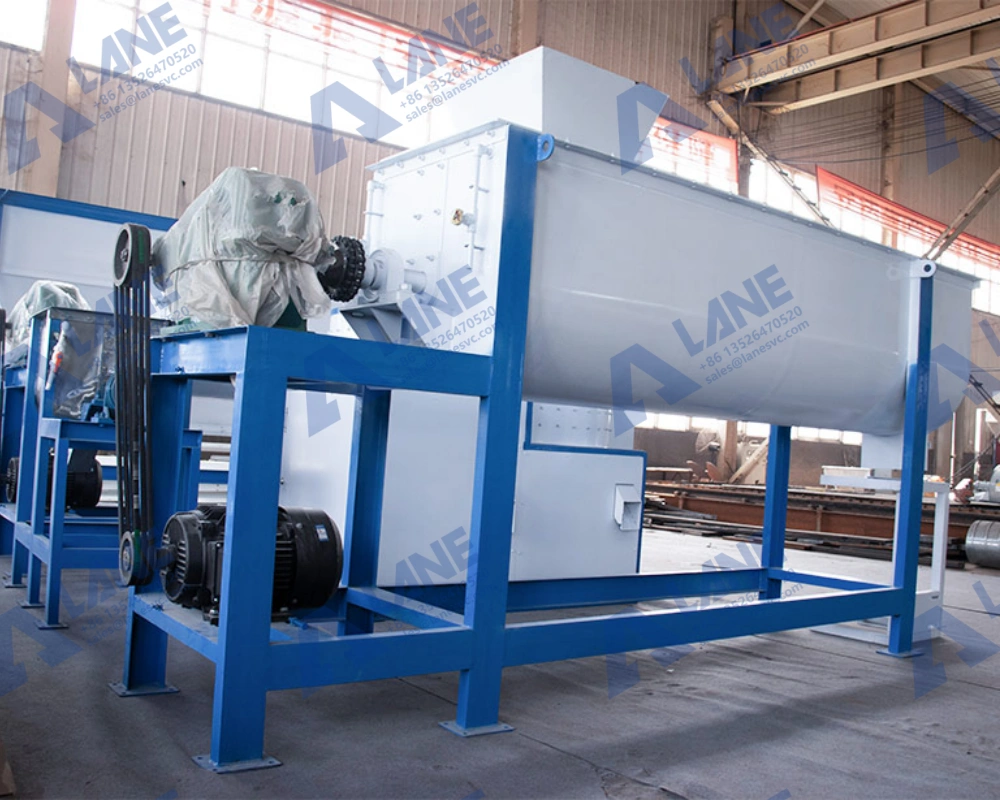
On-site Practical Solutions To Eliminate Horizontal Mixer Residue
The vast majority of horizontal fertilizer mixer tank residue problems do not need to modify the production line or replace the equipment. By standardizing the on-site operation and cleaning specifications, the problem of hanging wall and accumulation of materials can be greatly improved.
- Adjust Raw Material Moisture Before Mixing Operation
The moisture content of raw materials should be controlled uniformly before feeding, and the manure with high humidity should be dried with dry powder auxiliary materials in advance to reduce the overall viscosity, thus minimizing horizontal fertilizer mixer tank residue.
Maintaining the stability of the material moisture can weaken the adhesion between the material and the metal wall from the source, directly reducing horizontal fertilizer mixer tank residue.
- Execute Scientific Feeding Sequence For Each Batch
Strictly implement the “first dry, then wet” feeding logic, first put dry powder, straw powder, and auxiliary materials to fill the bottom of the warehouse.
The dry powder forms an isolation protective layer, and the subsequent wet manure material will not directly adhere to the wall of the silo, greatly reducing horizontal fertilizer mixer tank residue.
- Set Reasonable Mixing and Emptying Time
Adequate mixing and turning time is reserved for each batch to ensure that all corners and bottom materials are fully involved in mixing and blending, preventing horizontal fertilizer mixer tank residue from forming.
After the mixing is completed, the emptying time should be appropriately extended to clear the residual materials in the dead corners and reduce horizontal fertilizer mixer tank residue.
- Complete Quick Cleaning After Daily Production
Simplified cleaning is completed after daily shutdown, focusing on cleaning the root of the blade, the gap of the weld, and the micro horizontal fertilizer mixer tank residue in the blind area of the outlet.
Daily micro-cleaning can avoid the accumulation of small particles and harden them into stubborn horizontal fertilizer mixer tank residue deposits.
LANE Horizontal Fertilizer Mixer Optimized Design For Low Residue
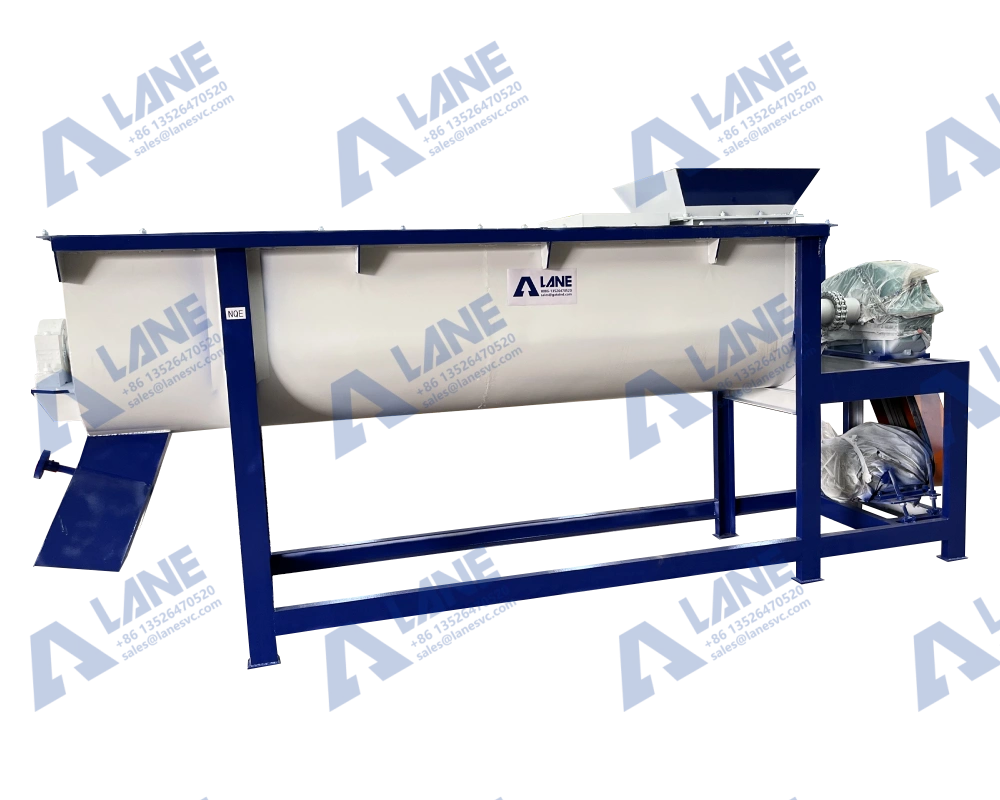
In response to the harsh working conditions of high humidity, high viscosity, and easy to hang on the wall of organic fertilizer, LANE Heavy Industry has made targeted upgrades and optimizations to the internal structure of the horizontal mixer, solving horizontal fertilizer mixer tank residue from the equipment structure level, and is suitable for long-term continuous organic fertilizer production.
Polished Inner Tank Wall Reduces Material Adhesion
Cage optimization: the whole machine’s cage wall adopts fine polishing treatment, with no welded bulges or rough burrs that could trap horizontal fertilizer mixer tank residue.
Anti-stick effect: The smooth metal surface greatly reduces the adhesive friction force of wet material, minimizing horizontal fertilizer mixer tank residue.
Production advantage: During the mixing and discharging process, most of the material can naturally slide down, and it is not easy to stick to the wall, fundamentally reducing horizontal fertilizer mixer tank residue.
Precision Blade Gap Design Realizes Blind-spot Free Scraping
LANE strictly controls the gap between the blade and the bottom and wall of the silo, and the error is controlled within the precision range.
Every rotation of the blade can cover the bottom and side wall of the silo, eliminating the blind spot of static horizontal fertilizer mixer tank residue accumulation.
Large Opening Discharge Port Eliminates Discharge Dead Zone
The large-diameter curved discharge structure is adopted, and the traditional right-angle dead corner design is eliminated.
The material smoothly empties along the curvature of the warehouse, there is no retention or accumulation at the port, and each batch empties more thoroughly, leaving minimal horizontal fertilizer mixer tank residue.
Anti-blocking Blade Structure Adapted To Viscous Manure Mixing
Characteristics of the blade: streamlined curved structure, not easy to wrap, hang, and entangle.
Practical value: The operation process continuously disperses micro-aggregates, adapts to the mixing conditions of high viscosity manure and decomposed waste, providing a stable solution for minimizing horizontal fertilizer mixer tank residue in viscous material mixing.
Daily Maintenance Rules To Prevent Residue Recurrence
90% of repeated horizontal fertilizer mixer tank residue growth is due to improper daily maintenance. Standardized daily inspection and maintenance is the key to maintaining the cleanliness and stable mixing quality of the warehouse for a long time.
- Daily Visual Inspection Before Shutdown
Before each stoppage, check the situation of the blade and the wall of the silo for sticking material, and deal with the slight horizontal fertilizer mixer tank residue in time to avoid accumulation and hardening.
- Weekly Deep Cleaning
Conduct a deep cleaning of the warehouse once a week to thoroughly remove horizontal fertilizer mixer tank residue hidden in welds, blade roots, and dead corners.
Deep cleaning can solve the hidden danger of stubborn horizontal fertilizer mixer tank residue that cannot be handled by daily simple cleaning.
- Regular Blade Wear Inspection Avoids New Dead Zones
The wear of the blade will change the original scraping gap and produce new horizontal fertilizer mixer tank residue dead corners.
Regularly check the wear state, timely maintenance and adjustment, and ensure that the equipment has no blind spots during the scraping process, preventing fresh horizontal fertilizer mixer tank residue from forming.
- Maintain Ventilated and Dry Tank Interior
After production, keep the warehouse ventilated to prevent moisture from accumulating, which exacerbates horizontal fertilizer mixer tank residue.
The environment in the drying chamber can effectively prevent the absorption of moisture and the hardening of trace horizontal fertilizer mixer tank residue into stubborn layers.
Frequently Asked Questions
Question 1: How much material waste can be reduced by solving the problem of mixer residue?
Answer: Standardizing the control of horizontal fertilizer mixer tank residue can reduce the loss of organic materials by 3% to 8% per month, significantly improving the utilization rate of raw materials and the production profit of the workshop.
Question 2: Is daily cleaning necessary for horizontal fertilizer mixer?
Answer: Daily simple cleaning is time-saving and effective, which can effectively prevent the accumulation and hardening of micro-materials, and is an essential process for long-term horizontal fertilizer mixer tank residue control.
Question 3: Does completely decomposed sticky manure still produce residue in the silo?
Answer: Decomposed manure still has a colloidal viscosity, and under the condition of high humidity and improper feeding, there will still be obvious horizontal fertilizer mixer tank residue accumulation on the wall.
Question 4: Does LANE Horizontal Fertilizer Mixer require high-frequency maintenance?
Answer: The low residue optimized structure greatly reduces the probability of sticking, wear, and blockage, and the daily maintenance amount is lower than that of ordinary mixers, with minimal horizontal fertilizer mixer tank residue concerns during long-term operation.
Question 5: Can optimized blade design completely eliminate mixing dead zones?
Answer: The precision gap blade design covers the entire blade, and under normal operation conditions, it can basically eliminate the blind area of the mixing material, achieving less horizontal fertilizer mixer tank residue in the silo.
Conclusion
Horizontal fertilizer mixer tank residue stems from viscous materials, improper operations, and structural blind spots. Most losses can be cut by moisture control, feeding sequence, and daily cleaning—no upgrades needed. LANE’s low-residue design solves sticky buildup, ensuring uniform mixing and thorough emptying. Facing repeated horizontal fertilizer mixer tank residue? Consult LANE for tailored solutions.