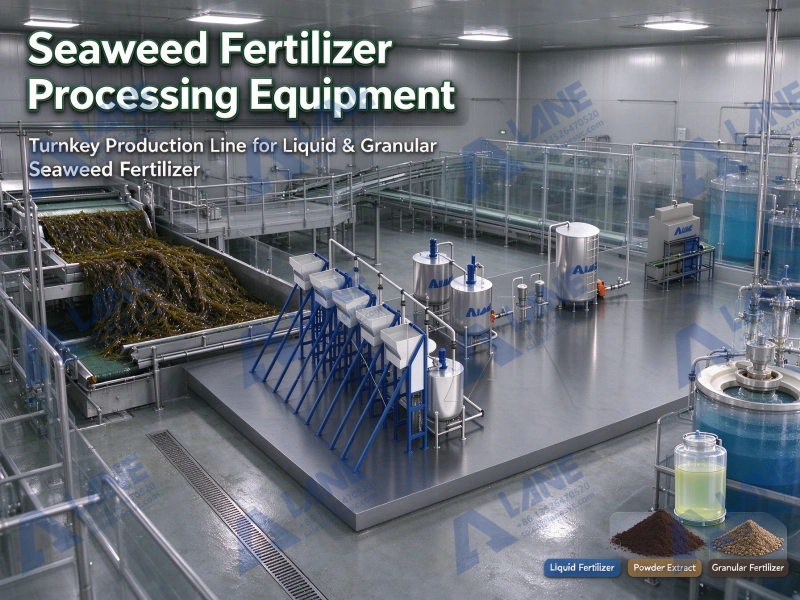
How Rotary Granulator Processes Agricultural Waste into High-quality Fertilizer Granules
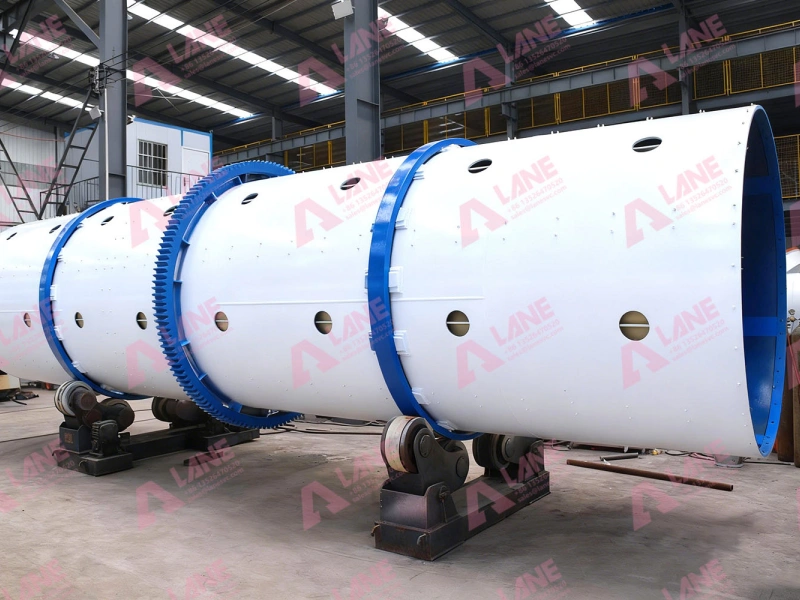
As a production engineer with over ten years of experience in organic fertilizer production line commissioning, I have visited countless farm and fertilizer processing factories across many countries. A common trouble troubles most agricultural operators: massive agricultural waste piles up year after year. Crop straw, poultry droppings, livestock manure and leftover materials from grain processing are either stacked randomly to pollute soil and water, or burned directly to trigger air pollution.
These waste materials contain rich organic matter and mineral nutrients, yet loose raw materials cannot be circulated and sold as commercial fertilizer directly. Complete resource conversion relies on standardized composting, crushing, mixing and granulation procedures. Among all processing equipment, the Rotary Granulator Processes Agricultural Waste to turn scattered waste materials into round, solid fertilizer pellets with market competitiveness.
The Necessity of Granulation for Agricultural Waste Before Commercial Fertilizer Production
Many small farms try to sell fermented manure and straw compost in bulk, but they always face poor sales and high transportation loss. Granulation treatment is not an optional extra step, but a necessary upgrade for agricultural waste to realize commercial value. Three practical advantages can explain the necessity of pelletizing treatment.
• The Transport and Storage Difficulties of Loose Organic Waste
Unprocessed agricultural waste features low bulk density, large overall volume and unstable internal moisture content. Fresh cow dung or rice straw will expand in volume when absorbing rainwater, and mildew will occur after long-term stacking in warehouses.
After being processed by the Rotary Granulator, waste materials are pressed into solid pellets. The overall volume can be reduced by nearly 60%, moisture volatilization speed slows down obviously, warehouse storage cycle is extended greatly, and long-distance truck transportation cost is cut effectively.
• The Market Requirement for Uniform and Dust-Free Fertilizer Materials
Fertilizer dealers and large planting bases have fixed procurement standards for finished fertilizer products. Powdered organic fertilizer will produce a lot of dust during loading, unloading and spreading. Manual spreading will lead to uneven nutrient distribution in farmland, affecting crop growth consistency.
Uniform spherical fertilizer pellets made by the Rotary Granulator have no dust overflow during use. Planter machines can realize automatic quantitative fertilization, which matches the modern precision planting mode and raises the market acceptance of waste-based fertilizer products.
• The Nutrient Preservation and Value Enhancement Through Granulation
Organic nutrients in loose compost will decompose rapidly under wind and sunlight. After pellet molding, the outer layer of fertilizer particles forms a protective structure. Organic nitrogen, phosphorus, potassium and trace elements inside the pellets release slowly with soil water infiltration.
Slow-release fertilizer pellets have longer fertilizer efficiency, which can be sold at a higher unit price compared with bulk compost. Farmers can get more profit from agricultural waste recycling projects.
The Processing of Different Agricultural Waste Types by Rotary Granulator
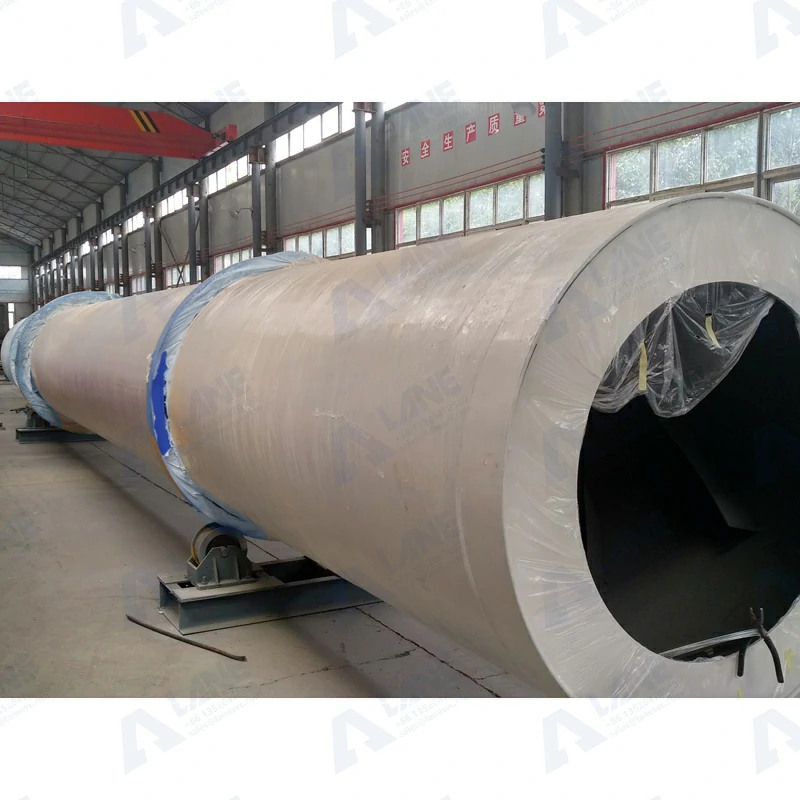
Different agricultural waste has different fiber content, moisture and viscosity. The Rotary Granulator Processes Agricultural Waste with targeted parameter adjustment for three mainstream waste raw materials, to guarantee stable granulation effect for various waste materials.
> The Processing of Poultry Manure into Organic Fertilizer Granules
Chicken manure and duck manure are high-nitrogen agricultural waste, with high initial moisture and strong odor. Direct granulation without fermentation will lead to soft pellets and serious odor residue.
Standard production flow: complete aerobic composting for poultry manure → block crushing by cage crusher → uniform mixing with straw powder for moisture adjustment → feeding into Rotary Granulator for rolling pellet formation → drum drying → rotary screening → finished pellet packaging.
Straw powder acts as the drying agent and binder inside the cylinder, the rotary rolling action of the granulator wraps manure powder into round fertilizer pellets, effectively reducing the pungent smell of poultry manure fertilizer.
> The Conversion of Crop Residue into Valuable Fertilizer Products
Corn stalk, wheat straw, rice husk and peanut vine are typical fiber-rich crop residues. Pure straw materials have weak adhesion, so they cannot form intact pellets only by rolling extrusion.
Production operation tips: crush crop residue to 20-40 mesh first, mix with livestock manure compost to enhance adhesion, then send the mixed material into the Rotary Granulator. Adjust the rotating speed of the cylinder properly to extend material rolling time for solid pellet molding.
Crop residue fertilizer pellets can improve soil organic matter content and loosen hardened farmland soil, very popular for orchard planting and greenhouse vegetable cultivation.
> The Handling of Livestock Waste for Large-scale Fertilizer Production
Cow manure, pig manure and sheep manure are the main waste from large-scale breeding farms. Daily waste output of medium and large breeding farms can reach dozens of tons, requiring continuous granulation equipment to match waste disposal capacity.
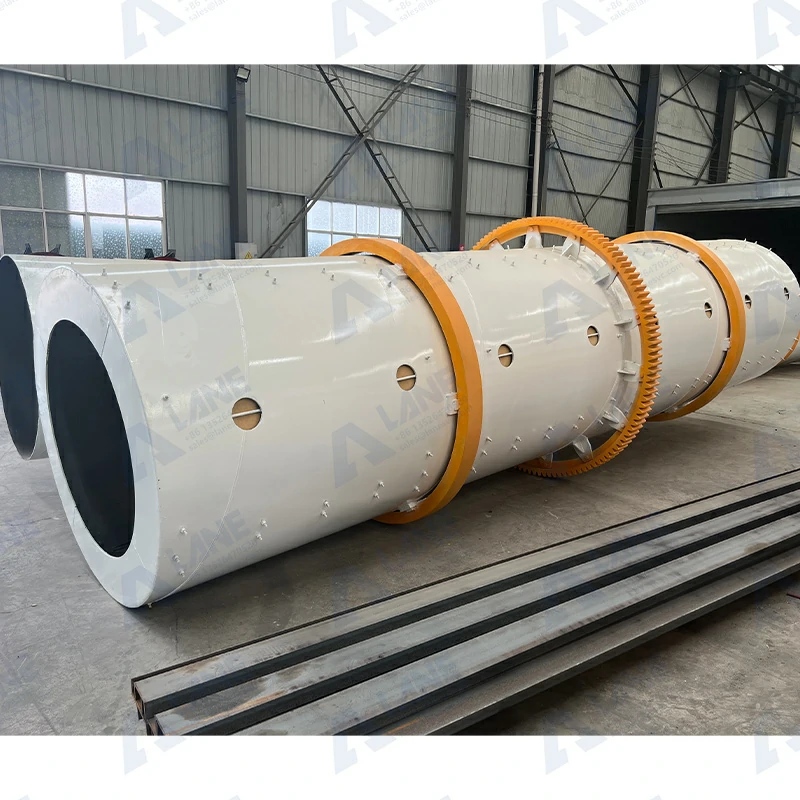
LANE Rotary Granulator supports 1–30 tons per hour continuous feeding operation. The cylinder lining adopts wear-resistant rubber plate, which avoids wet manure sticking to the inner wall during long-time continuous operation, cuts down manual shutdown cleaning frequency greatly.
Complete breeding waste fertilizer production line can realize zero discharge of breeding waste, the whole production process meets environmental protection inspection standards for breeding enterprises.
| Model | Drum size(mm) | Rotation Speed(rpm) | Thickness(mm) | Capacity(tph) | Power(kw) | Tilt Angle(°) |
|---|---|---|---|---|---|---|
| LAZR-1060 | Φ1000*6000 | 13 | 10 | 2-5 | 7.5 | 2-2.5° |
| LAZR-1260 | Φ1200*6000 | 13 | 10 | 3-6 | 11 | 2-2.5° |
| LAZR-1560 | Φ1500*6000 | 13 | 10 | 6-8 | 15 | 2-2.5° |
| LAZR-1870 | Φ1800*7000 | 13 | 12 | 8-10 | 18.5 | 2-2.5° |
| LAZR-2080 | Φ2000*8000 | 11.5 | 12 | 10-15 | 22 | 2-2.5° |
| LAZR-2290 | Φ2200*9000 | 11.5 | 14 | 15-20 | 30 | 2-2.5° |
| LAZR-2410 | Φ2400*10000 | 11.5 | 16 | 15-20 | 37 | 2-2.5° |
The Role of Rotary Granulator in Agricultural Waste Fertilizer Production
In the whole waste fertilizer production line, the rotary granulator is the core molding equipment connecting front-end raw material treatment and back-end drying screening. Its structural design and operating mode determine the finished pellet yield and quality directly.
- The Improvement of Fertilizer Particle Formation by Rolling Granulation
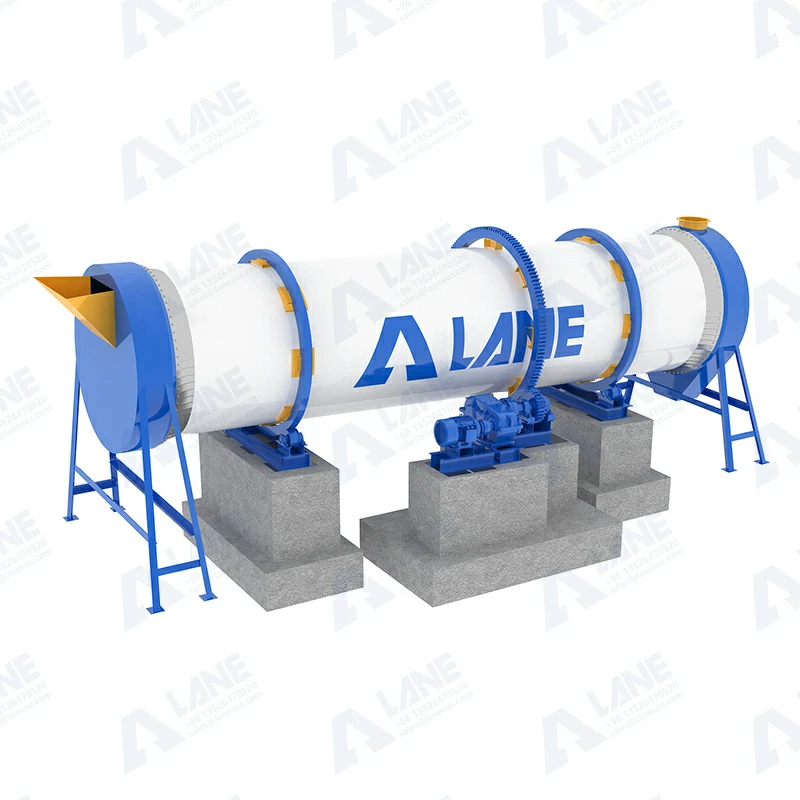
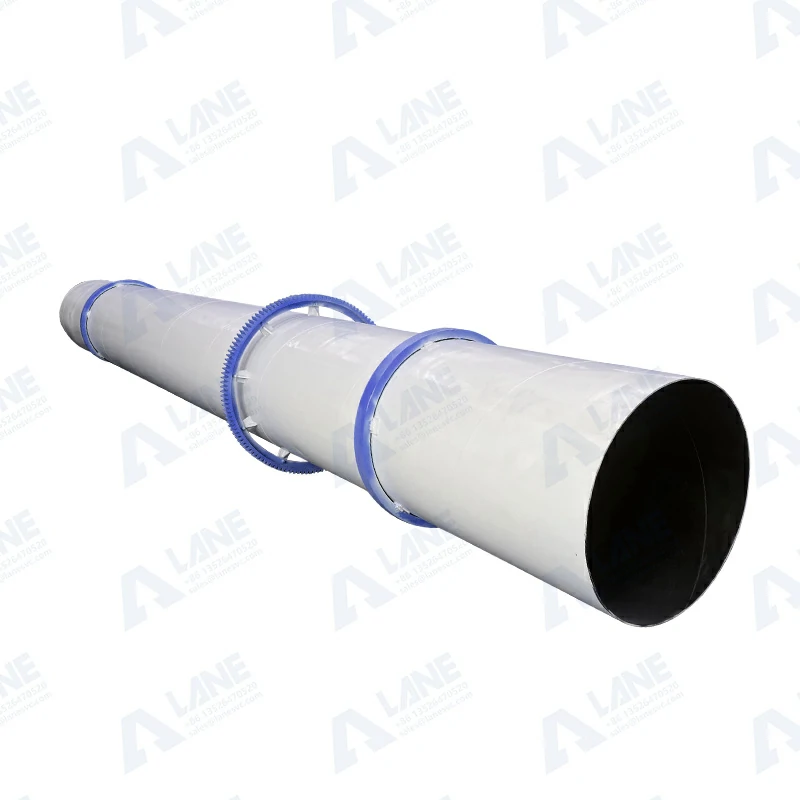
The cylinder of Rotary Granulator tilts at a fixed angle. When the main motor drives the cylinder to rotate slowly, the internal material rolls and turns over continuously along the inclined cylinder wall.
Spray a small amount of water or liquid binder at the feeding port, fine organic powder agglomerates into small mother pellets under rolling friction. Small pellets keep wrapping fine powder to grow into standard-size spherical fertilizer particles.
Compared with extrusion granulation equipment, rolling granulation has lower equipment failure rate and smoother continuous operation for high-fiber agricultural waste materials.
- The Adaptability of Adjustable Operation Conditions to Different Organic Materials
All running parameters of LANE rotary granulator can be adjusted according to raw material conditions, including cylinder rotating speed, feeding speed and binder spraying flow.
When processing high-moisture poultry manure, reduce feeding volume and raise cylinder rotating speed to speed up pellet forming; for dry crop straw mixed materials, increase binder spraying volume and slow down rotation speed for sufficient rolling agglomeration.
Flexible parameter adjustment makes the Rotary Granulator Processes Agricultural Waste of various states without replacing internal accessories frequently.
- The Support of Continuous Production for Commercial Fertilizer Manufacturing
Small-scale manual granulation or disc granulation can only realize intermittent production, which cannot digest the daily waste output of large farms.
Rotary granulator adopts through-type feeding and discharging structure. Raw materials enter from the front feeding end, finished pellets flow out from the tail discharging port automatically. The production line can run 24 hours with two shifts arrangement to realize mass fertilizer output.
Stable daily output helps fertilizer factories sign long-term supply contracts with planting bases and agricultural material distributors.
Common Granulation Challenges and Their Solutions for Agricultural Waste
During on-site equipment debugging, three typical granulation faults often appear when processing agricultural waste. Targeted adjustments can solve these problems without large equipment renovation.
- The Low Granulation Rate Caused by Improper Raw Material Preparation
The main inducements of low pellet forming rate are three points: raw material moisture is too high or too low, fermentation is incomplete, and coarse hard blocks are not crushed fully.
Solutions: Test raw material moisture before feeding, control overall moisture between 25% to 32%; extend compost turning cycle for unfermented waste; check the crusher blade wear regularly to eliminate large hard blocks in advance.
- The Problem of Weak Fertilizer Granules After Production
Fresh pellets break easily after falling, caused by insufficient binder addition, short rolling time inside the cylinder, and untimely drying treatment after granulation.
Optimization plan: add a small amount of bentonite as solid binder for pure straw materials; lower granulator rotating speed to prolong rolling time; send finished pellets to the rotary dryer within 10 minutes after discharging to remove excess surface moisture.
- The Issue of Uneven Fertilizer Particle Size During Continuous Operation
Unstable feeding belt speed will lead to sudden material surge, making part of the material fail to complete rolling granulation. Excessive binder will also make multiple small pellets stick together into oversized agglomerates.
Improvement measures: install frequency converter for feeding conveyor to realize stable uniform feeding; calibrate binder spray valve to keep fixed flow rate, avoid local excessive binder accumulation.
The Selection Criteria for a Suitable Rotary Granulator in Agricultural Waste Processing
Many new waste fertilizer project purchasers only focus on the price of single granulator equipment, resulting in equipment capacity mismatch and frequent granulation faults after production start. Three core selection principles for reference.
• The Matching of Equipment Capacity with Available Agricultural Waste Volume
Calculate the total daily agricultural waste production of the farm or waste collection station, select a rotary granulator with hourly processing capacity 1.2 times the peak waste volume, reserve sufficient production surplus for seasonal waste growth.
For family farms with daily waste less than 5 tons, choose 1–5t/h small granulator; for breeding groups with daily waste over 20 tons, configure 20–30t/h large rotary granulator.
• The Equipment Configuration Choice Based on Raw Material Characteristics
For high-viscosity chicken manure and pig manure raw materials, order granulator with built-in rubber anti-sticking lining; for hard fiber crop straw, choose thickened wear-resistant cylinder wall and reinforced driving gear structure.
LANE supports personalized structural configuration adjustment according to customer raw material samples, no universal standard configuration for all working conditions.
• The Necessity of Building a Complete Production System Instead of a Single Machine
A single rotary granulator cannot finish full waste fertilizer production independently. The standard complete technological flow is listed as follows:
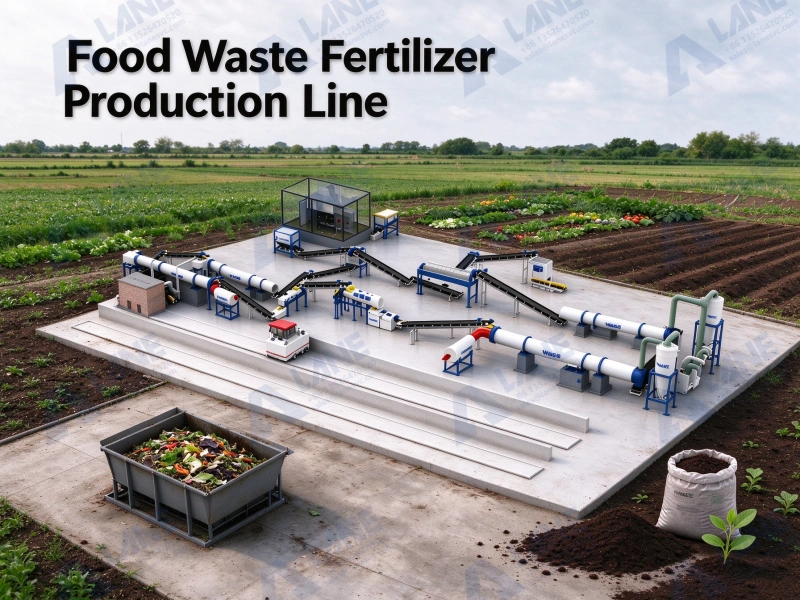
Agricultural Waste Raw Material → Compost Turning Fermentation → Lump Crushing → Horizontal Mixing → Rotary Granulator → Rotary Dryer → Rotary Screener → Finished Fertilizer Packing
Purchasing supporting crushing, mixing, drying and screening equipment together with granulator can avoid production line bottleneck caused by mismatched front and back equipment.
The Advantages of Choosing LANE Rotary Granulator for Agricultural Waste Fertilizer Projects
We have accumulated rich practical experience in agricultural waste granulation through hundreds of domestic and overseas organic fertilizer project cases. Our rotary granulator is optimized targeted for wet, sticky and high-fiber waste materials, three core advantages support stable project operation.
> The Customized Granulation Solutions for Different Organic Materials
Our technical team analyzes customer waste samples for free, tests raw material moisture, fiber ratio and viscosity in the factory laboratory, then adjusts granulator rotating speed, lining structure and feeding mode to make exclusive granulation parameters for customers.
Whether it is pure straw waste, fresh livestock manure or mixed compost materials, we can achieve granulation rate above 85% for agricultural waste raw materials.
> The Complete Equipment Support from Raw Material Processing to Packaging
LANE is not only a single granulator manufacturer, we can undertake overall layout design for agricultural waste organic fertilizer production lines. From fermentation turner, crusher, mixer to dryer, screener and automatic packaging machine, all supporting equipment can be supplied in one set.
Unified equipment matching reduces the debugging difficulty after production line installation, shortens the whole project construction cycle.
> The Technical Assistance for Overseas Fertilizer Production Projects
For overseas customers who purchase our granulation equipment, we can arrange professional after-sales technicians to go abroad for on-site installation guidance, equipment debugging and worker operation training.
After the project is put into production, we provide long-distance online technical follow-up, solve granulation abnormal problems remotely to guarantee continuous factory operation.
Frequently Asked Questions
The Capability of Rotary Granulator to Process Different Agricultural Waste Types
Yes. After adjusting internal liner structure and operating parameters, the Rotary Granulator Processes Agricultural Waste including poultry manure, livestock dung, crop straw, mushroom residue and kitchen organic waste. It can adapt to almost all common agricultural organic waste granulation demands.
The Suitable Agricultural Waste Materials for Rotary Granulation
Suitable raw materials cover fermented livestock manure, all kinds of crop straw, mushroom substrate residue, fruit and vegetable processing leftover waste. Hard mineral waste and raw materials with more than 40% moisture are not suitable for direct rotary granulation.
The Necessity of Composting Agricultural Waste Before Rotary Granulation
It is better to complete aerobic composting fermentation in advance. Fermentation decomposes crude fiber, reduces raw material odor and improves material adhesion for better pellet forming effect. If customers only do waste volume reduction treatment, fresh waste can be granulated with dry powder blending for moisture control.
The Methods to Improve Fertilizer Granule Quality from Agricultural Waste
Control raw material moisture strictly, match reasonable binder proportion, stabilize continuous feeding speed, and timely dry the finished pellets after granulation. Four simple operation steps can greatly upgrade pellet roundness and hardness.
Conclusion
Agricultural waste is no longer a burden for farmers as discarded trash, but has become a recyclable raw material with market value for organic fertilizer. Through standardized pre-treatment of waste at the front end and processing with mature drum granulation equipment, crop straw, poultry manure, and livestock manure can be reliably converted into marketable organic fertilizer pellets.
For large-scale farms, agricultural waste collection and storage stations, and organic fertilizer startup factories, selecting appropriately matched drum granulators and complete production lines is the key to simultaneously achieving waste reduction, environmental compliance, and increased profitability.
LANE relies on on-site production experience of agricultural waste fertilizer projects, to provide targeted Rotary Granulator and whole-line process design according to your waste type, daily disposal capacity and finished fertilizer requirements. Send your raw material condition to our sales team, we will deliver detailed equipment configuration plan and production suggestions within one working day.