How To Cut Monthly Power Consumption Of Animal Excrement Fertilizer Production Line?
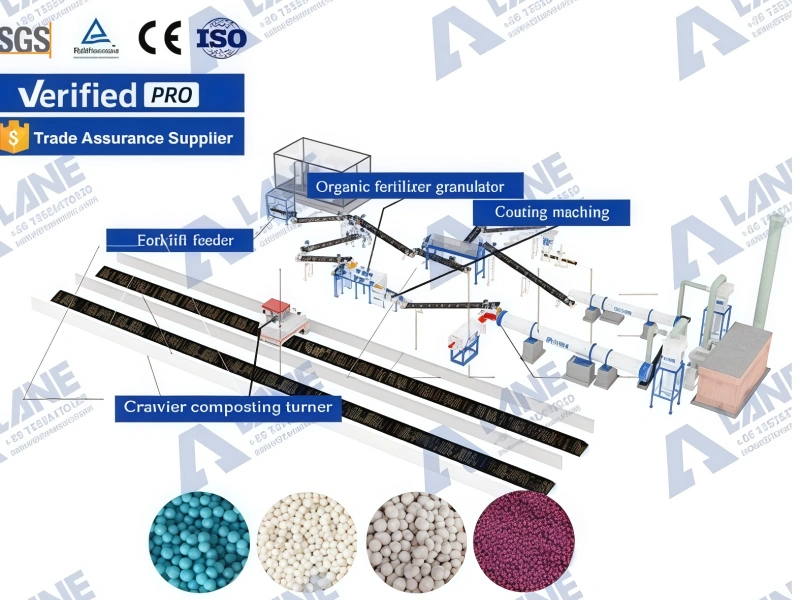
Small and medium-sized breeding fertilizer workshops rely entirely on Animal Excrement Fertilizer Production Line for daily manure disposal and organic fertilizer manufacturing.
Long-hour non-stop operation of the whole line brings continuous high electricity bills, which takes up a large share of monthly production cost.
Most factory managers only calculate the single power consumption of each machine separately, ignoring hidden power waste caused by unreasonable overall flow matching of Animal Excrement Fertilizer Production Line.
Equipment Matching Optimization to Lower Power Loss of Animal Excrement Fertilizer Production Line
Many factory owners blindly select high-power supporting machines when configuring Animal Excrement Fertilizer Production Line, simply thinking higher power brings higher output.
In fact, excessive power configuration will lead to long-term no-load power loss during low-yield production periods, which is one of the biggest invisible power consumption sources in the workshop.
Reasonable Power Model Selection for Granulator Matched with Manure Output
Many plant owners buy high-power granulator blindly for Animal Excrement Fertilizer Production Line, far exceeding daily manure processing demand of their own breeding farms.
When the daily raw material supply is insufficient, the granulator motor keeps idling with full power, wasting stable electricity every hour during low-yield shifts.
Long-term unreasonable power matching can increase monthly electricity expenditure by 20% to 30% invisibly.
Timely Replacement of Worn Transmission Bearings Reduces Extra Power Load
Conveyor belts, crusher spindles and mixer rotating shafts of Animal Excrement Fertilizer Production Line are equipped with supporting bearings.
After 3 to 4 months of continuous contact with damp manure dust, bearing inner rings will wear and lose lubrication effect.
Friction resistance rises sharply, and driving motors need to consume extra power to overcome rotation resistance every working day.
Independent Control Switches for Standby Equipment Avoid Idle Power Draining
The original integrated power control cabinet of standard Animal Excrement Fertilizer Production Line supplies synchronous power to all standby machines, including spare crusher, standby conveyor and reserve granulator set.
Even if these devices are not put into operation, the circuit still keeps power supply and generates continuous idle power loss.
Install separate independent control switches for each standby equipment to cut off power completely during intermittent production periods.
Frequency Converter Retrofit for Continuous Feeding Equipment Stabilizes Power Output
Fixed-frequency feeding motors matched with traditional Animal Excrement Fertilizer Production Line only have two operation modes: full speed or shutdown.
Sudden full-speed feeding will cause instantaneous material surge, forcing follow-up granulator and crusher to bear overload power impact repeatedly.
Retrofit feeding motors with frequency converters to adjust conveying speed according to real-time raw material stock, smooth power fluctuation and cut invalid power surge loss.
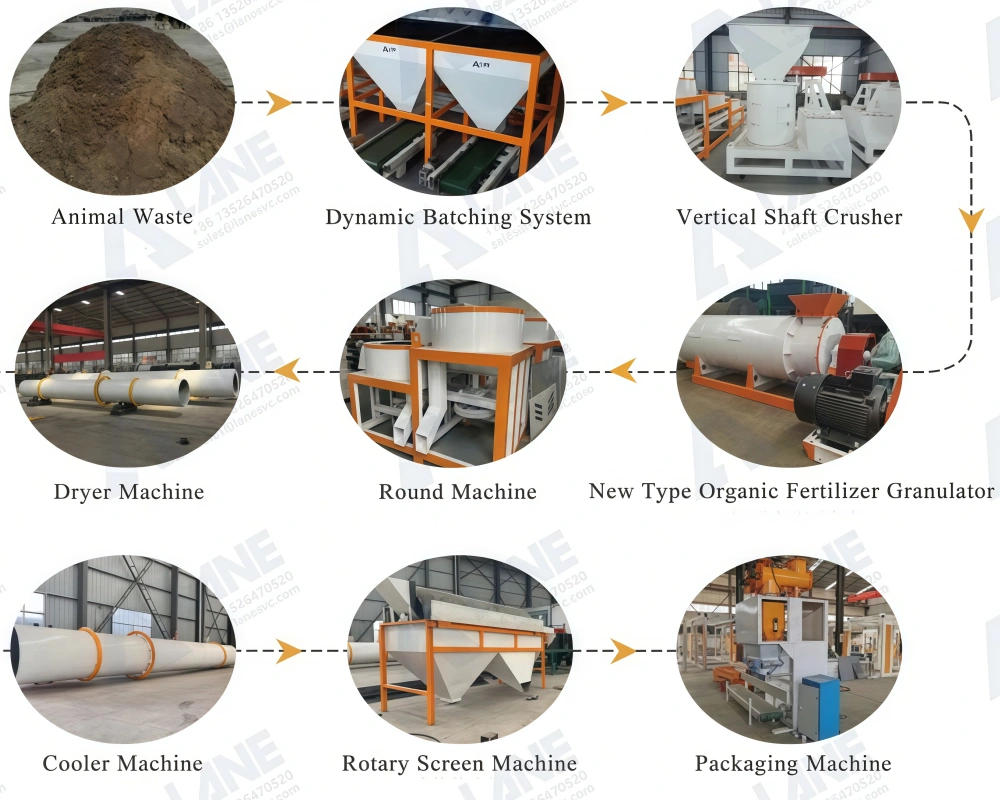
Raw Material Recycling Skills to Lower Auxiliary Material Purchase Cost
Apart from electricity cost, the repeated purchase of carbon source auxiliary materials and filler additives also occupies a large proportion of the monthly operating cost of Animal Excrement Fertilizer Production Line.
Many workshops directly discard screening residues and oversized lumps, wasting recyclable organic raw materials and increasing repeated procurement expenditure of straw, sawdust and humic acid powder.
Re-Process Oversized Screening Residues Instead of Direct Discarding
After granulation, the screening system of Animal Excrement Fertilizer Production Line will separate out oversized unformed manure particles and fine powder fragments that fail to meet finished product standards.
Most small workshops clean these residues out of the workshop and discard them directly, which wastes fermented organic materials formed after a whole fermentation cycle.
All screened residues can be conveyed back to the front-end crusher for secondary smashing and re-granulation, fully reusing organic components without purchasing extra base materials.
Collect Waste Crop Straw from Breeding Yard for Self-Produced Carbon Source
Animal Excrement Fertilizer Production Line needs a large amount of carbon-rich straw auxiliary materials to adjust manure moisture and balance carbon-nitrogen ratio during fermentation.
Many factory managers purchase straw powder from external suppliers at fixed prices every month, ignoring waste crop straw piled around the breeding yard.
Collect corn stalks, rice straw and wheat straw left after crop harvest on the surrounding farmland, crush them with self-owned shredder and mix them into manure raw materials, completely cutting external carbon source procurement cost.
Recycle Waste Mushroom Residue as Natural Organic Filler Additive
Mushroom residue discarded by local edible fungus planting bases contains rich humus and loose fiber, which can be used as natural filler for Animal Excrement Fertilizer Production Line.
Mixing mushroom residue into manure can reduce the adding proportion of purchased bentonite and humic acid powder.
Cooperate with nearby mushroom farms to collect waste residues free of charge, replacing expensive commercial functional additives and lowering monthly auxiliary material cost obviously.
Daily Operation Standardized Management to Cut Hidden Manpower Cost
Many people ignore that unreasonable operation management of Animal Excrement Fertilizer Production Line will bring extra labor cost besides power and material expenditure.
Unstandardized operation leads to frequent equipment blockage and failure, requiring extra workers to stay on site for long-time cleaning and maintenance, which increases daily labor wages invisibly.
Form Fixed Shift Inspection Standard to Reduce Sudden Failure Maintenance Work
Set up fixed pre-shift and mid-shift inspection procedures for Animal Excrement Fertilizer Production Line, assign special operators to check bearing lubrication, pipeline blockage and raw material moisture every 2 hours.
Hidden small faults can be eliminated in advance during inspection, avoiding sudden shutdown that requires 2 to 3 workers to repair for several hours.
Standardized inspection rules cut extra temporary maintenance labor input by more than 65% every month.
Concentrate Raw Material Pre-Treatment to Avoid Split Multi-Shift Labor
Scattered raw material handling will extend the daily working hours of Animal Excrement Fertilizer Production Line, forcing the factory to arrange morning, afternoon and night three shifts of workers.
Concentrate all manure collection, straw crushing and pre-mixing work to the morning shift, complete all raw material pre-treatment within 4 hours, and the production line only needs one shift of workers to finish granulation, drying and packaging.
Reasonable centralized pretreatment reduces shift labor quantity and daily salary expenditure effectively.
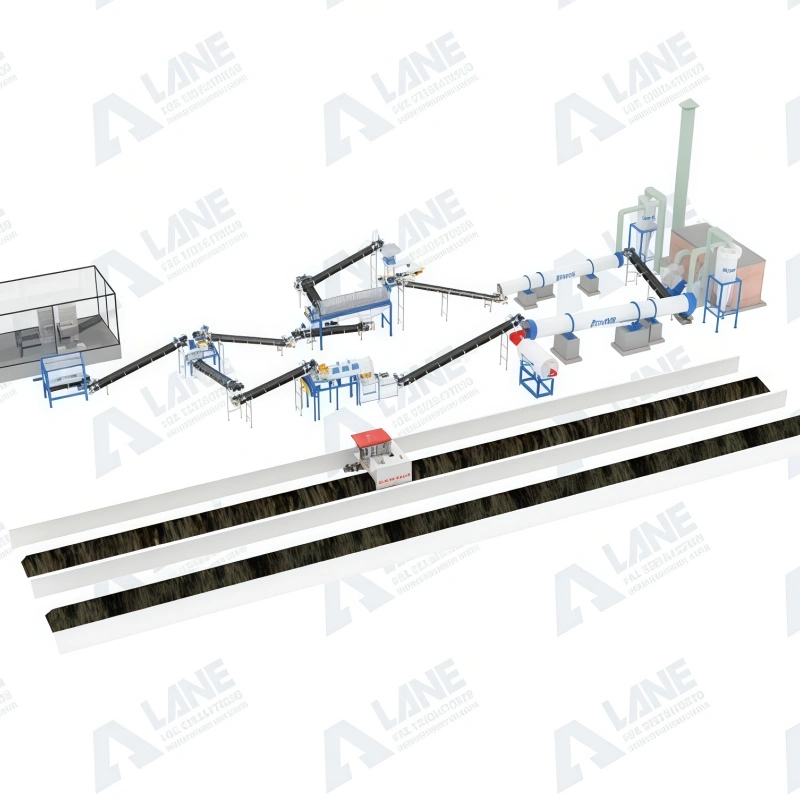
Long-Term Equipment Maintenance Cost Reduction Plan for Production Line
Regular maintenance is necessary to extend the service life of Animal Excrement Fertilizer Production Line, but many workshops adopt passive maintenance mode, replacing damaged parts only after equipment breaks down.
This emergency maintenance mode will bring high-cost spare parts purchase and long production shutdown loss, raising the overall long-term operation cost of the production line.
Regular Lubrication Maintenance Extends Service Life of Wearing Parts
All rotating wearing parts of Animal Excrement Fertilizer Production Line, including rollers, turning teeth and conveyor rollers, need fixed-cycle grease lubrication.
Carry out lubrication filling every three working days, reduce metal friction loss between parts, and extend the replacement cycle of alloy wear parts from 3 months to 7 to 8 months.
Less frequent spare parts replacement greatly cuts long-term accessories procurement cost.
Batch Purchase of Wearing Parts to Get Factory Direct Discount
Roller teeth, sealing gaskets, conveyor belts and bearings are universal wearing parts of Animal Excrement Fertilizer Production Line.
Instead of buying small batches of spare parts separately every time when parts are damaged, place quarterly batch orders with the equipment manufacturer to enjoy factory direct bulk purchase discount.
Batch procurement can reduce the unit price of wearing parts by 15% to 22% each time.
Concluding Paragraph
Most breeding fertilizer factory operators only focus on the one-time investment of purchasing Animal Excrement Fertilizer Production Line, while ignoring the cumulative monthly hidden expenditure including electricity, auxiliary materials, labor and maintenance.
The multi-dimensional cost optimization schemes covering equipment matching, raw material recycling, daily operation management and regular maintenance can effectively control the comprehensive operating cost of the whole line without lowering daily organic fertilizer output.
If your workshop has long-term high monthly operation cost after putting Animal Excrement Fertilizer Production Line into production, you can sort out your daily manure processing volume, workshop shift arrangement and monthly spare parts replacement records. Our technical team can formulate targeted cost-saving adjustment plans combined with the actual operation state of your production line.
| Product Name | Model | Yield | Detail | Speed | Power |
|---|---|---|---|---|---|
| Crawler Compost Turner | LALG-2500 | 400-1500m*3/h | Stacking height 600mm-1500mm | 5-10m/min | 36-170 horsepower |
| Forklift Feeding Hopper | LAH-1.5-3 | Silo size: 1-4 meters | 2250mm*1050mm*1590mm | 1450r/min | 2.2-3KW |
| Vertical Crucher | LAC-60V | 1-12t/h | ZQ series reducer | 1450r/min | 7.5-37KW |
| Organic Fertilizer Granulator | LAZJ-1000 | 1-8t/h | ZY series reducer | 1450r/min | 7.5-11KW |
| Polishing Machine | LAP2-800 | 2-10t/h | Double bearing | 1450r/min | 3-7.5KW |
| Rotary Drum Drying Machine | LARD:1.2-12 | 1-25t/h | ZQ series reducer | 1450r/min | 5.5-22KW |
| Cooling Machine | LARC-1.0-10 | 1-20t/h | ZQ series reducer | 1450r/min | 5.5-22KW |
| Rotary Screen Machine | LAS-1240 | 1-23t/h | ZQ series reducer | 1450r/min | 3-7.5KW |
| Pellet Packing Machine | LAB-50K | 4-30 bags/minute | Packaging specification: 20-50kg | 4-6 bags/min | 50Hz/60Hz/220V/380V |