Humic Acid Fertilizer for Sandy Soil: How to Improve Soil Water and Nutrient Retention
Sandy soil is easy to cultivate, but it may be more difficult to manage throughout the growing season. Water rapidly penetrates deep into the soil, where organic matter content is usually low. Before crops can fully absorb nutrients, these nutrients may be lost through drainage before the plants have a chance to take them up.
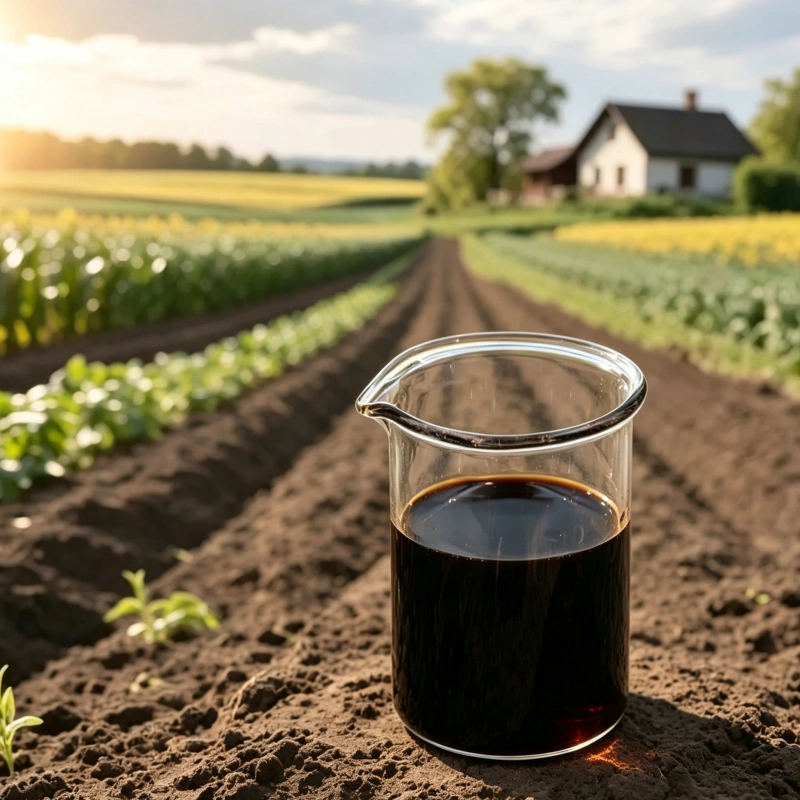
Precisely for this reason, Humic Acid Fertilizer for Sandy Soil helps improve water retention, nutrient availability, and root-zone conditions in sandy soils. Learn how to select, apply, and produce Humic Acid Fertilizer for Sandy Soil for better crop management.
is increasingly regarded as part of an overall strategy for soil and nutrient management. Humic acid will not transform sandy soil into clay, nor will it eliminate the need for proper irrigation and fertilization. Its value lies in improving the soil environment, enabling water and nutrients to be retained for a longer period near the root zone.
Therefore, for both growers and fertilizer producers, the issue lies not only in whether humic acid is effective but also, more critically, in how to select, apply, and produce humic acid fertilizers suitable for sandy soils, in order to address the practical limitations of sandy soils.
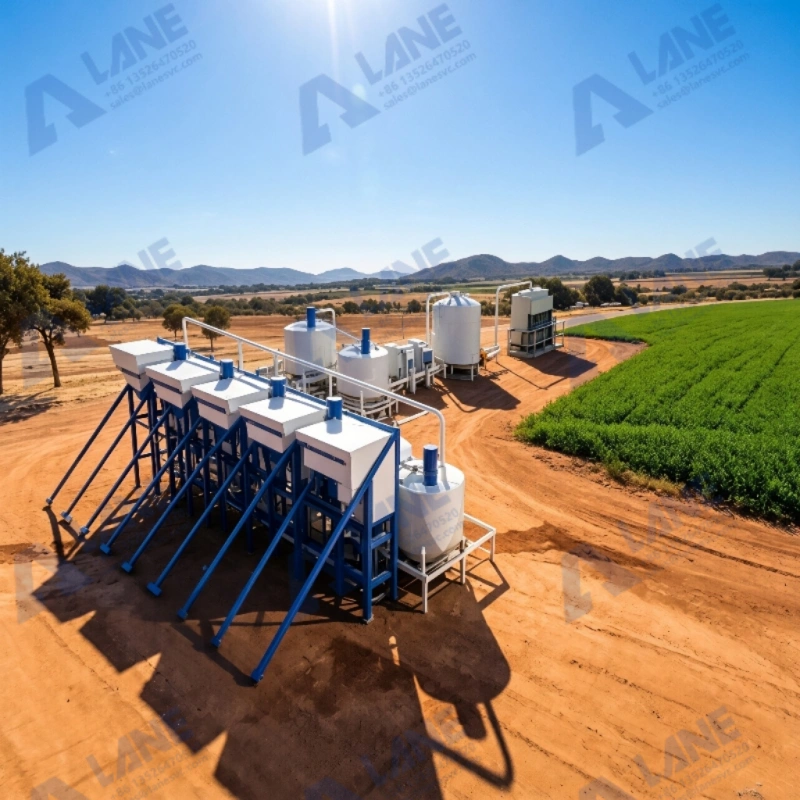
Why Is Sandy Soil Difficult to Manage?
The main problem with sandy soil is not that it cannot support crops. The problem is that its physical structure makes water and nutrient management less forgiving.
Sandy particles create relatively large pores. After irrigation or rainfall, water can move downward quickly instead of remaining around the active root zone.
Water moves rapidly in the root zone.
Sandy soil may appear sufficiently moist after irrigation, but the actual conditions can change rapidly.
When water enters below the main root zone, crops can no longer easily access it. This may lead to a cycle of frequent irrigation followed by rapid drying.
Therefore, for sandy soil, humic acid fertilizer should be used in conjunction with irrigation management, rather than as a substitute for it.
Drainage can lead to nutrient loss
Nitrogen and other soluble nutrients are particularly sensitive to excessive drainage.
When irrigation water flows rapidly through sandy soil, some soluble nutrients are carried away from the root zone. Farmers might compensate by increasing the frequency of fertilization, but this may not necessarily address the fundamental soil management issues. A better approach is to improve the conditions for the continuous supply of nutrients to plants.
Low organic matter content limits soil resistance
Many sandy soils contain relatively low levels of organic matter, which affects soil aggregation, water management, and the biological environment around plant roots.
This is why humic acid fertilizer is often discussed as a soil conditioning component, rather than merely an additional source of nutrients.
How Does Humic Acid Fertilizer Help Sandy Soil?
Humic substances interact with soil particles, water, nutrients, and organic matter. Their effect depends on the source of the humic material, application rate, soil condition, crop, and other management practices.
The purpose of Humic Acid Fertilizer for Sandy Soil is therefore not to “fix” sandy soil with one application. It is to gradually improve the conditions around the root zone.
Improving the soil environment
Humic substances can contribute to better soil aggregation and improve the physical environment around plant roots.
In sandy soil, where water normally moves rapidly through large pores, even modest changes in the soil environment can be useful.
This is one reason growers may include Humic Acid Fertilizer for Sandy Soil in long-term soil management programs.
Supporting nutrient availability
Humic substances can interact with mineral nutrients and soil particles. Depending on the formulation and soil conditions, this can help create a more favorable environment for nutrient availability.
However, Humic Acid Fertilizer for Sandy Soil should not be treated as a substitute for nitrogen, phosphorus, potassium, or micronutrient management.
The fertilizer program still needs to provide the nutrients required by the crop.
How Can Humic Acid Improve Water Retention?
Water retention is one of the most important reasons to consider Humic Acid Fertilizer for Sandy Soil.
The goal is not to make sandy soil hold water in the same way as a heavy clay soil. Instead, the goal is to improve the soil environment so that a greater proportion of applied water remains useful to the crop.
More water around the root zone
Humic substances can contribute to changes in soil aggregation and pore conditions.
When the soil structure is better managed, water distribution around the root zone can become more favorable.
This does not mean that Humic Acid Fertilizer for Sandy Soil can stop drainage. Sandy soil will still have relatively rapid water movement. The practical objective is to improve the efficiency of the water already being applied.
Irrigation and humic acid should work together
A common mistake is to apply Humic Acid Fertilizer for Sandy Soil while leaving an inefficient irrigation schedule unchanged.
If irrigation is excessive, water may still move rapidly below the root zone.
A more practical strategy is:
Humic acid application → improved soil environment → better water management → more effective root-zone use
The exact application schedule should depend on the crop, soil condition, irrigation system, and fertilizer formulation.
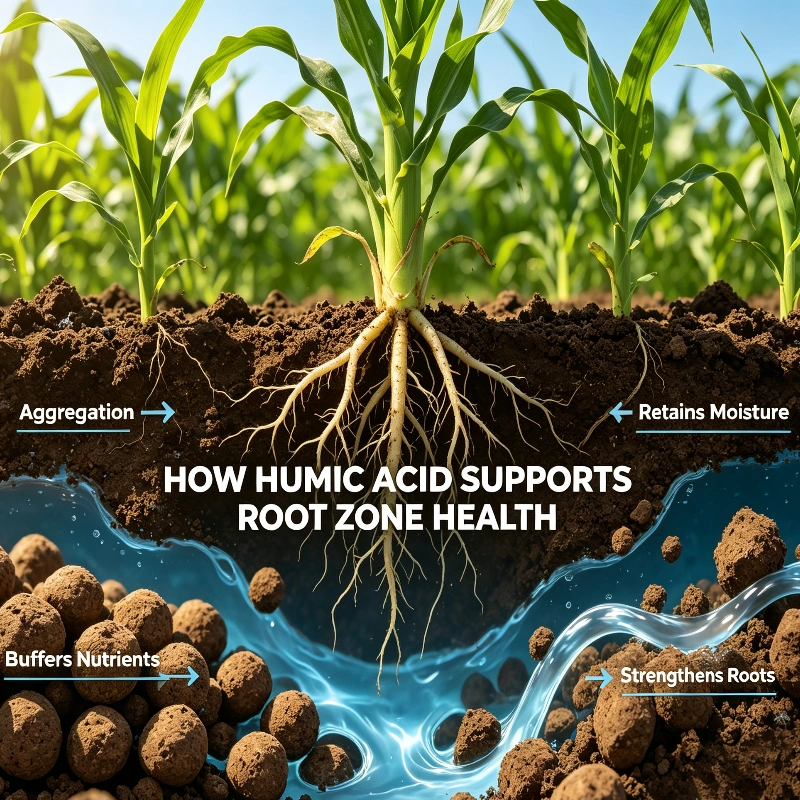
How Can Humic Acid Help Reduce Nutrient Loss?
Nutrient loss is another major concern in sandy soil.
Because water moves quickly through the soil profile, nutrients that are readily soluble may also move away from the root zone.
Improving nutrient retention conditions
Humic substances can interact with nutrients and soil components, helping create conditions in which nutrients remain available in the root-zone environment.
This is one of the main reasons Humic Acid Fertilizer for Sandy Soil can be useful as part of a nutrient management program.
But the objective should be described accurately.
Humic acid does not completely prevent nutrient leaching. Instead, it can support better nutrient-use conditions when combined with appropriate fertilizer rates and irrigation management.
Avoid excessive fertilizer application
More fertilizer does not necessarily compensate for poor nutrient retention.
Applying a large amount of fertilizer to sandy soil at one time may increase the amount vulnerable to movement with irrigation water.
For Humic Acid Fertilizer for Sandy Soil, a better strategy is usually to coordinate application with crop demand and water management.
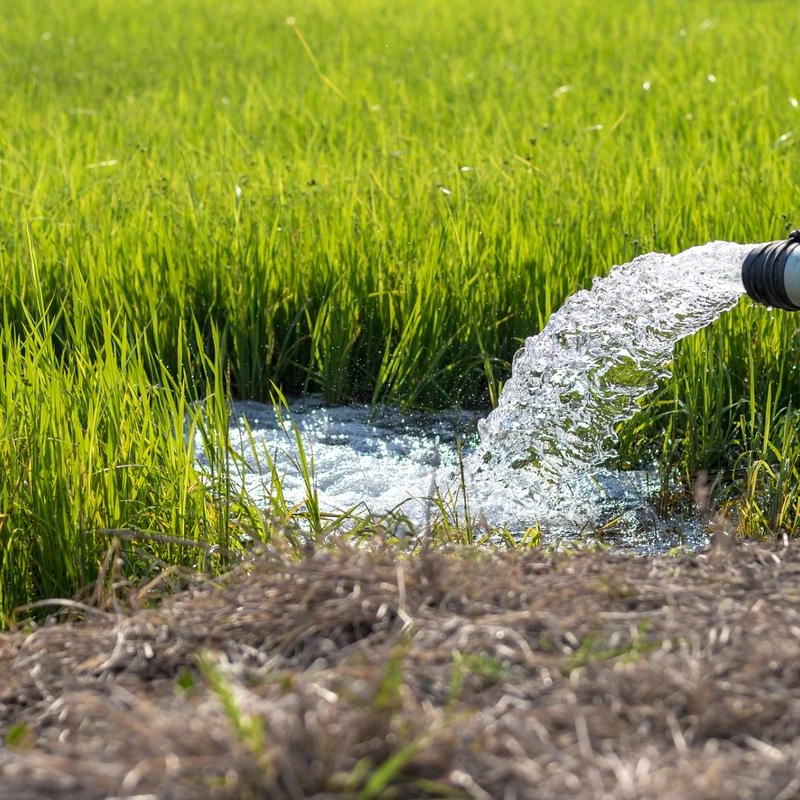
This is particularly important for liquid formulations that can be applied through irrigation or other liquid fertilizer systems where compatible.
How to Choose Humic Acid Fertilizer for Sandy Soil?
Not all humic acid products should automatically be considered suitable for every type of sandy soil. The choice should be based on the actual soil and crop requirements.
Identify the main soil limiting factors.
Ask which of the following questions is the most critical:
• Water is lost too quickly after irrigation.
• Nutrients are difficult to retain in the root zone.
• The organic matter content is relatively low.
• The soil structure needs improvement.
Fertilization is difficult to coordinate with irrigation. If water management is the primary issue, fertilization strategies should focus on moisture management in the root zone.
If nutrient loss is the primary concern, the fertilization plan should be reassessed.
Consider crop types and application methods.
The root structures and nutrient requirements vary among different crops. The methods of using humic acid fertilizers for field crops, vegetable crops, fruit tree crops, and nursery crops in sandy soil may differ. The method of application is also crucial. Liquid humic acid fertilizer may be suitable for liquid spraying systems, while other formulations can be selected based on different field conditions.
Check the compatibility of the formula.
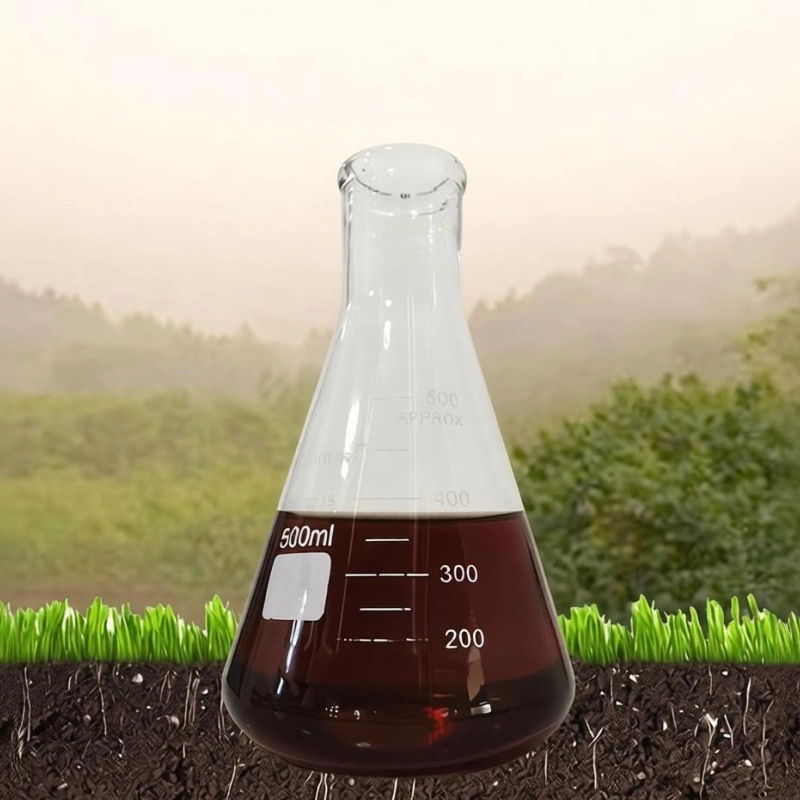
For liquid fertilizers, solubility and physical stability are crucial. The formula may contain humic acid along with other nutritional or functional ingredients. The final product must remain fully uniform during storage, transportation, and application. This is particularly important when using humic acid fertilizers specifically for sandy soil, which require repeated liquid application.
How Should Humic Acid Fertilizer Be Applied to Sandy Soil?
There is no single application rate that fits every sandy soil.
The useful starting point is the relationship between soil condition, crop demand, irrigation, and fertilizer concentration.
Coordinate application with irrigation
Liquid Humic Acid Fertilizer for Sandy Soil can be easier to integrate into an existing liquid fertilizer program.
The important point is timing.
Applying water and nutrients without considering the movement of water through the soil can still result in losses.
Where the application system allows it, humic acid can be coordinated with irrigation so that the material reaches the active root zone.
Avoid treating humic acid as the only soil amendment
Humic acid can be one component of soil improvement, but it should not be expected to solve every limitation of sandy soil.
Depending on the field, growers may also consider:
• Compost or other organic matter sources
• Improved irrigation scheduling
• Split fertilizer applications
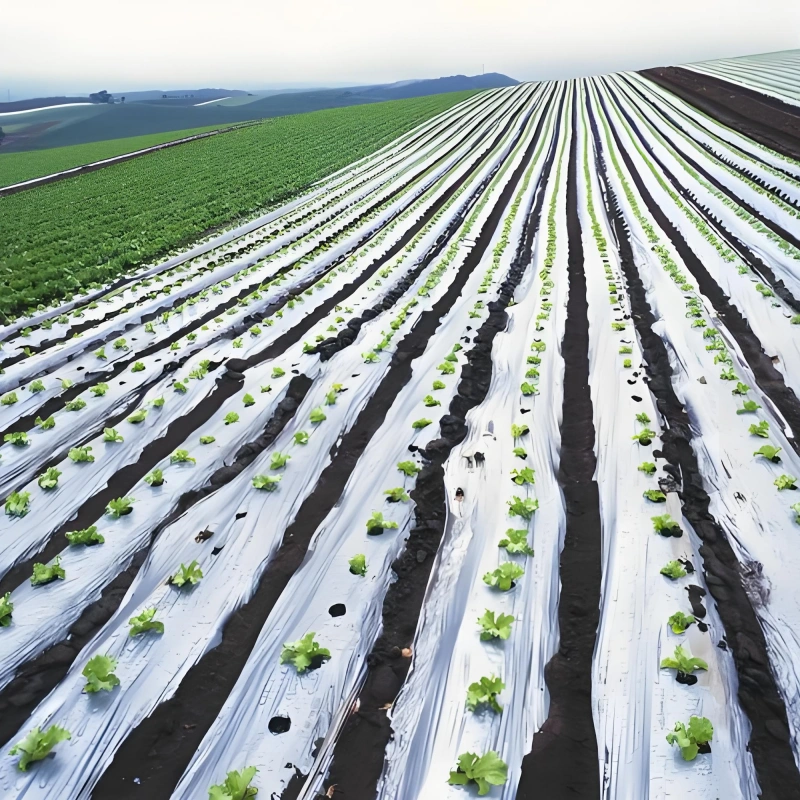
• Mulching
• Appropriate nutrient management
• Crop-specific root-zone management
The role of Humic Acid Fertilizer for Sandy Soil is strongest when it fits into this broader management system.
How Is Liquid Humic Acid Fertilizer Produced?
For manufacturers, producing Humic Acid Fertilizer for Sandy Soil in liquid form involves a different engineering logic from producing granular fertilizer.
The key challenge is not granulation, drying, cooling, or screening. It is achieving complete dissolution, uniform mixing, stable liquid quality, and reliable filling.
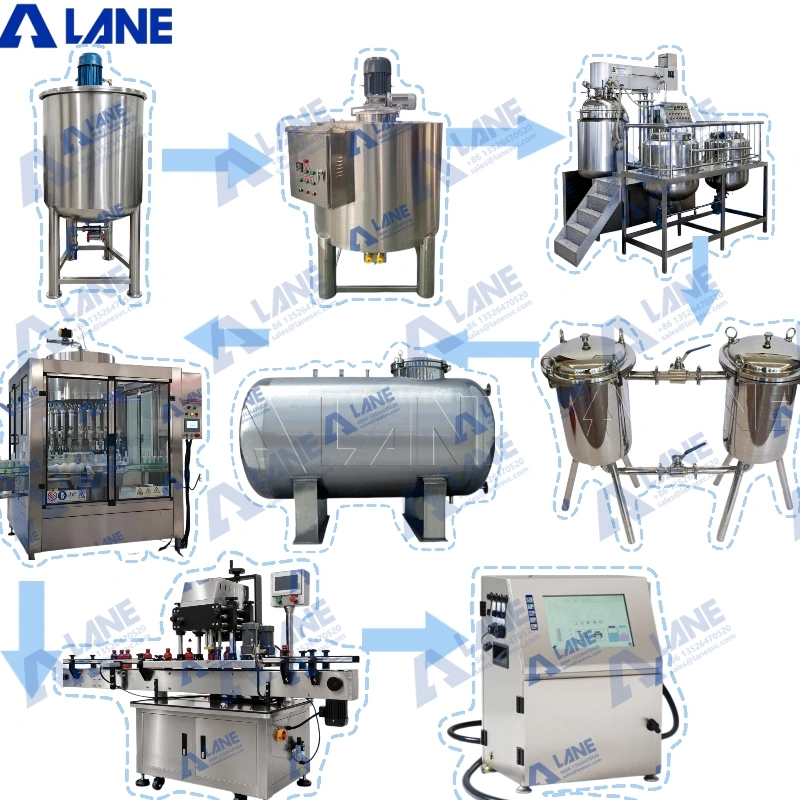
A typical liquid fertilizer process can follow:
Raw Material Preparation → Dissolving → Mixing → Homogenization → Filtration → Storage → Filling & Packaging
The exact configuration depends on the raw materials, formula, viscosity, target capacity, and finished-product requirements.
Incomplete dissolution → Dissolving Tank
Solid humic or fulvic raw materials cannot simply be added to water and assumed to dissolve completely.
The raw material needs suitable contact with water, agitation, and, where required by the formulation, controlled heating.
A Dissolving Tank provides the controlled environment needed for this stage.
The objective is straightforward:
Solid raw material + water + controlled agitation → sufficiently dissolved solution
The actual operating conditions depend on the solubility and characteristics of the selected humic material.
Uneven ingredient distribution → Mixing Tank
After the main raw material has been dissolved, other components may need to be incorporated into the formulation.
These may include additional nutrients, fulvic acid, seaweed extract, amino acids, trace elements, or other compatible ingredients.
This is where the Mixing Tank becomes important.
The purpose is not simply to “stir the product.”
It is to create a uniform liquid in which the different components are distributed consistently throughout the batch.
For Humic Acid Fertilizer for Sandy Soil, this matters because inconsistent concentration can lead to inconsistent application results.
Suspended particles and inconsistent liquid quality → Homogenization and Filtration
Even after mixing, the liquid may contain small undissolved particles or agglomerated material.
A homogenization stage can help improve the consistency of the liquid before it moves toward storage.
Filtration then removes unsuitable particles that could affect downstream pumps, pipes, valves, or filling equipment.
The practical sequence is:
Mixing → Homogenization → Filtration
The filtration specification should be selected according to the final product and the requirements of the application and filling system.
Production and filling need a buffer → Storage Tank
Continuous production and filling do not always operate at exactly the same rate.
A Storage Tank provides a buffer between processing and packaging.
It also gives the manufacturer a controlled location for temporarily holding the finished liquid fertilizer before filling.
For a commercial Humic Acid Fertilizer for Sandy Soil product, storage stability should be considered during line design rather than only after the equipment has been installed.
Stable product output → Filling and Packaging
The final stage is filling the liquid fertilizer into the required containers.
The filling system needs to match:
• Package size
• Filling accuracy
• Product viscosity
• Required production capacity
• Packaging format
A reliable filling stage helps turn a technically acceptable liquid formulation into a commercially usable product.
What Problems Can Occur When Using Humic Acid Fertilizer for Sandy Soil?
Even a suitable humic acid product may produce disappointing results if the underlying management problem is not addressed.
The soil still dries quickly
If the irrigation interval is too long or water is being applied inefficiently, Humic Acid Fertilizer for Sandy Soil cannot compensate for the entire problem.
The irrigation schedule may need to be adjusted together with the soil amendment program.
Nutrient loss remains high
If fertilizer is applied in excessive quantities or at the wrong time, nutrients can still move below the active root zone.
Humic acid should therefore be combined with appropriate nutrient rates and application timing.
Liquid fertilizer becomes non-uniform
For manufacturers, precipitation or settling can become a serious issue.
The problem may originate from:
• Incomplete dissolution
• Poor mixing
• Incompatible ingredients
• Excessive concentration
• Inadequate filtration
• Unsuitable storage conditions
The solution should be traced back to the formulation and process rather than simply increasing mixing time.
Field results vary between applications
Sandy soil is not a uniform material.
Soil organic matter, irrigation method, crop type, climate, and existing nutrient levels can all affect the response to Humic Acid Fertilizer for Sandy Soil.
A product that performs well in one field should not automatically be expected to produce exactly the same result elsewhere.
How Should a Liquid Fertilizer Production Line Be Designed?
A reliable liquid fertilizer production line should start with the product rather than the equipment.
Before selecting tanks and downstream equipment, manufacturers need to clarify several points:
• Raw materials — What type of humic or fulvic material is being used?
• Formulation — What other nutrients or functional ingredients are included?
• Target capacity — How much liquid fertilizer needs to be produced per hour or per batch?
• Physical properties — What are the expected viscosity, solubility, and suspended-solid characteristics?
• Storage requirements — How long must the product remain stable before use or shipment?
• Packaging — What container sizes and filling speeds are required?
Only after these conditions are known should the equipment configuration be finalized.
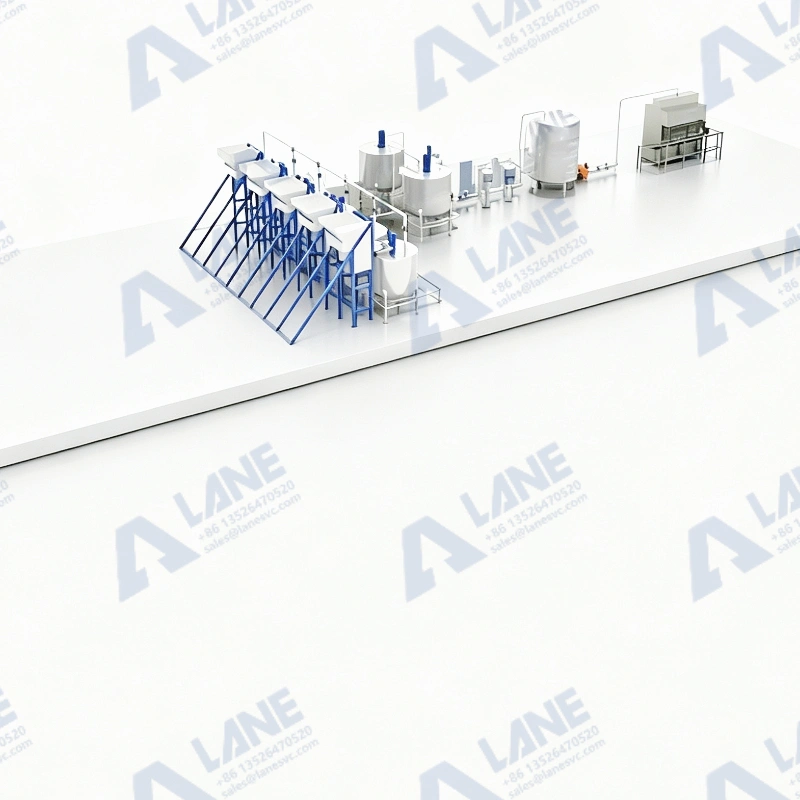
When LANE designs a liquid fertilizer production line, the equipment selection is therefore normally connected to the raw material, formulation, production capacity, and finished-product requirements rather than being based on a fixed equipment list.
For a Humic Acid Fertilizer for Sandy Soil project, the design logic can be summarized as:
• Dissolution problem → Dissolving Tank
• Mixing problem → Mixing Tank
• Consistency problem → Homogenization
• Particle problem → Filtration
• Storage and production balance → Storage Tank
• Packaging requirement → Filling System
This approach keeps the production line focused on actual manufacturing problems.
Why Is Liquid Humic Acid Fertilizer Practical for Sandy Soil Applications?
Liquid Humic Acid Fertilizer for Sandy Soil can offer flexibility in how the fertilizer is applied.
Where the formulation and irrigation system are compatible, liquid fertilizer can be integrated into existing liquid application or fertigation practices.
This can make repeated application easier to coordinate with crop demand.
However, “liquid” does not automatically mean “better.”
The real advantage depends on the formulation, application equipment, irrigation system, and management strategy.
From the manufacturer’s side, this is also why production stability matters. If the liquid product settles quickly, blocks application equipment, or changes significantly during storage, the theoretical advantages of the formulation become much less useful in practice.
A Practical Strategy for Using Humic Acid Fertilizer for Sandy Soil
A practical program should connect the soil problem with the application method rather than starting with the fertilizer product alone.
Step 1: Identify the actual soil problem
Determine whether the main limitation is rapid drainage, low organic matter, nutrient loss, or a combination of these factors.
Step 2: Understand crop requirements
Different crops have different root-zone depths and nutrient requirements.
The fertilizer strategy should reflect these differences.
Step 3: Select the appropriate formulation
Choose a liquid or other formulation according to the application system and product requirements.
For liquid Humic Acid Fertilizer for Sandy Soil, check solubility, compatibility, concentration, and storage stability.
Step 4: Coordinate fertilizer and water
Do not treat irrigation and fertilizer application as separate operations.
The goal is to keep water and nutrients available where active roots can use them.
Step 5: Monitor the root zone
Look at soil moisture, crop growth, fertilizer response, and signs of nutrient deficiency.
Field observation is often more useful than assuming that one fixed application program will work everywhere.
Step 6: Adjust the program
If the soil still dries too quickly, the irrigation strategy may need adjustment.
If nutrient loss remains high, fertilizer timing or dosage may need to be reviewed.
If the liquid product becomes unstable during storage, the formulation or production process needs to be investigated.
The same principle applies throughout the production side:
Raw materials → Formulation → Process testing → Equipment matching → Finished-product testing
This is a more reliable way to develop Humic Acid Fertilizer for Sandy Soil for commercial production.
FAQ
Is Humic Acid Fertilizer for Sandy Soil suitable for all crops?
Not necessarily. The suitability of Humic Acid Fertilizer for Sandy Soil depends on the crop, soil condition, existing nutrient levels, application method, and fertilizer formulation.
Can Humic Acid Fertilizer for Sandy Soil stop nutrient leaching?
No fertilizer can be expected to completely stop nutrient leaching in sandy soil. Humic Acid Fertilizer for Sandy Soil may support better nutrient-retention conditions, but fertilizer rate, timing, irrigation, and soil management remain important.
Can liquid humic acid fertilizer be used with irrigation?
It can be suitable for compatible liquid application or fertigation systems, provided the formulation has appropriate solubility, viscosity, filtration, and physical stability.
What equipment is needed to produce liquid Humic Acid Fertilizer for Sandy Soil?
A typical process may include a Dissolving Tank, Mixing Tank, homogenization and filtration equipment, a Storage Tank, and a filling system. The exact configuration depends on the formulation and production capacity.
What is the most important factor when designing a Humic Acid Fertilizer for Sandy Soil production line?
The formulation should come first. Raw material characteristics, target concentration, production capacity, viscosity, storage stability, and packaging requirements should be confirmed before the equipment configuration is finalized.