Mushroom Compost Recycling Machine & Production Line | Spent Substrate to Organic Fertilizer
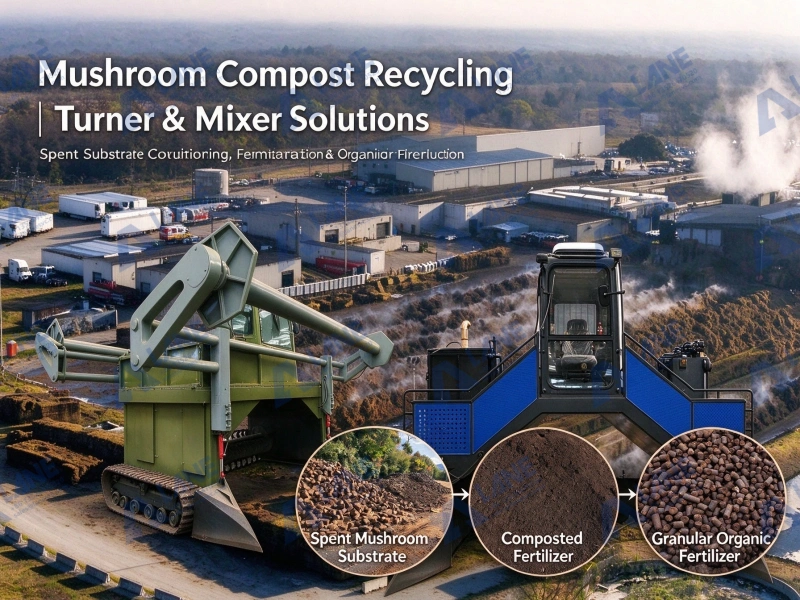
• Every year, tens of millions of tons of spent mushroom substrate are generated worldwide, and Mushroom Compost Recycling forms a golden closed-loop that converts this waste into soil amendments.
• As high-value horticultural “black gold”, properly advancing Mushroom Compost Recycling can thoroughly eliminate soil compaction and greatly improve the water retention and nutrient locking capacity of sandy soil.
• Despite the tremendous carbon reduction and ecological benefits of Mushroom Compost Recycling, a large number of growers are facing conversion bottlenecks due to a lack of professional technology and equipment support.
• Therefore, mastering the complete workflow of Mushroom Compost Recycling alongside scientific desalination, proportioning and curing techniques is the decisive factor for high returns and large-scale profitable operation of the project.
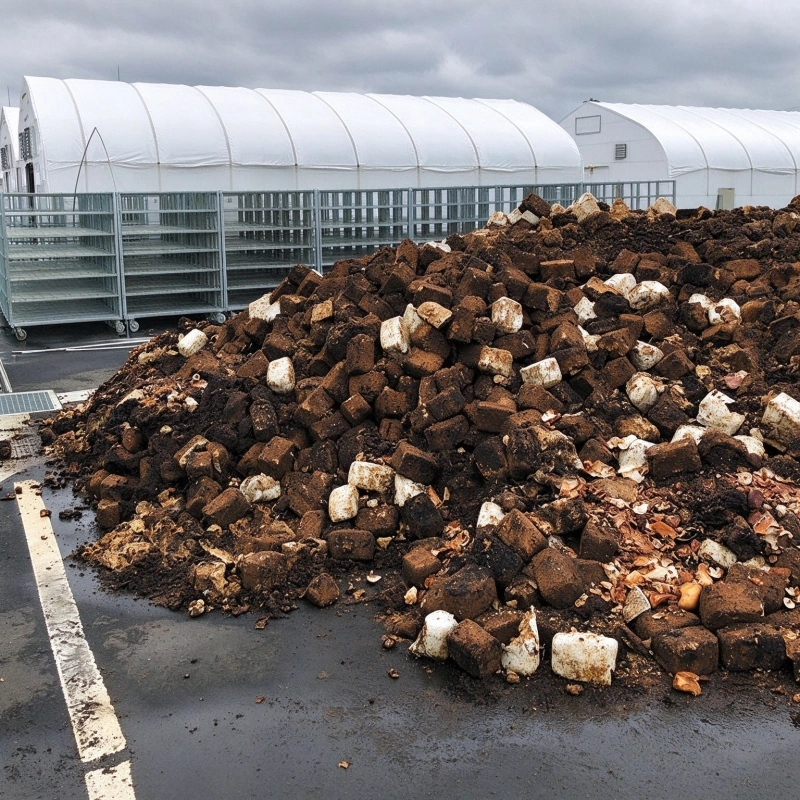
Why Your Recycling Line Fails to Generate Profit
💸 Industry Paradox: Gold Everywhere on the Surface, Zero Profit in Reality
• Paper accounting: Raw material costs are extremely low; suppliers even pay freight to have the waste hauled away, and market demand remains robust.
• Real dilemma: Most growers and recyclers want to carry out Mushroom Compost Recycling but cannot get it right. Capital is invested with no revenue in return.
• Root cause: Without efficient conversion, Mushroom Compost Recycling turns into a capital-devouring black hole. • Core logic: The focus of Mushroom Compost Recycling is not whether recycling is feasible, but which recycling method can deliver profits.
🚨 Four Profit-Killing Issues and Equipment Solutions
| Profit Killer | Critical Causes | Equipment Solution (Turnaround) |
|---|---|---|
| 1. Long fermentation cycle | • Natural windrow composting takes 60–90 days
• Storage yards overflow quickly and odour complaints arise • Low site turnover slows capital circulation |
💡 Windrow Turner + Trough Fermentation System
• Forced aerobic heating shortens fermentation to 15 days • Fully eliminates overflow risks for Mushroom Compost Recycling |
| 2. Unstable finished product quality | • Uneven manual mixing and crude screening
• Inconsistent nutrient levels between batches • Buyers force heavy price cuts or reject shipments |
💡 Twin-Shaft Mixer + Grading Sieve
• Continuous precise mixing to standardize formulations • Impurity removal stabilizes output quality for Mushroom Compost Recycling |
| 3. Only raw-grade bulk sales | • Low bulk selling price with no added value
• Limited transport radius that blocks cross-regional sales • No access to high-end horticulture and growing media markets |
💡 Pelletizing Line + Automatic Packaging System
• Powder converted into pellets with upgraded appearance and doubled selling price • Higher product premium unlocks premium markets for Mushroom Compost Recycling |
| 4. Excessive labour cost | • Manual bag opening, turning and bagging
• High administration and payroll costs erode margins • Net returns worse than simply hauling away raw substrate |
💡 Automatic Feeding + Integrated Line Linkage
• Cut labour expenditure by 80% • A well-tuned line extracts maximum profit per ton for Mushroom Compost Recycling |
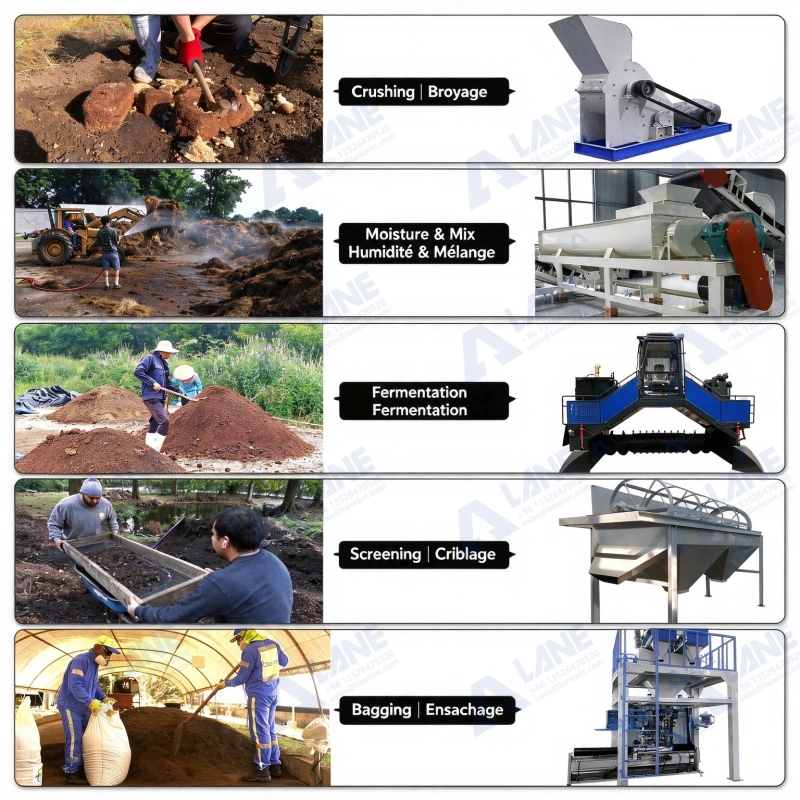
Mushroom Compost Recycling & Core Equipment Specifications
| Process Step | 🔧 Operation Content | 🚨 Risks of Skipping | 🛠️ Recommended Core Equipment | 📊 Direct Core Parameters |
|---|---|---|---|---|
| ① Raw Material Receiving & Bag Opening | Remove plastic films, plastic ropes and large non-degradable debris from mushroom bags. | • Wrapped impurities burn out motor bearings• Blocked conveyors and rejected batches due to excessive plastic content | Automatic High-Efficiency Mushroom Bag Opening & Sorting Machine | • Throughput: 20–30 m³/h
• Labour: Only 1 operator (90% labour reduction) |
| ② Crushing | Break hardened mushroom blocks and shred residual coarse fibre, cottonseed hulls and straw. | • Hard lugs break turning machine blades• Anaerobic conditions inside windrows disrupt the Mushroom Compost Recycling process | Heavy-Duty High-Power Hammer Mill | • Main motor power: 37 kW–55 kW• Discharge particle size: ≤ 5 mm (loose, fragmented texture) |
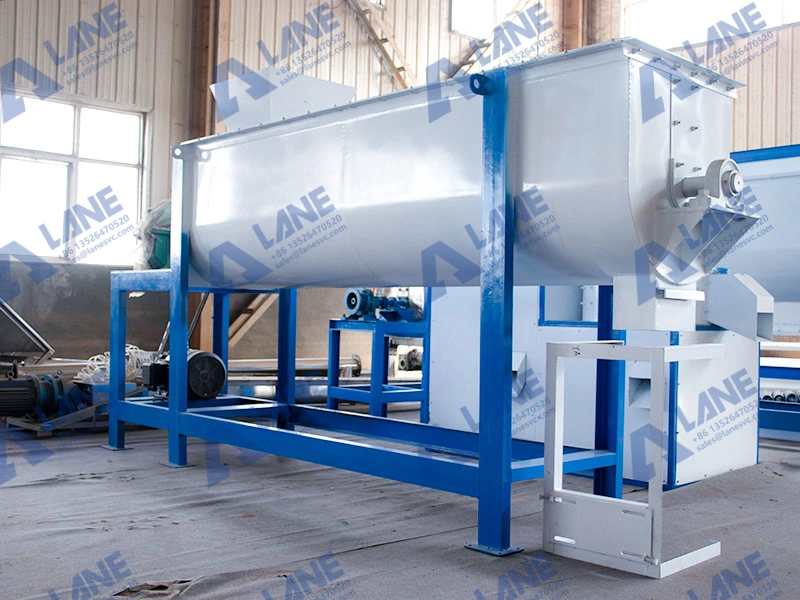
| ③ Conditioning & Mixing | Precisely spray water to adjust moisture content; add livestock manure or urea quantitatively to balance C/N ratio. | • Uneven moisture causes partially uncured compost• Local over-wet anaerobic decay and inconsistent fertility | Heavy-Duty Continuous Twin-Shaft Mixer | • Mixing uniformity: ≥ 95%• Optimal moisture range: 55%–65% |
| ④ Fermentation & Turning | Mechanically toss and break windrows to force oxygen injection and release accumulated steam. | • Anaerobic fermentation triggers odour complaints• Temperature below 50 ℃ fails to kill pathogens and weed seeds | Hydraulic Trough Turner / Wide-Span Crawler Turner | • Turning depth: 1.5 m – 2.2 m• Fermentation cycle shortened from 60 days to 12–15 days for Mushroom Compost Recycling |
| ⑤ Screening | Grade fully cured compost and remove undercomposed large particles and fine contaminants. | • Finished product contains lignified chunks, stones or micro plastic• Poor appearance downgrades products and blocks applicators | Heavy-Duty Multi-Deck Vibrating Sieve / Rotary Cleaning Sieve | • Finished sieve aperture: 2 mm – 5 mm• Single machine capacity: 15 – 25 t/h |
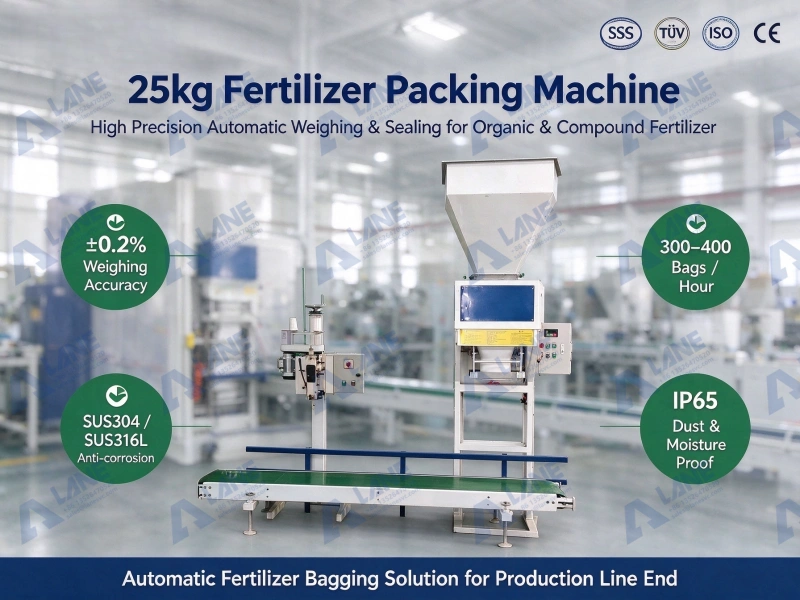
| ⑥ Deep Processing (Optional) | Extrude powder into uniform pellets, low-temperature drying, cooling, weighing and bagging. | • Bulk powder only with low price and 50 km transport limit• No brand premium and wasted profit potential of Mushroom Compost Recycling | New Rotary Drum Pelletizer + Dryer & Cooler + Automatic Packer | • Pellet size: Φ 3–5 mm spherical pellets• Packing speed: 300 – 400 bags/hour |
Diversified Long-term Application Lines to Boost Added Value
• Flexible Extension
• Mushroom substrate recycling is never a single-track business. Selling cured material in bulk at low prices only captures the thinnest margin layer.
• With flexible matching of upstream raw material formulations and downstream equipment, the same front-end primary processing line can branch into five distinct high-value industrial chains.
• In Mushroom Compost Recycling, the depth of your processing ultimately defines your profit ceiling.
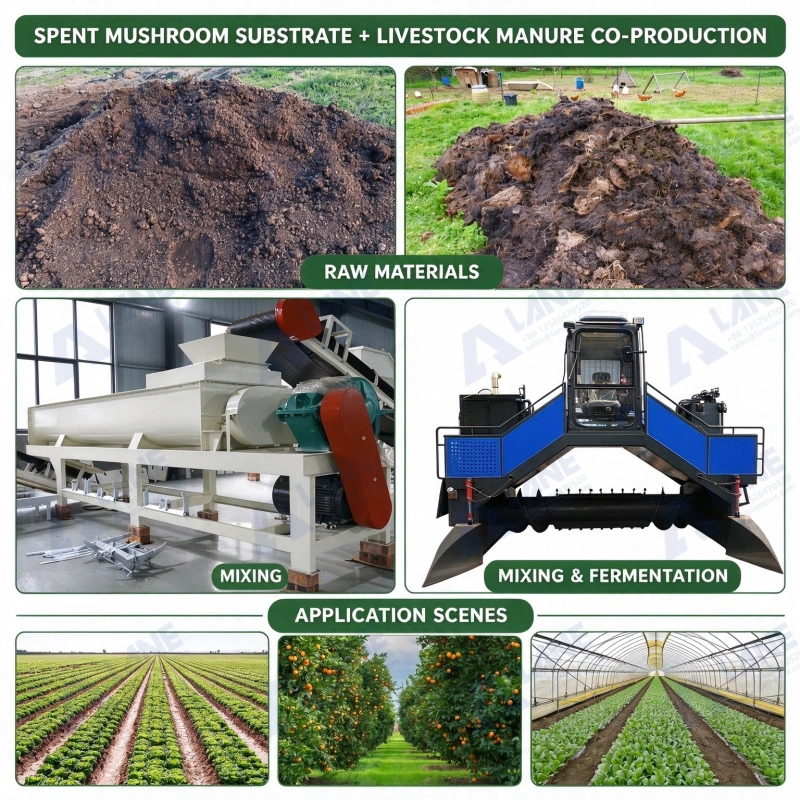
1️⃣ Spent Mushroom Substrate + Livestock Manure Co-Production → General Organic Fertilizer Line
• Core logic: Source manure from nearby farms → Mix mushroom substrate with chicken or cow manure for controlled fermentation → Fast heating and thorough curing → Sell finished fertilizer directly to vegetable bases, orchards and greenhouses.
• Recommended machinery: Spent Mushroom Substrate carbon source feeding system → Trough turner → Twin-shaft mixer
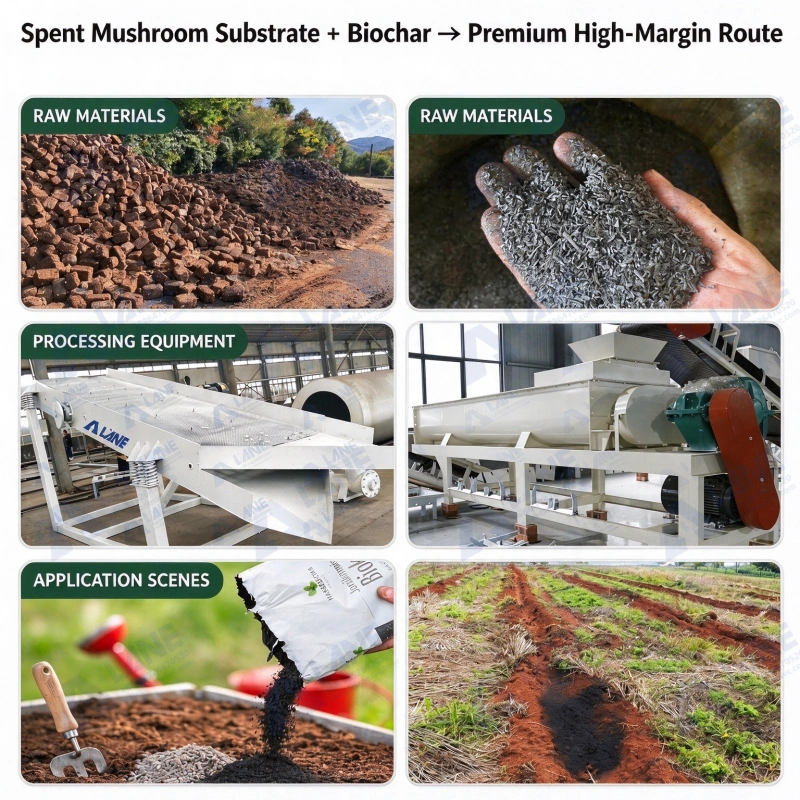
2️⃣ Spent Mushroom Substrate + Biochar → Biochar-Based Fertilizer Line (Premium High-Margin Route)
• Core logic: Share the front-end fermentation line → Add carbonization equipment to turn mushroom substrate or coconut shell into biochar for blending → Profit doubles → Target high-end organic farms, overseas soil remediation and large-scale carbon offset projects.
• Recommended machinery: biochar-based fertilizer line → Continuous eco-friendly carbonizer → High-frequency vibrating sieve & mixer
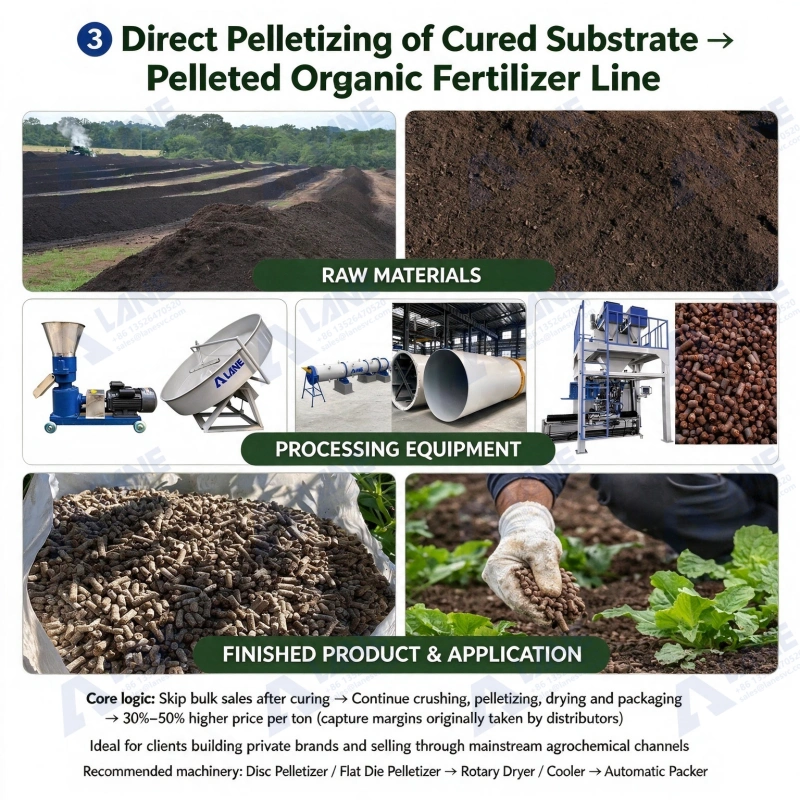
3️⃣ Direct Pelletizing of Cured Substrate → Pelleted Organic Fertilizer Line
• Core logic: Skip bulk sales after curing → Continue crushing, pelletizing, drying and packaging → 30%–50% higher price per ton (capture margins originally taken by distributors) → Ideal for clients building private brands and selling through mainstream agrochemical channels.
• Recommended machinery: Disc Pelletizer / Flat Die Pelletizer → Rotary Dryer / Cooler → Automatic Packer
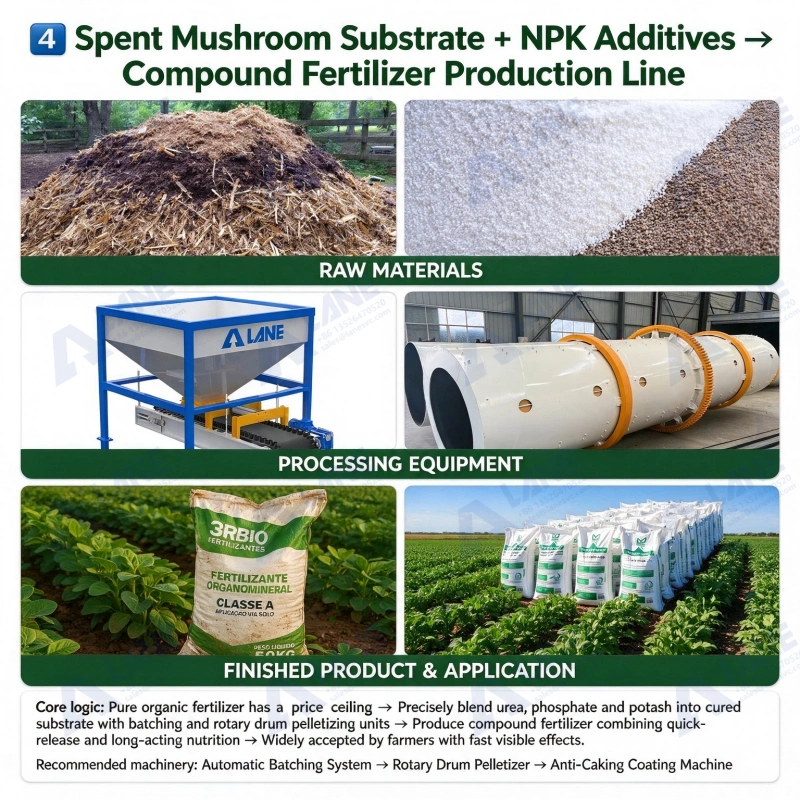
4️⃣ Spent Mushroom Substrate + NPK Additives → Organic-Inorganic Compound Fertilizer Line
• Core logic: Pure organic fertilizer has a price ceiling → Precisely blend urea, phosphate and potash into cured substrate with batching and rotary drum pelletizing units → Produce compound fertilizer combining quick-release and long-acting nutrition → Widely accepted by farmers with fast visible effects.
• Recommended machinery: Automatic Batching System → Rotary Drum Pelletizer → Anti-Caking Coating Machine
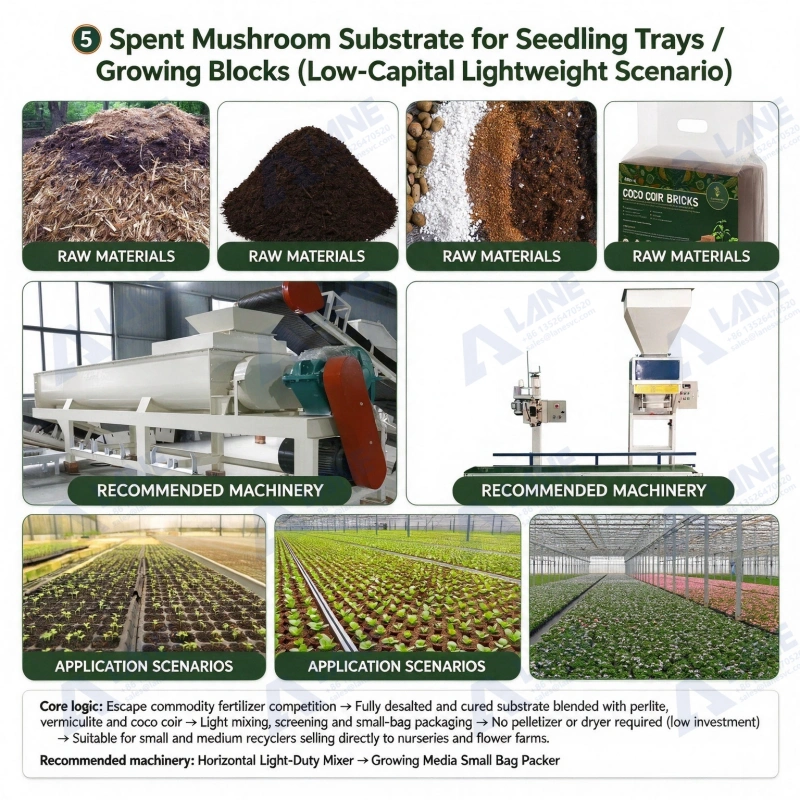
5️⃣ Spent Mushroom Substrate for Seedling Trays / Growing Blocks (Low-Capital Lightweight Scenario)
• Core logic: Escape commodity fertilizer competition → Fully desalted and cured substrate blended with perlite, vermiculite and coco coir → Light mixing, screening and small-bag packaging → No pelletizer or dryer required (low investment) → Suitable for small and medium recyclers selling directly to nurseries and flower farms.
• Recommended machinery: Horizontal Light-Duty Mixer → Growing Media Small Bag Packer
Finished Product Sales
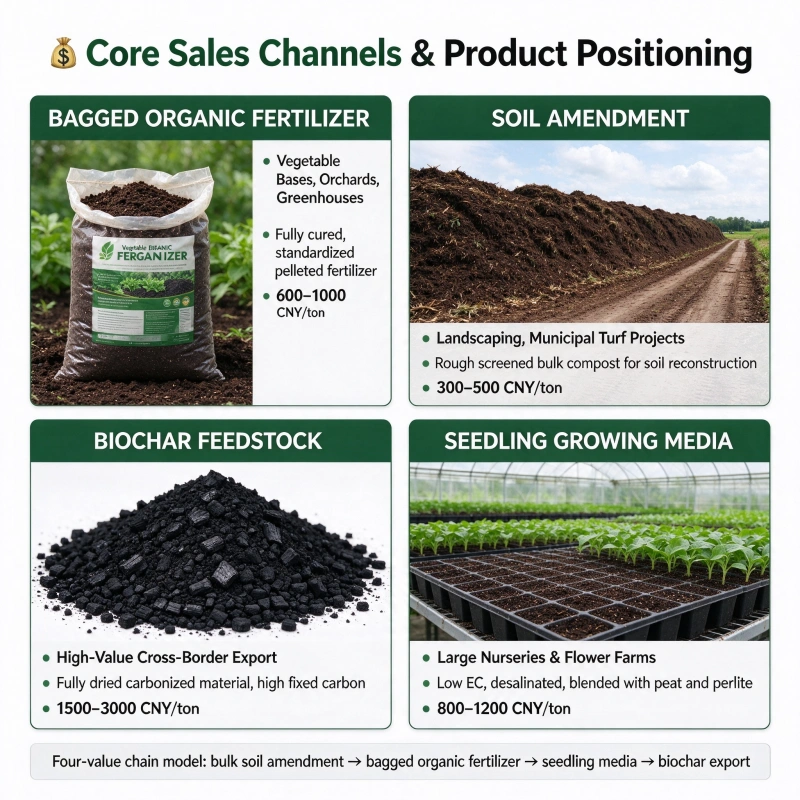
💰 Core Sales Channels & Product Positioning
• Bagged Organic Fertilizer → Vegetable Bases, Orchards, Greenhouses
• Positioning: Fully cured, standardized pelleted or powdered fertilizer after deep processing, targeting high-value cash crops.
• Price range: Wholesale price 600 – 1000 CNY/ton depending on organic matter content.
• Soil Amendment → Landscaping, Municipal Turf Projects
• Positioning: Rough screened bulk cured compost with excellent porosity for large-scale soil reconstruction.
• Price range: Bulk project price 300 – 500 CNY/ton, stable demand and huge shipment volume for Mushroom Compost Recycling.
• Biochar Feedstock → High-Value Cross-Border Export
• Positioning: Fully dried carbonized material with high fixed carbon content, compliant with international environmental standards and carbon reduction requirements.
• Price range: Export or special industrial grade 1500 – 3000 CNY/ton, unlocking the top-tier premium of Mushroom Compost Recycling.
• Seedling Growing Media → Blended Mix for Large Nurseries & Flower Farms
• Positioning: Low EC value after thorough desalination, fine screening and proportioned mix with peat and perlite, premium lightweight growing medium.
• Price range: Converted by volume or premium retail bags, overall output value 800 – 1200 CNY/ton.
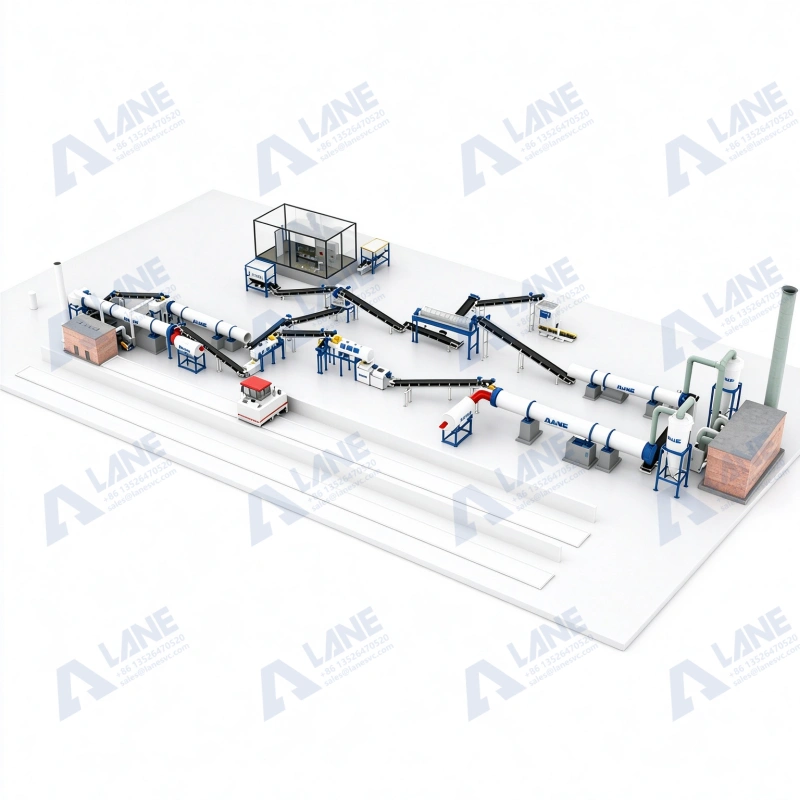
Three-Tier Equipment Packages
• For Mushroom Compost Recycling equipment selection, bigger is not always better.
• Oversized equipment leads to idle capacity. You must match your setup scientifically according to raw material supply volume and downstream sales throughput.
📊 Core Selection, Configuration & Specification Table
| ⚙️ Equipment Tier | 👥 Ideal Operator | 📊 Daily Throughput | 🛠️ Core Configuration | 🗺️ Footprint | 🧑🤝🧑 Operators |
|---|---|---|---|---|---|
| 1️⃣ Small Line | Single Farm / Cooperative | 1 – 3 t/d | Hammer mill + Twin-shaft mixer + Small turner + Vibrating sieve | ~300 ㎡ | 1 – 2 |
| 2️⃣ Medium Line | Regional Recycling Hub | 5 – 10 t/d | Automatic bag opening & feeding + Trough fermentation turner + Pelletizing line + Automatic packaging | ~1500 ㎡ | 2 – 3 |
| 3️⃣ Large Line | Industrial Integrated Plant | 20 t/d + | Full automatic continuous line + Central intelligent control system + Linked drying and coating | ~5000 ㎡ | 3 – 4 |
Why Choose Us?
• Proven Track Record
• For Mushroom Compost Recycling, polished PPT concepts cannot compare with reliably operating equipment on site.
• We avoid empty brand storytelling and rely on solid facts and data to prove we are your most reliable equipment supplier.
🏭 1. Industry Experience: Project Count & Operation Tenure
• Hard facts: To date, we have delivered over 120 spent mushroom substrate and organic fertilizer recycling projects worldwide.
• Service life: Our earliest delivered Mushroom Compost Recycling deep processing lines have run continuously under heavy load for more than 8 years, with equipment depreciation far below the industry average.
• Client feedback: High-viscosity, high-moisture and corrosive mushroom substrate creates harsh working conditions. Our core components adopt special wear-resistant anti-corrosion materials that withstand long-term exposure to this tough environment.
📐 2. Customized Solutions for Site-Specific Deployment
• Hard facts: We refuse generic one-size-fits-all machinery packages, because no two Mushroom Compost Recycling sites are identical.
• Layout design: Whether you have a narrow workshop, split-level yard or confined indoor space, our engineering team delivers customized 3D plant layout drawings within 48 hours to maximize every square metre.
• Capacity tuning: We calibrate the matching capacity of crushing, fermentation and pelletizing units based on local raw material peak supply and sales channels, ensuring no bottlenecks, blockages or idle running for your Mushroom Compost Recycling line.
🛠️ 3. After-Sales Support: Dispute-Free Rapid Response System
• Hard facts: We understand the heavy losses caused by line shutdowns in Mushroom Compost Recycling, so we implement a nationwide fast response commitment.
• Online support: Professional after-sales engineers connect via video call within 15 minutes for remote troubleshooting, resolving 90% of control and operational faults remotely.
• On-site emergency service: For critical hardware failures, technicians from nearby service stations carry key spare parts and arrive on-site within 24 hours for urgent repairs, preventing yard overflow and production halt for your Mushroom Compost Recycling project.