Small-Scale Liquid Fertilizer Production Line (1–3 t/h): Cost, Equipment & Setup Guide
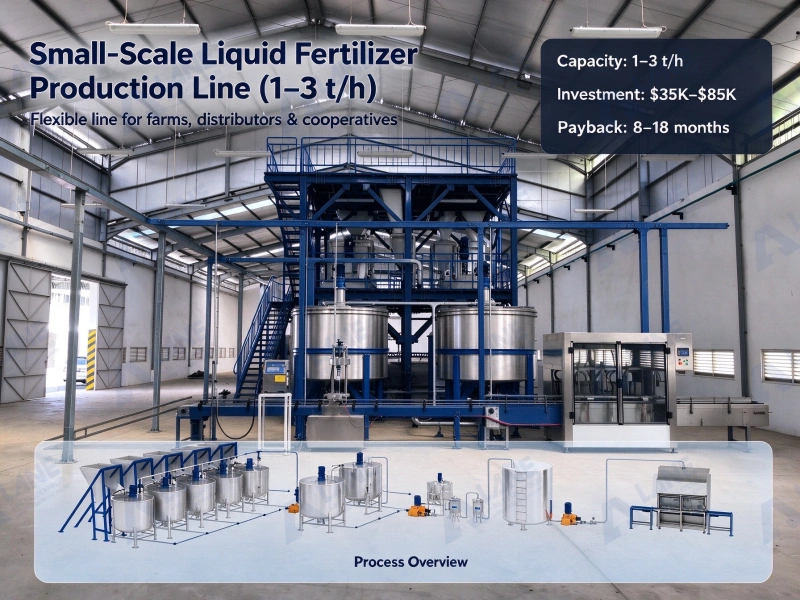
Why is a Small-Scale Liquid Fertilizer Production Line (1–3 t/h) the right conversation to have right now?
> Fertigation is becoming mainstream → drip irrigation + water-soluble fertilizer is now the default on modern farms.
> Organic cultivation is growing fast → farmers want flexible, custom liquid formulas, not a one-size-fits-all powder.
> A full-scale plant demands high investment and a large footprint → most mid-size users simply can’t reach it.
That gap is exactly where a Small-Scale Liquid Fertilizer Production Line (1–3 t/h) fits: a low-threshold entry point built for farms, distributors and cooperatives.
This article walks you through — in order — the raw materials, the application scenarios, the equipment configuration, the choice of technology and the real cost. By the end, you’ll know whether a Small-Scale Liquid Fertilizer Production Line (1–3 t/h) makes sense for you, and what you should buy first.
2. Raw Materials at a Glance
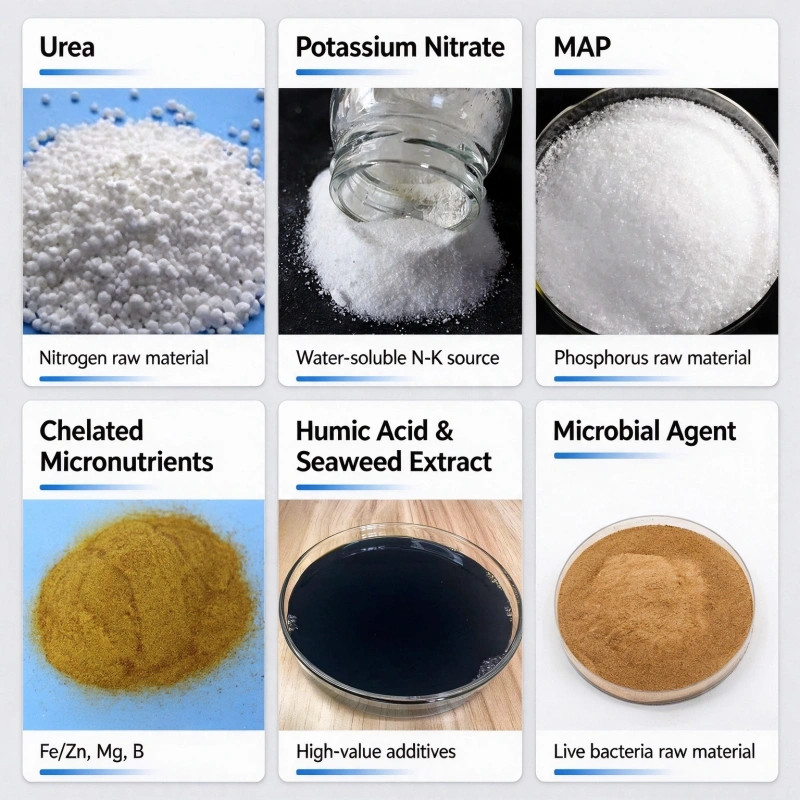
Before you spec any equipment, understand what goes into the tank. There are three families of ingredients, and each one changes how your Small-Scale Liquid Fertilizer Production Line (1–3 t/h) must be built.
Macronutrients → urea, potassium nitrate, monoammonium phosphate. These are the base: they define the core formula.
Secondary & micronutrients → chelated iron / zinc, magnesium sulfate, boric acid. Small in quantity, critical in quality.
Functional additives → amino acid solution, humic acid, seaweed extract, microbial agents. These raise the added value and the margin.
Now the key point — the physical form of your raw material decides the line’s complexity :
> Fully liquid → direct mixing → ⭐ cheapest, simplest.
> Solid + liquid → add a dissolving tank and stirring → ⭐⭐ most universal.
> High-viscosity / paste → add high-shear emulsification → ⭐⭐⭐ higher investment.
> Contains live microbes / heat-sensitive → low temperature + low shear + 316L stainless steel → ⭐⭐⭐⭐ the most demanding.
The rule of thumb is simple: your raw material decides the configuration. A Small-Scale Liquid Fertilizer Production Line (1–3 t/h) must be built around what you actually have. Keep reading to see how each scenario lands in practice.
3. Production Process (Step by Step)
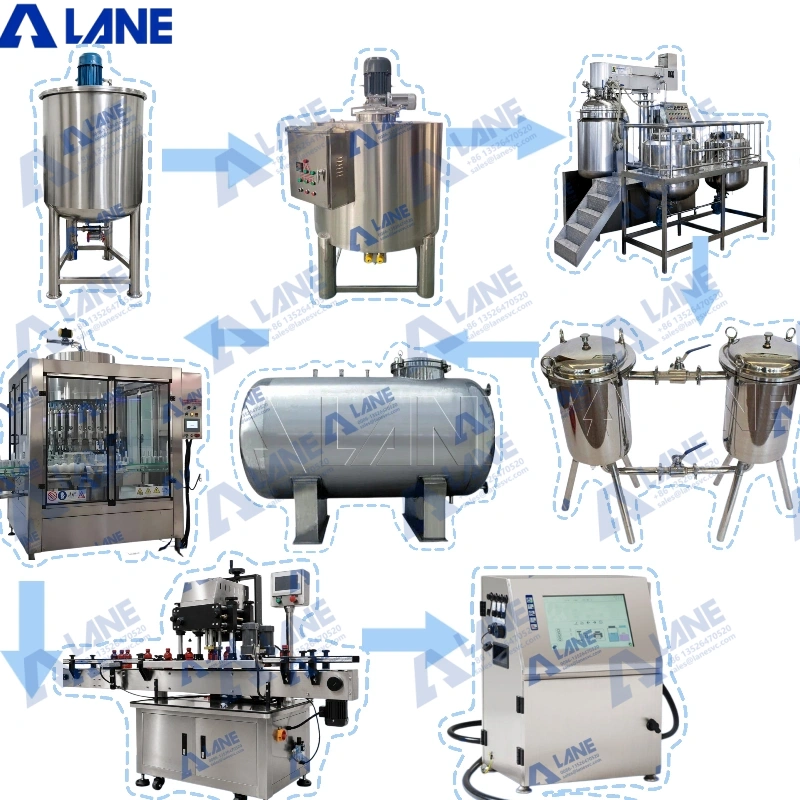
A Small-Scale Liquid Fertilizer Production Line (1–3 t/h) is really seven connected steps. Here is the sequence, in the exact order your product will travel:
> Raw material dosing → weighing system / flow meter; solids and liquids are metered separately for accuracy.
> Dissolving & mixing → dissolving tank plus high-shear mixer; urea and potassium are broken down, micronutrients dispersed.
> Reaction / aging → a reaction vessel for chelation (when needed); then settling to drop undissolved impurities.
> Filtration → multi-stage filter, 50–200 mesh, to stop drip-lines from clogging.
> pH adjustment → controlled to 4–7 to prevent sedimentation during storage.
> Filling & packaging → automatic filler from 1 L to 1000 L, following your customers’ specifications.
> Quality control → lab tests for specific gravity, pH and EC value.
Each step matters, but note how two of them — filtration and pH — determine whether your customers come back. A Small-Scale Liquid Fertilizer Production Line (1–3 t/h) that skips either will produce complaints, not repeat orders.
4. Application Scenarios × Matching Production Line
This is the section that tells you whose problem your Small-Scale Liquid Fertilizer Production Line (1–3 t/h) actually solves. Each scenario has a different pain point, and therefore a different configuration.
| SCENARIO | END USER | CORE PAIN POINT | KEY CONFIGURATION | ON-SITE OUTCOME |
|---|---|---|---|---|
| Field drip irrigation | Large growers / commercial farms | Clogged drip lines, inconsistent concentration, insufficient seasonal output | Dissolving tank + two-stage filtration (100→200 mesh) + 25 L filling line | Cost cut by 40%, zero dripper clogging, payback within 8 months |
| Fertilizer distribution | County-level resellers | Slim profit margins, farmers attribute poor crop performance to them, seasonal inventory pressure | Automatic dosing + multi-size filling (5/10/20 L) + labeling & coding system | 30–40% lower cost than sourcing from suppliers, doubled margin, shift from trader to manufacturer |
| Cooperatives | Joint cooperatives / village collectives | Variable product performance, disputes among members, lack of consistent quality control | PLC recipe switching + small-pack filling (5–10 L) + individual batch records per household | 3,000–4,000 cost saving per household annually, soil-tailored formulas, stable uniform quality |
| Organic farms | Organic growers / bio-fertilizer workshops | Live microbes vulnerable to heat and high shear; purchased bio-fertilizer unstable | Low-temperature mixing tank (<40 °C) + low-shear agitation + 316L stainless steel + sterile filling | Bacteria survival rate >90%, standardized in-house fertilizer, excess production available for sale |
| Foliar spraying | Micro-fertilizer plants / specialty fertilizer brands | Frequent spray nozzle blockages, poor filling accuracy, inconsistent packaging volume | Ultra-fine filtration (200 mesh+) + micro-dosing pumps + 100 mL–1 L filling & capping line | Zero nozzle-clog complaints, filling accuracy ±0.5%, finished products ready for shipment |
| Soilless cultivation | Greenhouses / hydroponic bases | Calcium and phosphorus incompatibility, tedious cleaning between different nutrient formulas | Dual reactors + independent pipelines + CIP online cleaning + EC/pH real-time monitoring | Custom nutrient formulas, cost halved, one-click cleaning for recipe changeover |
| Seaweed / algae liquid fertilizer | Seaweed extract producers, functional fertilizer brands | Viscous foamy seaweed slurry; heat degrades active ingredients, easy sedimentation & stratification | Low-speed defoaming mixing + low-temp mixing (<45 °C) + colloid mill / high-shear homogenizer + two-stage filtration (100→150 mesh) | Active substance retention >85%, no storage stratification, compatible with NPK for value addition |
The golden rule for seaweed fertilizer : low temperature, low foam, never break the active matter. Every other fertilizer wants to be mixed as evenly as possible; seaweed fertilizer is different — mix gently, don’t hurt it. This single principle is why your Small-Scale Liquid Fertilizer Production Line (1–3 t/h) may need a very different mixing head than your neighbor’s.
5. Equipment List for a 1–3 t/h Line
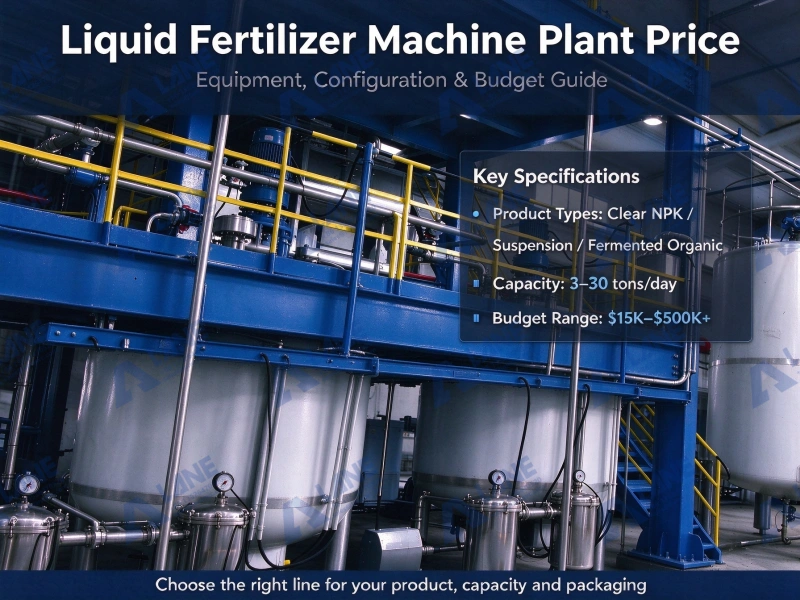
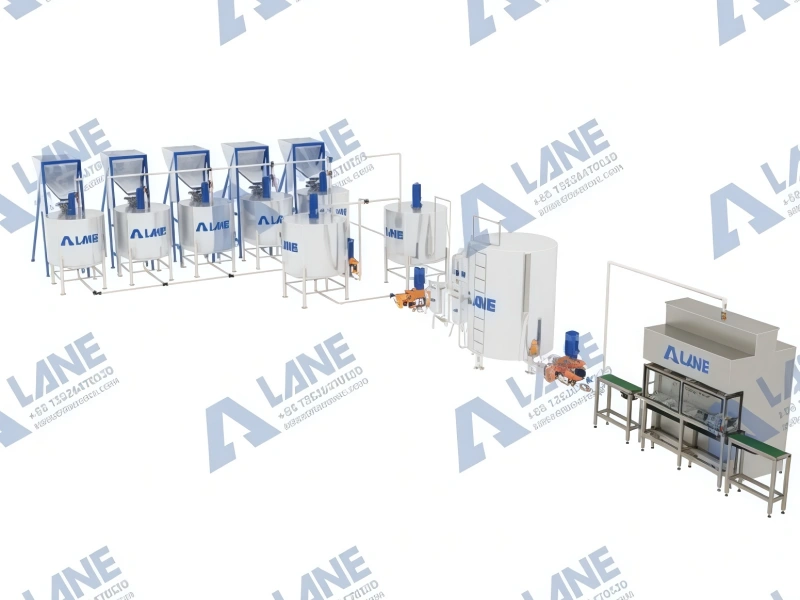
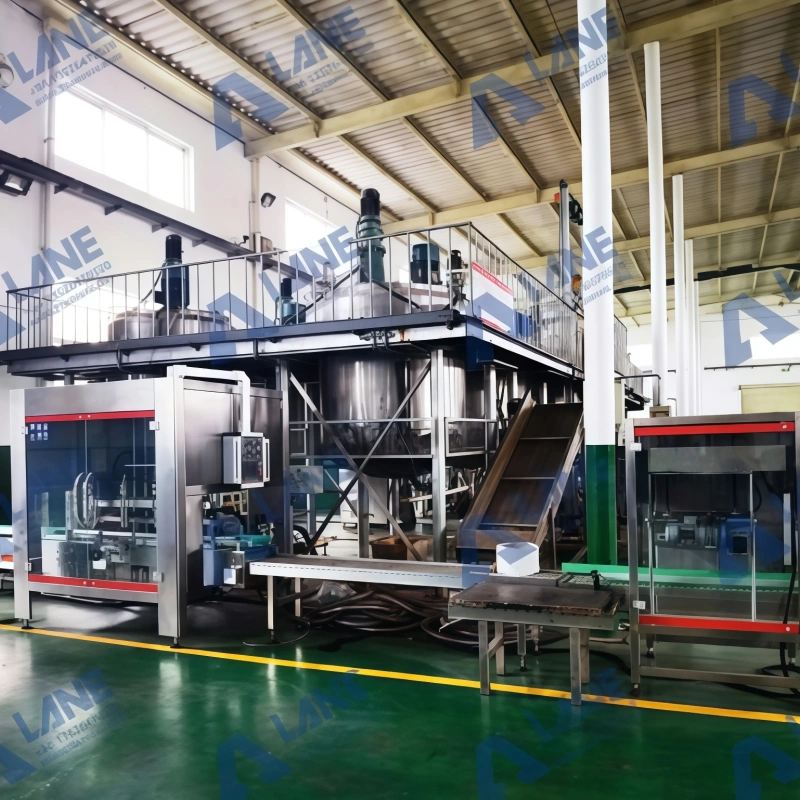
Here is what a complete Small-Scale Liquid Fertilizer Production Line (1–3 t/h) contains — first the base configuration for the solid-liquid mixing route:
> Dissolving tank → 2–3 m³, 304 stainless steel, heating + stirring → dissolves solid raw materials.
> Mixing / reaction vessel → 2 m³, stirring + temperature control → uniform mixing + chelation.
> Settling / aging tank → 1–2 m³ → settles undissolved impurities.
> Multi-stage filtration → 100 mesh → 200 mesh → prevents clogging in drip lines and nozzles.
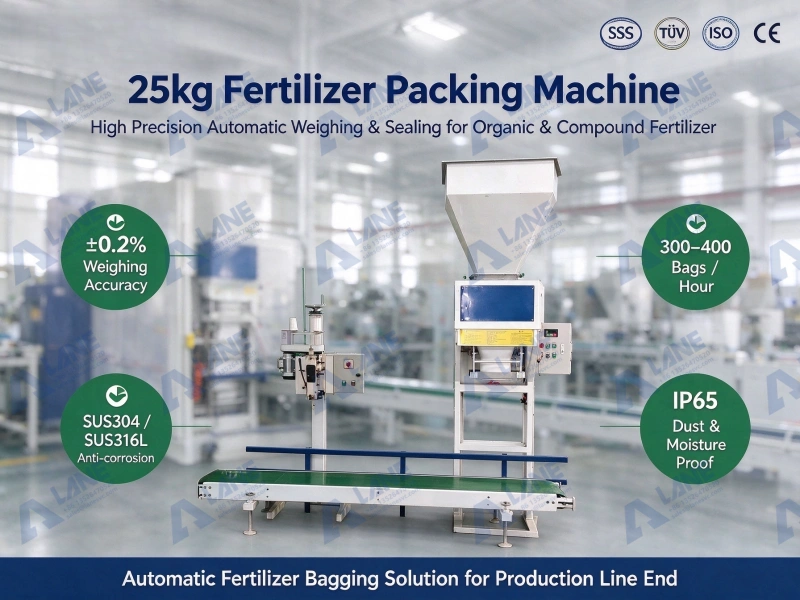
> Filling line → automatic or semi-automatic, 5–25 L → accurate dosing filling.
> Control cabinet → PLC → one-touch start/stop + recipe storage.
Upgrade modules (optional, add as needed) :
> High-shear emulsifier → for high-viscosity / suspension types.
> Twin-tank system → for soilless-cultivation AB formulas.
> Low-temperature mixing tank → for biological / organic fertilizer.
> CIP cleaning system → for frequent recipe changes.
> Labeling + coding + cartoning → for distributor private-labeling.
Notice that a Small-Scale Liquid Fertilizer Production Line (1–3 t/h) grows with you. You can start with the base six items, then add modules only when your order book justifies them.
6. Cost Breakdown
How much does a Small-Scale Liquid Fertilizer Production Line (1–3 t/h) actually cost? Here is the honest breakdown in USD. (The XX figures are placeholders to be finalized with your team based on your exact capacity and material.)
| ITEM | RECOMMENDED BUDGET RANGE (USD) |
|---|---|
| Base Equipment (1–2 t/h) | $28,000 – $55,000 |
| Upgrade Modules | $3,000 – $18,000 |
| Workshop & Civil Construction | $2,000 – $8,000 |
| Auxiliary Equipment (Air compressor / Boiler / Lab) | $2,000 – $6,000 |
| Installation & Commissioning | Usually included in equipment quotation or accounts for 5–10% |
| Total Estimated Investment | $35,000 – $85,000 |
The two figures that matter most for your decision:
> Compared with a 10+ t/h full-scale line, investing in a Small-Scale Liquid Fertilizer Production Line (1–3 t/h) cuts total investment by 60–70 %.
> Payback period: 8–18 months, depending on capacity utilization and the gap between raw-material cost and sale price.
For a detailed quote tailored to your specific formula and region, contact our team for a custom proposal — no two projects are identical, and a generic price would only mislead you.
7. How to Choose: Quick Decision Flow
Stop guessing. Walk through these three questions, and the right Small-Scale Liquid Fertilizer Production Line (1–3 t/h) will pick itself.
Step 1 — What form is your raw material?
> Fully liquid → base mixing line → ✅ cheapest.
> Solid + liquid → standard dissolving line → ✅ most universal.
> Paste / high-viscosity → emulsifying-homogenizing line → ⚠️ higher investment.
> Contains live microbes → low-temperature low-shear line → ⚠️ demanding materials.
Step 2 — What is your main use?
> Field drip irrigation → filtration accuracy comes first.
> Distributor private-labeling → multi-size filling + labeling.
> Cooperative → flexible recipe switching.
> Organic / biological → low-temperature sterile.
> Foliar spraying → ultra-fine filtration + small packaging.
> Soilless cultivation → twin-tank system.
> Seaweed fertilizer → low-temperature low-foam + homogenization.
Step 3 — What is your daily output target?
> 5–8 t/day → 1 t/h, single shift.
> 10–20 t/day → 2–3 t/h, single shift.
> 30 t+/day → 3 t/h, double shift, or upgrade to 5 t/h.
Answer those three honestly, and you have your configuration. A Small-Scale Liquid Fertilizer Production Line (1–3 t/h) is built around these answers, not around a brochure.

8. Common Mistakes to Avoid
Every mistake below is one we’ve seen cost a real operator real money. None of them are exotic — they’re the classic traps in this exact product category:
Underestimating solid dissolving time → your real capacity ends up below the nameplate.
Insufficient filtration → drip-lines and nozzles clog, and the complaints land on you.
Wrong material choice (carbon steel) → acid & alkali corrosion scraps the tank within six months.
Poor filling accuracy → a few grams off per drum, and you lose tens of thousands over a year.
No room for expansion → when business grows, you can’t scale up without re-buying.
The common thread: every one of these is avoidable at the design stage of a Small-Scale Liquid Fertilizer Production Line (1–3 t/h) . Buy the filtration that your crops need, the steel your chemicals require, and the dosing accuracy your margin depends on — not the cheapest option on paper.
9. FAQ
How much does a small liquid fertilizer plant cost? A Small-Scale Liquid Fertilizer Production Line (1–3 t/h) typically runs between $XX,XXX and $XX,XXX, depending on materials, filtration and automation level. See Section 6 for the full breakdown.
Can one line produce both clear and suspension fertilizers? Yes, with the right upgrade. Add a high-shear emulsifier for suspensions; the base line already handles clear products.
What is the ROI period for a 1–3 t/h line? Generally 8–18 months, driven by capacity utilization and the spread between raw-material cost and selling price.
How many workers are needed? A semi-automatic line needs 2–3 operators per shift; a fully automatic line can run with fewer, especially with PLC control.
Which countries do you export to? We supply across Europe, North America, Africa and Asia — our engineering teams support installation in French-speaking, English-speaking and other regions.
Can the line handle seaweed / algae extracts? Yes — that’s exactly the low-temperature, low-shear configuration described in Section 4. Active-matter retention can exceed 85 %.
10. Small-Scale Liquid Fertilizer Production Line
Here is the honest summary. A Small-Scale Liquid Fertilizer Production Line (1–3 t/h) delivers three things at once:
> Low threshold — you don’t need a full-scale plant to start producing.
> Fast payback — 8–18 months in most working scenarios.
> Flexible adaptability — one line serves drip irrigation, distribution, cooperatives, organic, foliar and soilless applications.
Your raw material, your use case and your daily target have all been covered. Now it’s time to make it concrete.
👉 Get a Custom Quote for Your 1–3 t/h Liquid Fertilizer Production Line → contact our team today (via the contact page or WhatsApp) with your materials and daily output, and we’ll send back a tailored configuration, equipment list and price estimate.