

Large Inclination Belt Conveyor
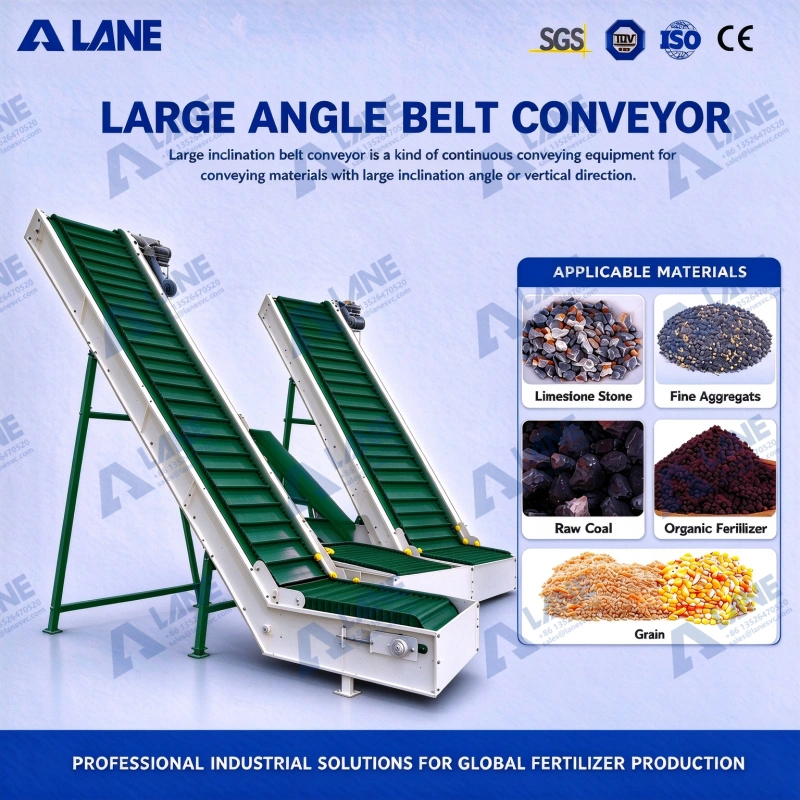
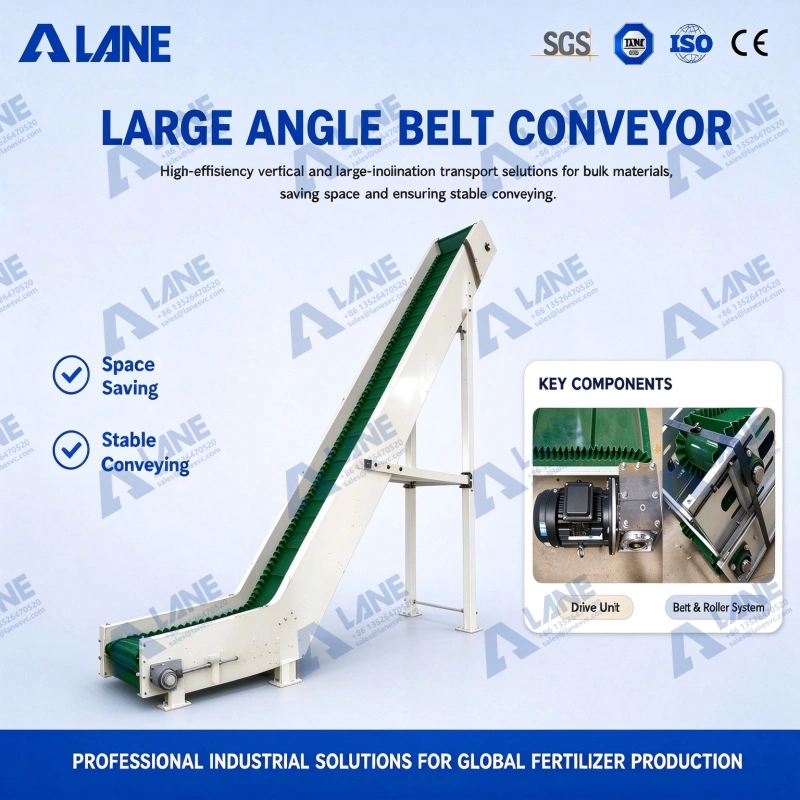
Is your plant short on space? Is the inclination of a conventional belt conveyor insufficient for your layout? Are maintenance costs for bucket elevators becoming too high? LANE’s Large Inclination Belt Conveyor is specifically designed for steep-angle bulk material lifting, providing an integrated solution to these space and material handling challenges.
As a leading manufacturer of Large Inclination Belt Conveyors, LANE uses a high-strength, laterally stable base belt combined with integrally formed sidewalls to achieve safe vertical conveying at angles of up to 90°. This design effectively prevents materials from sliding backward or spilling during steep-angle conveying. It can also reduce the floor space required by up to 70% compared with conventional belt conveyors. To help you select the right equipment and plan your production layout, we have outlined the application advantages and key technical features of LANE Large Inclination Belt Conveyors across different industries below.
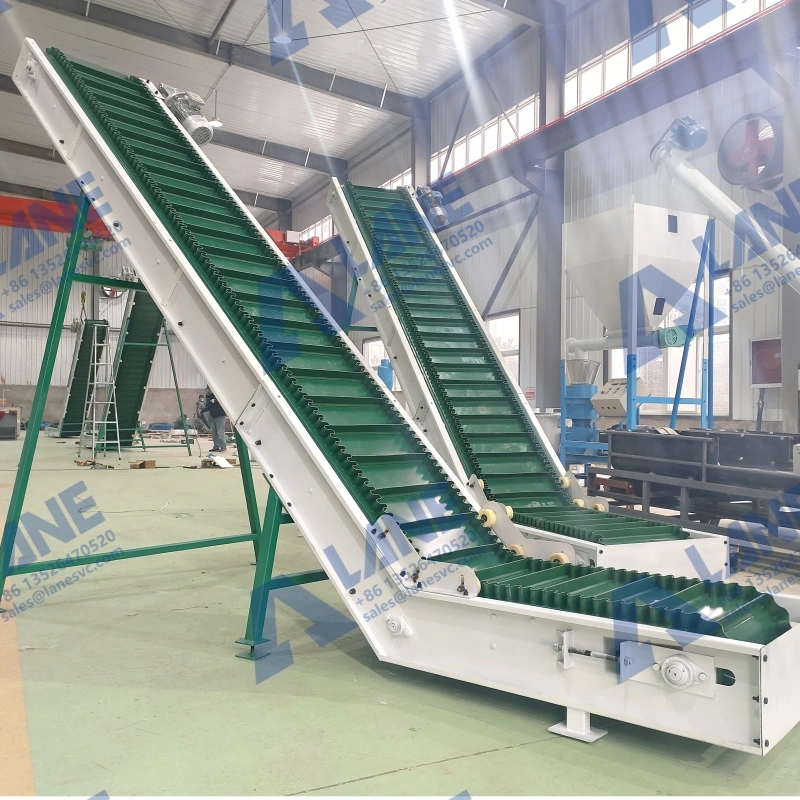
As one of LANE’s flagship bulk material lifting solutions, our corrugated sidewall belt conveyors feature upgraded structural design, manufacturing processes, environmental protection, and safety measures. Their main technical advantages include the following:
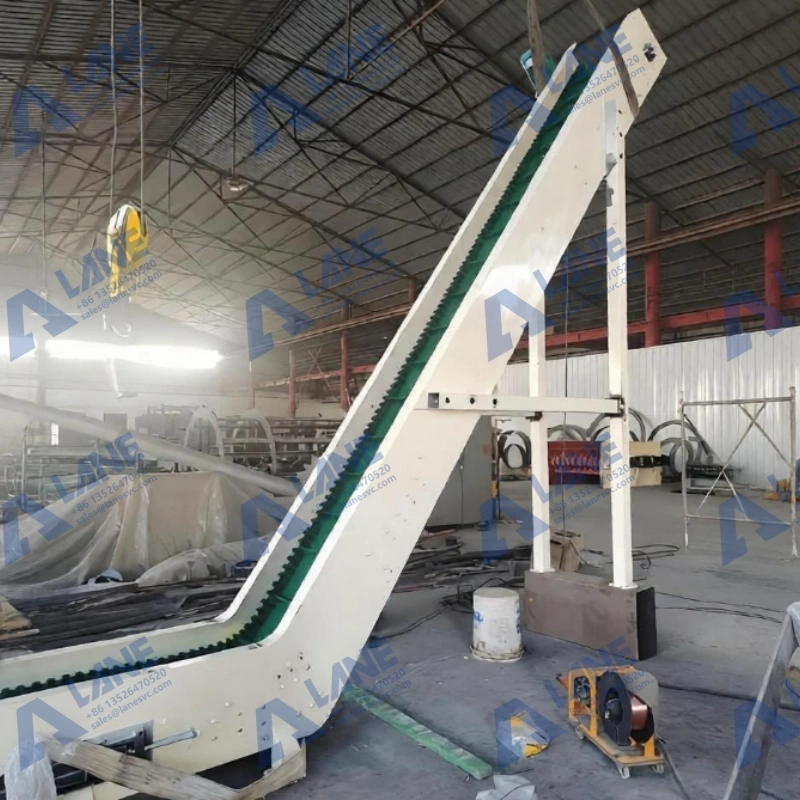
Main Features and Advantages
1. Steep-Angle Conveying with Maximum Space Savings
• High-angle conveying: Overcomes the inclination limitations of conventional conveyors, which are typically around 18°, and supports stable operation at inclinations ranging from 30° to 90°, including vertical conveying.
• Reduced civil construction investment: Thanks to its steep conveying angle, the overall footprint can be reduced to between one-half and one-fifth of that required by a conventional conveyor. This significantly shortens the conveying route and reduces factory construction and land costs.
2. Innovative Structural Design for Spill-Free Conveying
• Corrugated sidewalls and cross cleats: Made from high-quality composite rubber, the sidewalls and cross cleats form high-strength, enclosed carrying compartments along both sides of the base belt. This design prevents bulk materials from sliding backward or spilling during steep-angle operation.
• High lateral rigidity of the base belt: The specially designed base belt offers excellent resistance to bending and high lateral rigidity. It effectively prevents belt sagging under heavy loads and excessive drooping on the return side, helping the equipment operate more smoothly.
3. LANE’s Specialized Manufacturing Processes for Better Wear Resistance and Longer Service Life
• Wear-resistant and tear-resistant materials: LANE uses highly wear-resistant, impact-resistant rubber compounds. Depending on the characteristics of the material being conveyed, an anti-tear steel mesh layer can also be incorporated to improve durability under demanding operating conditions.
4. Environmentally Friendly Design for Modern Industrial Facilities
• Optional fully enclosed covers: For dusty bulk materials such as cement, fly ash, and grain, Large Inclination Belt Conveyors can be equipped with fully enclosed covers, feed chutes, and dust extraction connections. This configuration helps minimize dust emissions and meet stringent environmental assessment requirements.
5. Comprehensive Safety Protection for Reliable Operation
• Multiple safety protection devices: Standard safety features include belt misalignment switches, pull-cord emergency stop switches, belt slip switches, and anti-reverse devices. These systems help ensure rapid and safe shutdown in the event of an unexpected problem during steep-angle or vertical conveying, protecting both personnel and equipment.
6. Lower Overall Energy Consumption and Easier Maintenance
• Replacement of multi-machine conveying systems: A single machine can provide continuous conveying along a combined horizontal–inclined–horizontal route. This eliminates transfer points between multiple conveyors and significantly reduces potential system failure points.
• Energy-efficient operation: Compared with conventional bucket elevators or screw elevators, Large Inclination Belt Conveyor models feature lower running resistance and can reduce power consumption by more than 30%. Cleaning and routine maintenance are also simpler.
7. Flexible Customization to Match Process Requirements
• Special materials for different operating conditions: For demanding applications across different industries, LANE can supply sidewall conveyor belts with specialized properties, including heat resistance, wear resistance, acid and alkali resistance, flame resistance, and antistatic performance. These options accommodate conveying requirements ranging from high-temperature clinker to highly corrosive chemical materials.
Components and Working Principle
1. Main System Components (Key Components)
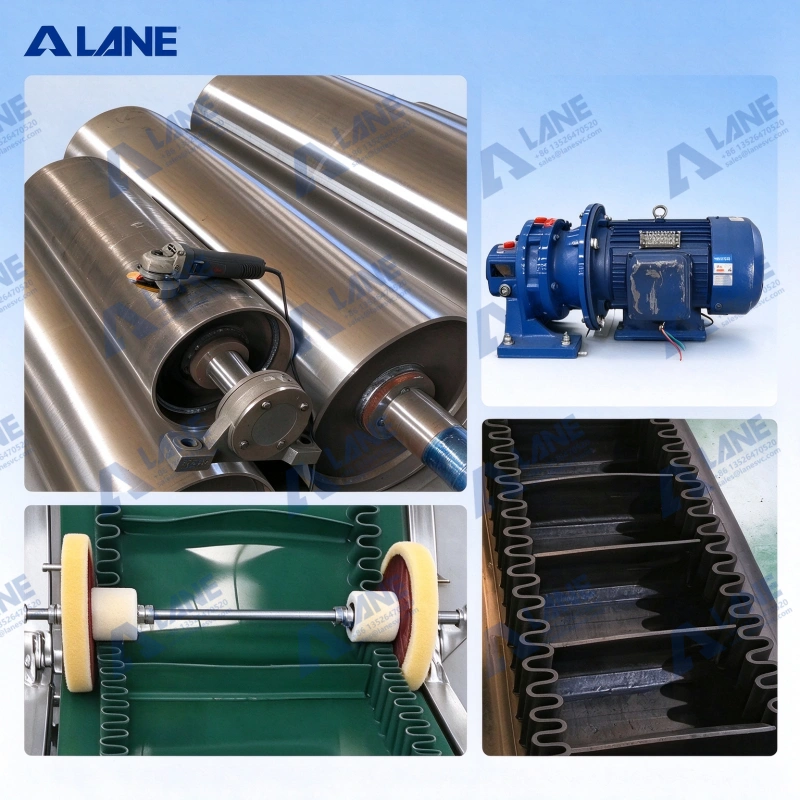
Large Inclination Belt Conveyors consist of the following core modules, carefully integrated to ensure safe and stable operation when conveying materials over large height differences.
• Corrugated sidewall conveyor belt (core component): Consists of a base belt, corrugated sidewalls, and cross cleats. The base belt provides tensile strength, the corrugated sidewalls prevent materials from spilling over the sides, and the cross cleats retain and support the material as it moves upward.
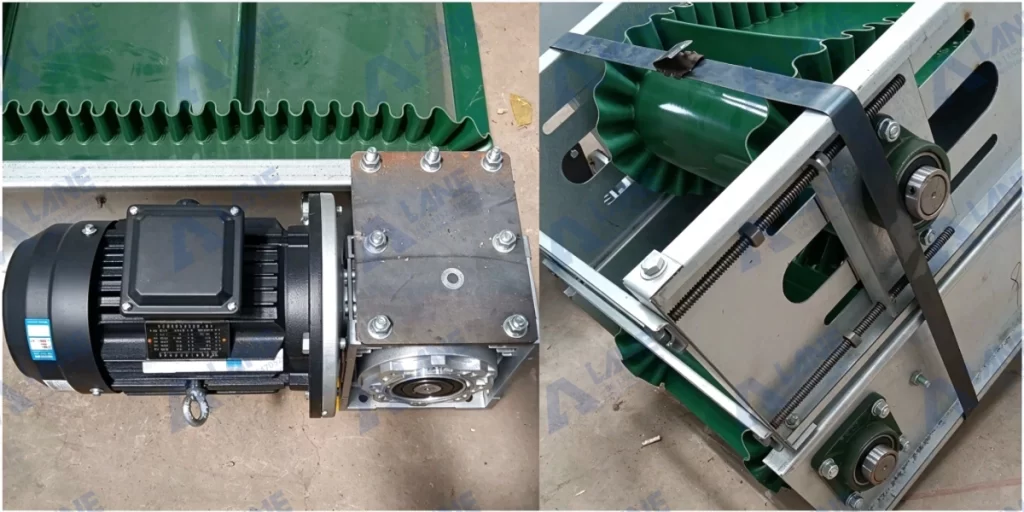
• Drive unit and power system: Includes a high-quality electric motor, gearbox, backstop, and coupling. These components provide the power required to operate the entire machine. The backstop is particularly important for preventing the belt from sliding backward when the conveyor stops under a heavy load.
• Drive and direction-changing pulley assemblies: High-strength pulleys are used throughout the system. The drive pulley has a rubber-covered surface to increase friction, while the direction-changing pulleys alter the belt’s travel direction to accommodate combined horizontal–inclined–horizontal conveying routes.
• Specialized idlers and belt pressure rollers:
>Supporting idlers: Support the conveyor belt along the horizontal and inclined sections.
>Pressure rollers at concave and convex transition sections: These key customized components hold the belt in position where its inclination changes, such as when transitioning from a horizontal section to an inclined section, preventing the belt from lifting or bouncing.
• Cleaning and tensioning devices:
>Belt tapping cleaner: A cleaning device specifically designed for sidewall conveyor belts. It uses vibration to remove small amounts of residual material trapped around the cross cleats and their gaps.
>Belt tensioning device: Maintains sufficient belt tension to prevent slippage on the pulleys.
• Safety protection and enclosure (optional): Includes full-length pull-cord emergency stop switches, belt misalignment switches, and fully enclosed dust covers designed to meet environmental assessment requirements.
2. Working Principle
The Large Inclination Belt Conveyor uses an innovative continuous conveying process based on compartmentalized material support. The complete operating sequence is outlined below, making bulk material lifting simpler and more efficient.
Step 1: Accurate Feeding on the Horizontal Section (Compartment Formation)
Bulk materials pass through the feeding chute → fall onto the conveyor belt at the bottom horizontal section → automatically enter individual compartments formed by the corrugated sidewalls and cross cleats → stabilize as the belt moves, ready for lifting.
Step 2: Smooth Transition Through the Curved Section (Belt Guidance)
The Large Inclination Belt Conveyor moves toward the concave transition section → LANE’s specially designed concave-section pressure roller assembly applies precise pressure → smoothly guides the belt from a low inclination or horizontal position into a steep incline, reaching vertical conveying at up to 90° → minimizes belt lifting and vibration.
Step 3: Steep-Angle or Vertical Lifting (High-Rigidity Load Support)
The drive unit starts operating → drives the belt upward along the inclined conveying path → the highly rigid base belt resists sagging under heavy loads → the cross cleats support the material while the corrugated sidewalls retain it on both sides → materials are lifted over a large height difference without sliding backward or spilling.
Step 4: Discharge at the Upper Section (Gravity-Assisted Unloading)
The material travels with the belt to the upper horizontal section → reaches the head drive pulley → the belt follows the pulley and turns along a curved path → the material loses its support within the compartments → gravity allows the material to discharge smoothly into a collection hopper or the next processing stage.
Step 5: Return-Side Cleaning (Clean Belt Recirculation)
The unloaded belt enters the return section → a specially designed belt tapping cleaner applies small vibrational impacts to the back of the belt → residual sticky dust trapped around the sidewalls and cross cleats is dislodged → the belt returns to a clean condition → the next conveying cycle begins.
Technical Parameter Table
| MODEL | CAPACITY (m³/h) | BELT CONVEYOR WIDTH (mm) | OVERALL WIDTH (mm) |
|---|---|---|---|
| LAD-300 | Inclination angle 30° retaining edge 40/60: 14/15m³/h Inclination angle 45 ° retaining edge 40/60: 10/11m³/h Inclination angle 60 ° retaining edge 40/60: 7/8m³/h |
300 | 480 |
| LAD-400 | Inclination angle 30° retaining edge 60/80: 20/34m³/h Inclination angle 45 ° retaining edge 60/80: 14/26m³/h Inclination angle 60° retaining edge 60/80: 10/18m³/h |
400 | 580 |
| LAD-500 | Inclination angle 30° retaining edge 80/120: 46/71m³/h Inclination angle 45 ° retaining edge 80/120: 35/57m³/h Inclination angle 60° retaining edge 80/120: 25/40m³/h |
500 | 870 |
| LAD-650 | Inclination angle 30° retaining edge 120/160: 104/120m³/h Inclination angle 45 ° retaining edge 120/160: 83/97m³/h Inclination angle 60° retaining edge 120/160: 58/69m³/h |
650 | 1020 |
| LAD-800 | Inclination angle 30 ° retaining edge 120/160/200/240: 128/157195/235m³/h Inclination angle 45 ° retaining edge 120/160/200/240: 102/127/157/195m³/h Inclined angle 60 ° retaining edge 120/160/200/240: 72/90/112142m³/h |
800 | 1220 |
| LAD-1000 | Inclination angle 30 ° retaining edge 120/160/200/240: 172/216/267/327m³/h Inclination angle 45 ° retaining edge 120/160/200/240: 137/175/216/271m³/h Inclination angle 60° retaining edge 120/160/200/240: 96/124/153/197m³/h |
1000 | 1400 |
| LAD-1200 | Inclination angle 30 ° retaining edge 160/200/240/300: 275/331/419/466m³/h Inclination angle 45 ° retaining edge 160/200/240/300: 222/267/347/384m³/h Inclination angle 60° retaining edge 160/200/240/300: 158/190/253/178m³/h |
1200 | 1690 |
| LAD-1400 | Inclination angle 30 ° retaining edge 160/200/240/300/400: 319/395/500/564/794m³/h Inclination angle 45 ° retaining edge 160/200/240/300/400: 258/318/414/465/680m³/h Inclination angle 60 ° eretaining edge 160/200/240/300/400: 184/226/302/337/524m³ /h |
1400 | 1890 |
Applications Across Multiple Industries
1. Wide Range of Suitable Materials (Applicable Materials)
Depending on bulk density, particle size, and physical characteristics, LANE equipment can convey the following types of bulk materials.
• Lumpy and high-hardness materials: Ores (iron ore, copper ore, and gold ore) → coal (run-of-mine coal, cleaned coal, and lump coal) → coke → sand and gravel aggregates → crushed stone → cobblestones.
• Powdered and granular materials: Cement clinker → fly ash → mineral powder → sintered ore fines → grains (wheat, corn, and soybeans) → fertilizer raw materials.
• Materials requiring special operating conditions: High-temperature materials (foundry sand and chemical clinker) → highly corrosive materials → sticky materials (wet sludge and municipal solid waste).
Note: For high-temperature, acidic, alkaline, or corrosive materials, LANE can customize the sidewall base belt with specialized heat-resistant or acid- and alkali-resistant properties.
2. Key Application Industries and Typical Scenarios (Target Industries & Scenarios)
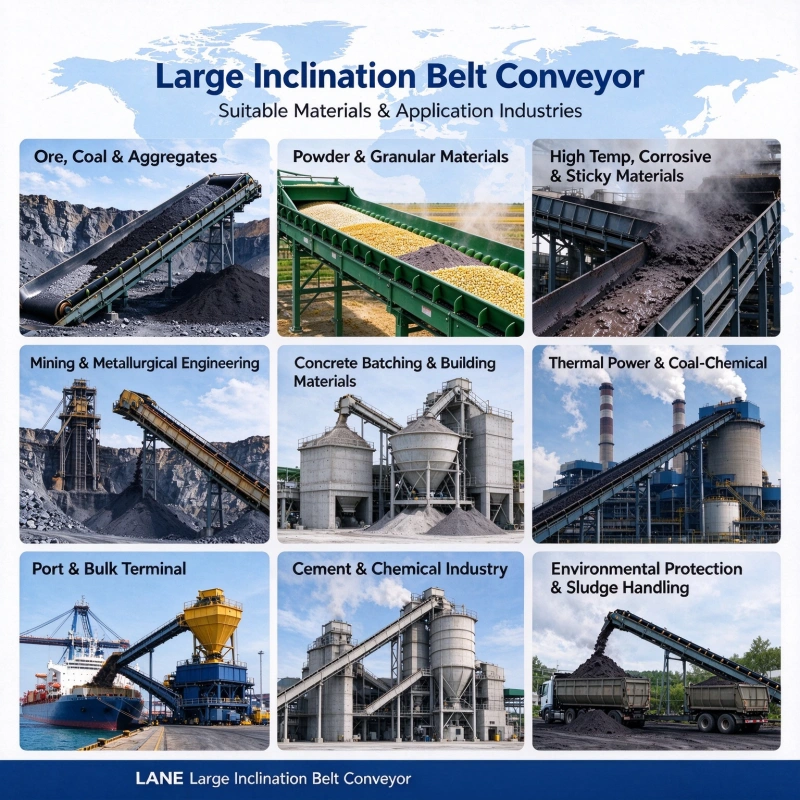
From deep underground mine shafts to elevated storage silos, LANE Large Inclination Conveyors play a central role in bulk material handling across the following industries.
• Mining and Metallurgical Engineering
>Applications: Vertical lifting of ore from deep underground shafts → waste rock removal from mine tunnels → elevated feeding of raw materials at mineral processing plants → charging systems for metallurgical blast furnaces.
• Commercial Concrete Batching Plants and Building Materials
>Applications: Sand and gravel aggregates move from ground-level storage bins → through the LANE vertical lifting system → to the main mixer on the upper floor. This replaces conventional long-distance belt conveyors while occupying minimal floor space.
• Thermal Power Plants and Coal-Chemical Industries
>Applications: Raw coal from storage yards → steep-angle conveying → elevated coal bunkers in boiler buildings; alternatively, environmentally controlled conveying of flue gas desulfurization gypsum and fly ash at power plants.
• Ports, Terminals, and Bulk Material Transfer
>Applications: Bulk materials unloaded from ships → compact transfer stations at the port → elevated receiving hoppers. This significantly improves loading and unloading efficiency where available terminal space is limited.
• Chemical, Cement, and Modern Environmental Protection Industries
>Applications: Lifting cement clinker to the top of storage silos; enclosed conveying of chemical raw materials; transporting dewatered sludge from wastewater treatment plants after filter pressing via a Large Inclination Belt Conveyor to waste collection trucks.
Applications in Fertilizer Production Lines
In modern compound fertilizer and organic fertilizer production lines, Large Inclination Belt Conveyors are mainly used at key transfer points involving large height differences and limited installation space. They provide vertical material lifting while helping eliminate gaps in the conveying process.
Station 1: Raw Material Batching → Mixing System
Various powdered or granular fertilizer raw materials, such as urea, ammonium phosphate, and potash fertilizer, are weighed by an automatic batching machine → collected on a horizontal conveyor belt → transferred to a LANE Large Inclination Belt Conveyor → vertically conveyed into an elevated twin-shaft mixer or mixing machine.
• Advantages: Replaces conventional bucket elevators, with reduced material blockage risks, improved resistance to corrosive operating conditions when appropriately configured, and easier cleaning.
Station 2: Rotary Drum or Granulation System → Drying and Cooling System
Wet granules formed by a granulator, such as a rotary drum granulator, roller granulator, or extrusion granulator, contain a certain amount of moisture and may be sticky → discharged from the outlet → transferred to a LANE sidewall belt conveyor for steep-angle lifting → conveyed vertically or at a steep angle into the feed inlet of a dryer or cooler.
• Advantages: The integrally formed cross cleats create enclosed carrying compartments. Even relatively soft, wet fertilizer granules can be conveyed at steep angles without slipping or undergoing crushing and deformation.
Station 3: Screening System → Return Material and Re-Granulation Loop
Oversized granules or fine powder rejected by the screening machine → collected in a hopper → transferred to a LANE Large Inclination Belt Conveyor for return conveying → lifted vertically → returned to the raw material bin or granulator for secondary granulation.
• Advantages: Its compact footprint allows the return conveying line to be installed close to walls or main equipment, making much better use of limited factory space.
Station 4: Finished Product Screening → Packaging and Finished Product Storage System
Qualified fertilizer granules after screening → pass through a coating machine, where an anti-caking agent is applied → enter the LANE vertical lifting system → are conveyed to the elevated hopper of an automatic weighing and packaging machine → are prepared for bagging.
• Advantages: The fully enclosed cover can be equipped with dust extraction connections to prevent fertilizer dust from escaping, maintain a clean packaging area, and meet environmental assessment requirements more easily.
Frequently Asked Questions About the LANE Large Inclination Belt Conveyor (FAQ)
To help you select and maintain the right equipment, LANE’s experienced technical engineers have provided professional answers to common questions that arise during the purchase and operation of steep-angle sidewall belt conveyors.
Q1: How does the LANE Large Inclination Belt Conveyor handle highly corrosive and sticky materials in fertilizer production lines?
A: For corrosive fertilizers such as NPK compound fertilizer and urea, LANE can customize special acid- and alkali-resistant or corrosion-resistant rubber base belts. Key material-contact components, including the frame and feed chute, can also be upgraded to SUS304 or SUS316 stainless steel.
For sticky organic fertilizers or wet granules, we equip the system with a high-frequency belt tapping cleaner. It applies small vibrational impacts to the back of the belt along the return section, effectively reducing fertilizer buildup around the sidewalls and cross cleats and helping maintain stable long-term operation.
Q2: How do I select the appropriate corrugated sidewall and cross-cleat heights for my materials?
A: The design of the sidewalls and cross cleats mainly depends on three factors: conveying inclination, material particle size or lump size, and hourly conveying capacity.
In general, a steeper conveying angle and larger material particles require higher sidewalls and cross cleats. For example, vertical conveying at 90° requires appropriately designed cross cleats with sufficient spacing and load-supporting capacity to retain the material.
Contact the LANE technical team, and we can provide a free, precise equipment selection calculation based on your process layout.
Q3: Are the sidewalls of a Large Inclination Belt Conveyor prone to tearing or detaching at curved transition sections? How does LANE improve the manufacturing process?
A: This is a common failure associated with conventional sidewall belt conveyors. However, LANE uses advanced hot-vulcanization integral molding technology, bonding the sidewalls, cross cleats, and high-lateral-rigidity base belt together under high temperature and pressure. This produces strong adhesion and eliminates the need for conventional cold-bonding processes.
At concave and convex transition sections, we also provide specially designed, high-precision pressure roller assemblies. These distribute localized stress more evenly, helping prevent sidewall detachment and tearing caused by repeated operation.
Q4: If factory space is limited, can a Large Inclination Belt Conveyor directly replace a conventional bucket elevator?
A: Yes. Compared with conventional bucket elevators, LANE Large Inclination Belt Conveyors offer three major advantages.
First, they handle materials more gently, helping reduce material damage when conveying soft, wet granules, such as freshly granulated fertilizer. Second, cleaning is much easier because the equipment has an open or semi-open structure, reducing the risk of internal material accumulation, jamming, or blockage. Third, operating power consumption is lower and noise levels are reduced.
With vertical conveying capability of up to 90°, this equipment is an ideal option for replacing conventional bucket elevators in energy-saving and equipment-upgrade projects.
Q5: Is the Large Inclination Belt Conveyor a standard machine? How can I obtain an accurate customized quotation?
A: Because every plant has different space constraints, lifting heights, material characteristics—including temperature, viscosity, and corrosiveness—and production capacity requirements, the Large Inclination Belt Conveyor is typically a customized piece of equipment rather than a standard machine.
You can contact our customer service team through our website and provide your basic process requirements or plant layout drawings. LANE commits to providing a professional design proposal and ex-works price quotation within 24 hours.