Manure Compost Drying: Cutting Excess Moisture for Stable Organic Fertilizer Production
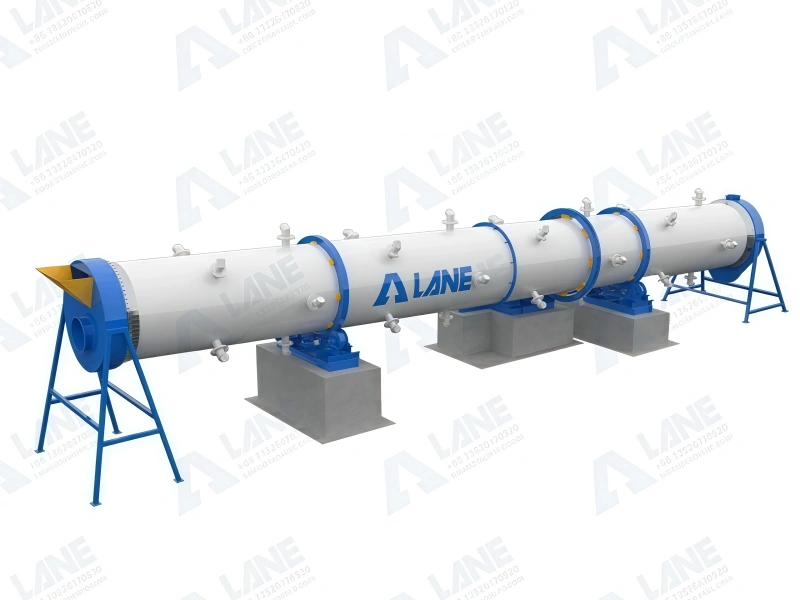
Working as a technical supervisor for organic fertilizer production lines, I have dealt with troubles from high-moisture manure compost for many livestock farms and composting bases. Raw compost piled from livestock dung and kitchen waste always holds excessive water, which blocks granulation machines, creates strong rotten odors, and pushes up delivery costs sharply. Standardized Manure Compost Drying pretreatment with LANE rotary drum dryer can adjust compost moisture to a qualified range. It stabilizes the whole organic fertilizer manufacturing process, and cuts extra costs on warehouse storage, compost fermentation and fuel consumption all at once.
Hidden Economic & Production Losses Brought by Undried Wet Manure Compost
Many farm operators choose to skip dedicated drying work and store wet manure compost directly to save early equipment investment.
This casual operation will bring continuous hidden losses in production, environment and raw material value.
• Excess Moisture Triggers Persistent Odor and Uncontrolled Secondary Fermentation
When the moisture content of manure compost exceeds 35%, anaerobic fermentation will keep going inside open yards or sealed raw material silos.
Rotten gas spreads to pollute the factory area and surrounding residential zones, which easily leads to environmental complaints.
Extra heat from secondary fermentation breaks down organic matter and nitrogen nutrients inside compost directly.
One pig farm client told me their 2000 tons of piled wet compost lost nearly 18% of organic nutrients within one month due to over-fermentation.
• High Water Content Inflates Transportation Expense of Raw Compost Materials
Free water accounts for a large proportion of total weight for wet manure compost.
The effective organic fertilizer raw material proportion drops, so buyers pay freight for useless water during long-distance transportation.
I calculated the actual cost difference: transporting wet compost with 40% moisture costs 32% more per ton than dried compost at 26% moisture for over-500km delivery.
• Sticky Wet Compost Causes Frequent Blockage on Granulator And Screening Machines
Undried manure compost has strong viscosity from high free water.
It sticks tightly to the inner cylinder of disc granulators, drum granulators and screen mesh surfaces.
Workers have to stop the whole production line for manual cleaning every 2 to 3 hours, which cuts the daily output of organic fertilizer by more than 40%.
Core Production Purposes of Manure Compost Drying For Organic Fertilizer Factories
Manure Compost Drying is not only for reducing water content simply.
It serves three core production goals for organic fertilizer factories to achieve stable production and product value improvement.
• Stabilize Compost Moisture to Match Fixed Granulation Process Standards
Organic fertilizer granulation has a fixed moisture requirement of 20% to 28% for qualified pellet forming.
Precise moisture adjustment via Manure Compost Drying makes raw compost texture uniform.
It avoids irregular large clods and fine powder waste during granulation, and reduces returned agglomerated materials for reprocessing.
• Lock Organic Nutrients Inside Compost to Prevent Nutrient Degradation
We adopt low-temperature drying mode for manure compost instead of high-temperature baking.
Mild heating stops violent fermentation inside compost, protecting nitrogen, phosphorus and active organic substances from decomposition.
Fertilizer finished products with complete nutrients can gain higher sales premium in agricultural material markets.
• Cut Long-term Mold And Caking Loss for Finished Compost Fertilizer
After Manure Compost Drying, finished compost loses free water that supports mold breeding.
Sealed bagged organic fertilizer can be stored for over 6 months, while undried compost goes moldy within 30 days.
Factories can arrange batch production in off-season without worrying about raw material deterioration.
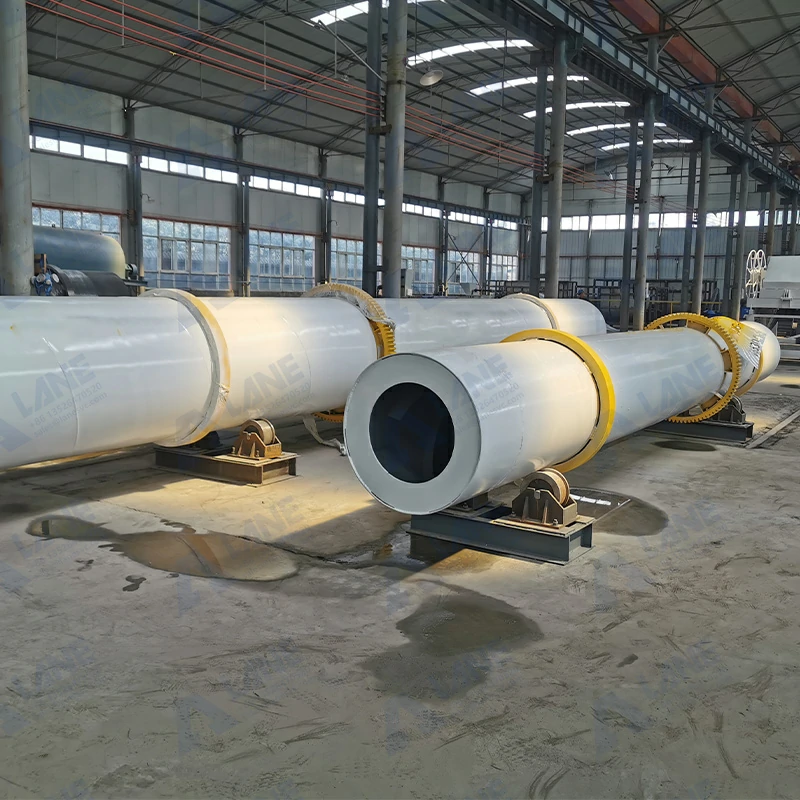
Customized Structural Configuration of LANE Rotary Drum Dryer for Manure Compost Drying
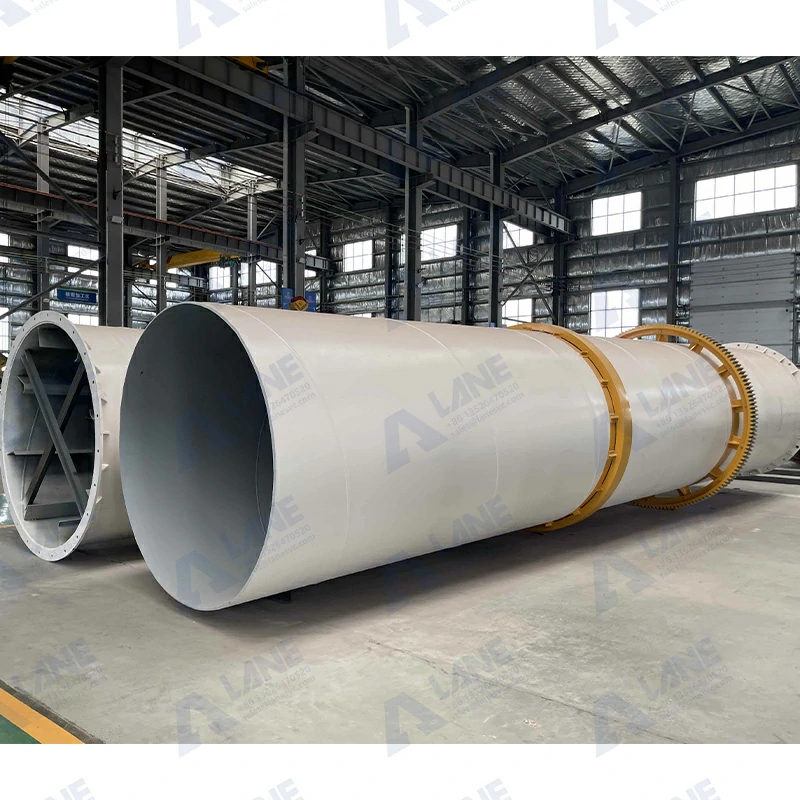
Our LANE rotary drum dryer has targeted structural upgrades aiming at the special traits of sticky, acidic livestock manure compost.
All structural designs focus on solving sticking, corrosion and uneven drying pain points on site.
• Combined Lifting Plate Structure for Full Turning of Clumpy Sticky Manure
We adjust the installation angle and layout quantity of lifting plates inside the drying cylinder.
The combined lifting plates break up lumpy manure compost when the cylinder rotates continuously.
It prevents thick manure buildup sticking on the inner cylinder wall, which fits the high-viscosity working condition of chicken manure, pig manure compost perfectly.
• Thickened Medium Carbon Steel Cylinder Resists Acid Corrosion from Animal Manure
Animal manure contains natural organic acid that will corrode ordinary thin steel barrels quickly.
The main cylinder of LANE dryer is welded with thickened medium carbon steel plates.
Matched anti-corrosion and wear-resistant riding wheels extend the continuous service life of the whole drying host greatly.
• Independent Hot Air Inlet Supports Stable Low-temperature Drying Production
The dryer reserves an independent hot air pipeline interface to connect with supporting hot blast stove equipment.
Workers can control hot air temperature stably to run low-temperature drying operation.
Mild hot air will not scorch organic matter in manure compost, matching the technical needs of low-temperature Manure Compost Drying.
| Model | Capacity(tph) | Drum Size(mm) | Rotation Speed(r/min) | Steel Plate Thickness(mm) | Lift Plate Thickness(mm) | Power(kw) |
|---|---|---|---|---|---|---|
| LARD0808 | 1-2 | Φ800*8000 | 5 | 8 | 4 | 5.5 |
| LARD1010 | 2-3 | Φ1000*10000 | 5 | 10 | 6 | 5.5 |
| LARD1212 | 3-5 | Φ1200*12000 | 5 | 10 | 6 | 7.5 |
| LARD1515 | 5-8 | Φ1500*15000 | 5 | 12 | 6 | 15 |
| LARD1616 | 8-12 | Φ1600*16000 | 5 | 12 | 6 | 18.5 |
| LARD1818 | 12-15 | Φ1800*18000 | 4 | 14 | 6 | 22 |
| LARD2020 | 20-25 | Φ2000*20000 | 4 | 14 | 6 | 37 |
| LARD2222 | 25-30 | Φ2200*22000 | 4 | 16 | 6 | 37 |
| LARD2424 | 30-35 | Φ2400*24000 | 4 | 16 | 6 | 45 |
| LARD2626 | 35-40 | Φ2600*26000 | 3 | 18 | 6 | 55 |
| LARD2828 | 40-45 | Φ2800*28000 | 3 | 18 | 6 | 75 |
| LARD3028 | 45-50 | Φ3000*28500 | 3 | 18 | 6 | 90 |
Complete Operation Flow of LANE Rotary Dryer In Manure Compost Drying Production Line
The whole drying flow runs continuously in a closed production line, divided into four clear steps from feeding to finished material delivery.
Each step has clear operation standards to guarantee stable moisture output.
• Even Feeding of Raw Manure Compost into Rotary Drying Cylinder
We use a quantitative screw conveyor for front-end feeding transportation.
It delivers wet manure compost evenly into the dryer inlet, avoiding concentrated feeding of large compost lumps.
Uniform material thickness inside the cylinder lays the foundation for consistent heat exchange.
• Hot Air Convection Heat Exchange inside the Rotating Dryer Cylinder
The driving device makes the drying cylinder rotate slowly and steadily.
Internal lifting plates lift and scatter manure compost repeatedly.
Hot air from the hot blast stove flows inside the cylinder for convection heat exchange, taking away free water inside compost efficiently.
• Qualified Dried Manure Compost Discharged for Downstream Processing
Workers test the moisture value of discharged compost at the dryer outlet.
Compost reaching the target moisture directly flows to lump crushing and granulation processes.
Materials with unqualified high moisture will be sent back to the feeding end for secondary drying treatment.
• Mandatory Matching with Rotary Cooler after Manure Compost Drying
High-temperature dried compost will absorb surrounding moisture quickly if packed directly.
The matched rotary cooler lowers compost temperature to normal ambient temperature rapidly.
Stable low temperature locks the finished moisture value for subsequent automatic packaging operation.
Practical Operation Advantages of Rotary Dryer for Manure Compost Drying Projects
Compared with traditional natural airing and mesh belt drying equipment, LANE rotary dryer has obvious advantages in operating cost and production adaptability.
All advantages are summarized from actual on-site operation records of organic fertilizer factories.
• High Heat Utilization Cuts Total Fuel Consumption of Drying Process
The closed cylinder structure reduces hot air overflow loss during heat exchange.
Exhaust flue gas after drying can be recycled to preheat fresh inlet air for the hot blast stove.
One chicken manure fertilizer factory cut fuel cost by 27% after replacing natural airing with our rotary dryer for Manure Compost Drying.
• Strong Adaptability to Different Types of Livestock Manure Compost
This dryer can handle mixed compost made from chicken manure, cow manure, pig manure and sheep manure freely.
Operators only need to adjust cylinder rotation speed and hot air temperature to match raw materials with different initial moisture content.
No need to replace main machine equipment for different manure raw material switching.
• Simple Daily Maintenance Reduces Manual Management Labor Cost
The vulnerable parts of the rotary dryer are concentrated on driving chains and supporting riding wheels.
Factory staff only need to do inspection and wall material cleaning every half month.
There is no need for full-time workers to guard the drying machine 24 hours every day.
• Large Continuous Production Capacity Matches Large-scale Manure Disposal
Single LANE rotary dryer can finish Manure Compost Drying for dozens to hundreds of tons of manure per day.
It perfectly matches centralized manure disposal projects of large breeding groups with daily dung output over 300 tons.
Stable continuous output guarantees the delivery schedule of organic fertilizer finished products.
Contrast Test: Natural Air Drying VS Rotary Dryer Manure Compost Drying
We made a group of comparative tests on site with the same batch of pig manure compost.
We record the differences in land occupation, weather resistance and finished moisture stability clearly.
• Land Occupation Comparison for Manure Compost Drying Treatment
Natural airing needs large-area hardened concrete yards for compost tiling and flipping.
Rotary dryer adopts vertical closed layout, which saves more than 70% of raw material drying yard land rent.
Small fertilizer factories can save land space for finished product storage and production expansion.
• Ability t o Resist Bad Weather Interference Comparison
Natural airing work will stop completely in rainy days and continuous cloudy weather.
The closed rotary dryer runs stably 24 hours a day under rain, snow and low temperature conditions.
Large-scale manure disposal projects will not delay the construction progress due to seasonal weather changes.
• Finished Compost Moisture Uniformity Contrast
Compost via natural airing has a huge moisture gap: the surface layer is dry while inner core keeps wet.
The rotary dryer controls the finished moisture error within ±2% for all discharged compost.
Stable moisture brings consistent granulation effect for the whole production line.
Practical Adjustment Skills to Optimize Manure Compost Drying Performance
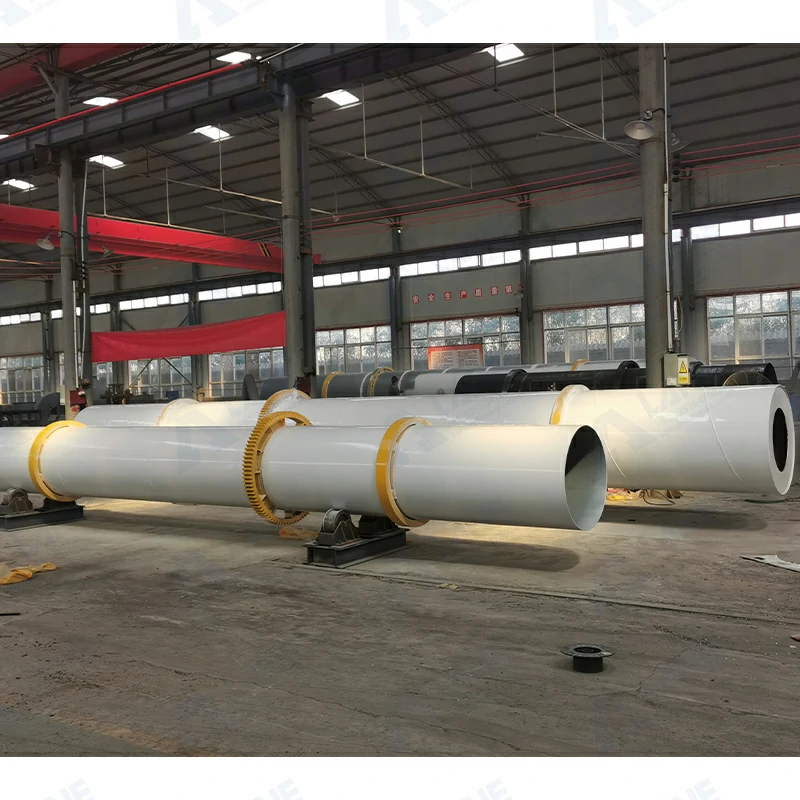
All adjustment methods are summarized from front-line machine operation experience, which can be operated directly by factory equipment operators.
No complex professional calculation is required for parameter adjustment.
• Adjust Rotary Drum Speed According to Initial Moisture of Raw Manure
Slow down the drum rotation speed when dealing with high-moisture manure compost.
Slower rotation prolongs the material staying time inside the cylinder for full dehydration.
Speed up the drum properly for low-moisture compost to lift daily processing capacity.
• Set Hot Air Temperature Based on Target Finished Moisture Index
Set hot air temperature below 120℃ if you need to retain active organic nutrients in compost.
Properly raise hot air temperature only when customers only need fast dehydration without high nutrient retention demand.
Two temperature modes correspond to two different organic fertilizer product positioning.
• Clean Adhered Manure on Inner Lifting Plates on A Regular Cycle
Arrange a short shutdown for cleaning accumulated manure on the cylinder wall and lifting plates every 15 days.
Thick manure buildup will block the lifting action of plates and reduce heat exchange efficiency.
Regular cleaning keeps the long-term drying efficiency of the rotary dryer stable.
Common On-site Fault Diagnosis for Manure Compost Drying Production
We list three frequent faults during dryer operation and give targeted solutions for on-site maintenance personnel to solve problems quickly.
• Severe Material Sticking on The Inner Wall Of Dryer Cylinder
Two main causes: incoming compost moisture is too high, or hot air supply temperature is insufficient.
Solutions: add pre-dehydration treatment for raw manure before feeding, or increase the heating power of the supporting hot blast stove.
• Excessively High Moisture of Discharged Dry Manure Compost
The problem comes from excessive feeding volume or insufficient hot air output of the hot blast stove.
Operators can cut down the feeding speed of the screw conveyor, or increase fuel supply to raise hot air temperature.
• Excessive Dust Emission at The Dryer Exhaust Flue Outlet
Over-high drying temperature makes fine manure powder form flying dust with exhaust gas.
Install cyclone dust removal equipment at the exhaust outlet, and lower the hot air temperature to avoid organic material scorching.
FAQ
Q1:What is the ideal moisture range after Manure Compost Drying for organic fertilizer granulation?
Answer: The most suitable moisture range for organic fertilizer granulation after Manure Compost Drying is 20% to 28%.
If you focus on hard round fertilizer pellets for long-term storage, we suggest controlling the final moisture between 22% and 25%.
We can adjust the dryer parameters to match your granulator model and finished fertilizer requirements.
Q2:Can a single rotary dryer complete Manure Compost Drying for multiple livestock manure types?
Answer: Yes, one LANE rotary dryer can handle compost from chicken, cow, pig and sheep manure freely.
You only adjust drum rotating speed and hot air temperature when switching manure raw materials.
No host machine modification or replacement is needed for different manure varieties.
Q3:How long is the investment payback cycle of rotary dryer for manure compost drying?
Answer: For medium-sized breeding fertilizer projects, the payback period is about 8 to 12 months.
The profit comes from saved freight, yard rent, fuel cost and reduced raw material scrapping loss.
Large-scale manure disposal projects can recover the equipment investment within 6 months.
Conclusion
Manure Compost Drying acts as an indispensable front-end process for livestock manure resource utilization to make organic fertilizer.
The LANE rotary drum dryer solves multiple core production pain points of wet manure compost including strong odor, granulator blockage, high transportation cost and organic nutrient loss, relying on stable dehydration performance, low daily maintenance cost and powerful raw material adaptability.
Whether you run a small-scale organic fertilizer processing factory or a super large breeding manure centralized disposal project, the complete drying production line can connect the whole industrial chain from front-end manure pretreatment to back-end fertilizer pellet forming smoothly.
It helps organic fertilizer manufacturers lift comprehensive finished product profit margin and achieve stable long-term production operation.