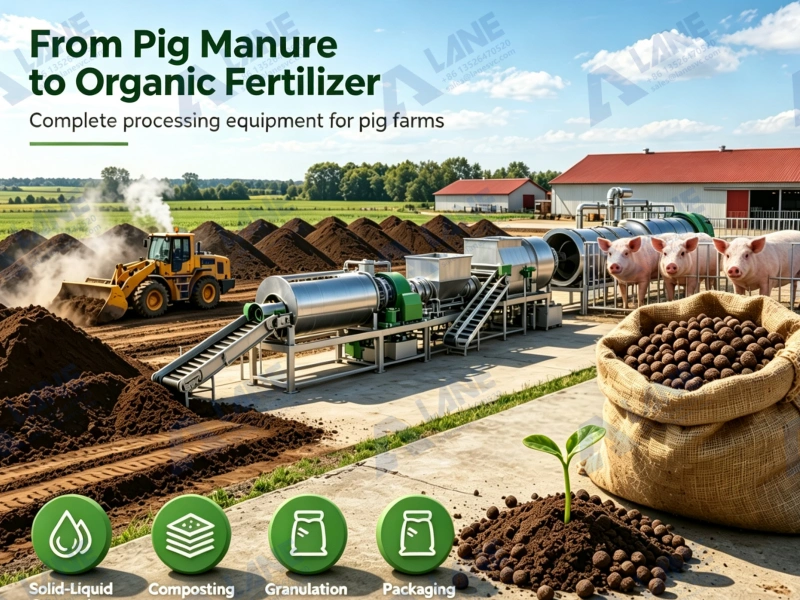
Material Moisture Control: How a Rotary Drum Dryer Improves Drying Performance in Production
Many fertilizer manufacturers face the problem of unstable raw materials every day. High-moisture organic fertilizer and compound fertilizer raw materials often have water content fluctuations on the production line.
If the moisture control is not in place, it will cause a series of failures in the granulation, maturation, and finished product storage stages. Many producers have tried simple drying methods, but they cannot stabilize the moisture index in large-scale production.
A reliable roller dryer can provide a feasible solution for stable material moisture control in the entire process of continuous fertilizer production.
Why Stable Material Moisture Control Matters for Fertilizer Manufacturing
Fertilizer granulation is extremely sensitive to water content. Tiny changes in raw material moisture will directly change particle forming effects on the production line.
Every production link after granulation, including drying, screening and packaging, relies on qualified material moisture control. Unregulated moisture breaks the whole production rhythm.
> High Raw Material Humidity Brings Common Production Troubles
Excess moisture inside raw materials makes it hard for powder materials to form regular round particles during granulation. Soft particles easily stick together and block granulator equipment.
When wet materials directly enter the follow-up process without proper drying, residues will accumulate inside conveying equipment. Operators need to stop production regularly to clean stuck materials.
> Unstable Moisture Shortens Fertilizer Shelf Life
Fertilizer particles with uneven moisture levels tend to absorb moisture from air after packaging. Agglomeration happens easily during long-term stockpiling.
Constant moisture exchange inside stacked fertilizer will accelerate the loss of active nutrients. Merchants cannot store finished goods for a long time before delivery.
> Poor Material Moisture Control Raises Overall Operation Costs
Frequent shutdowns to handle blocked equipment cut down total daily output. Every unplanned stop creates extra labor losses and wasted raw materials.
Manufacturers have to spend extra funds on auxiliary dehumidifying equipment if the main drying system cannot finish standard material moisture control.
Basic Working Logic of Rotary Drum Dryer for Material Moisture Control
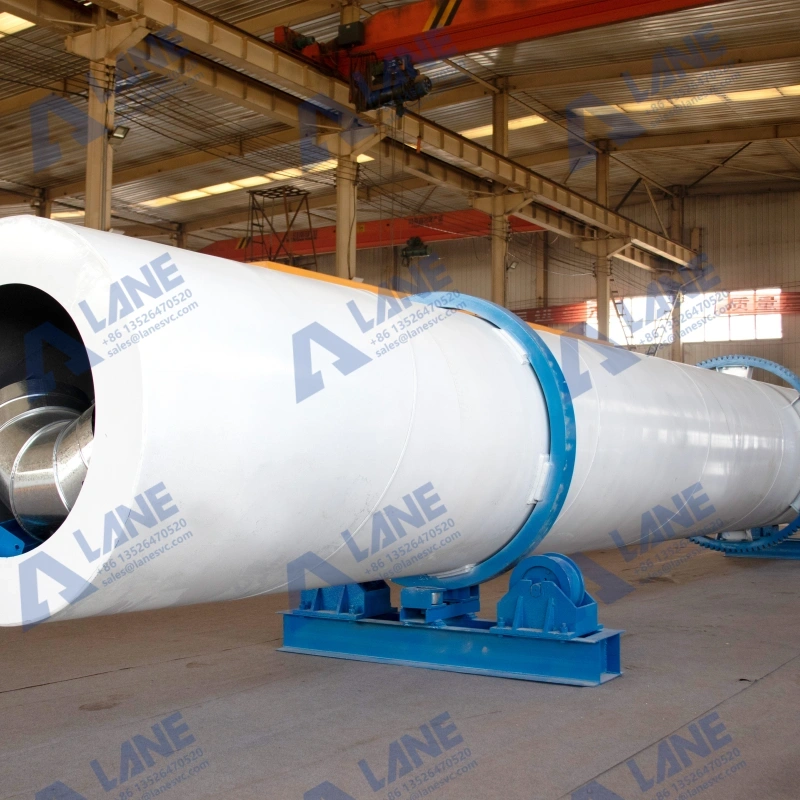
A rotary drum dryer completes material moisture control by thermal convection drying inside a rotating cylinder. The whole system works continuously to process large volumes of wet fertilizer raw materials.
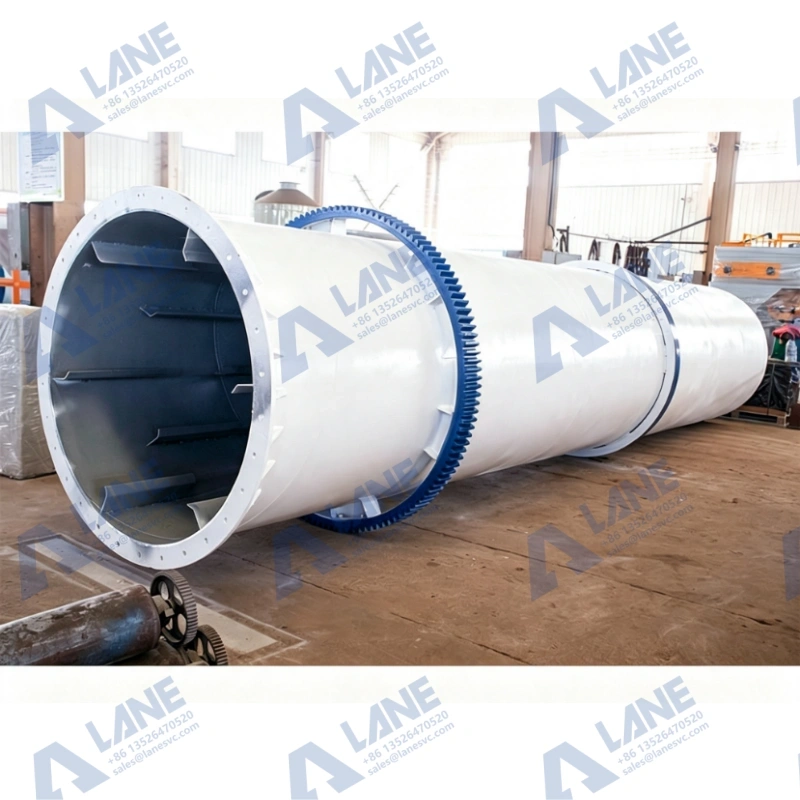
LANE rotary drum dryer integrates feeding unit, rotating cylinder, hot gas system and discharging unit into one complete set to finish steady dehydration tasks.
> Main Component Layout of LANE Rotary Drum Dryer
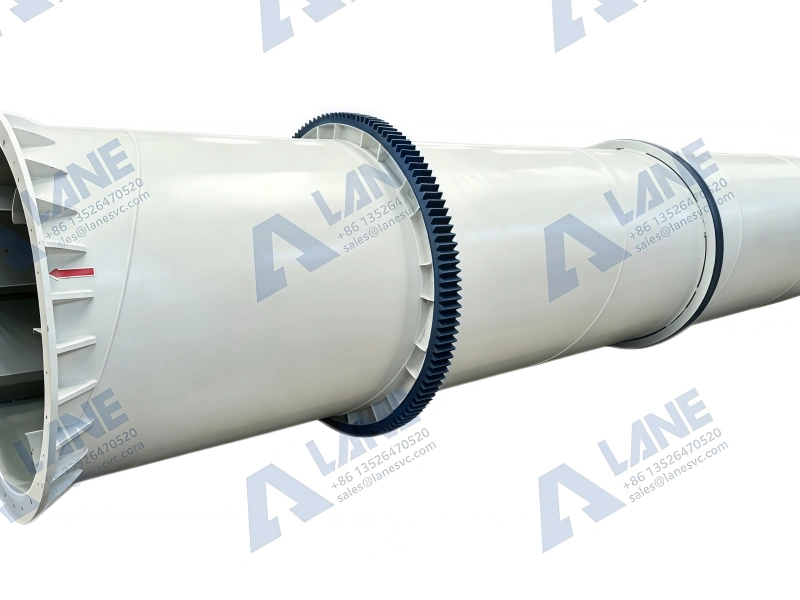
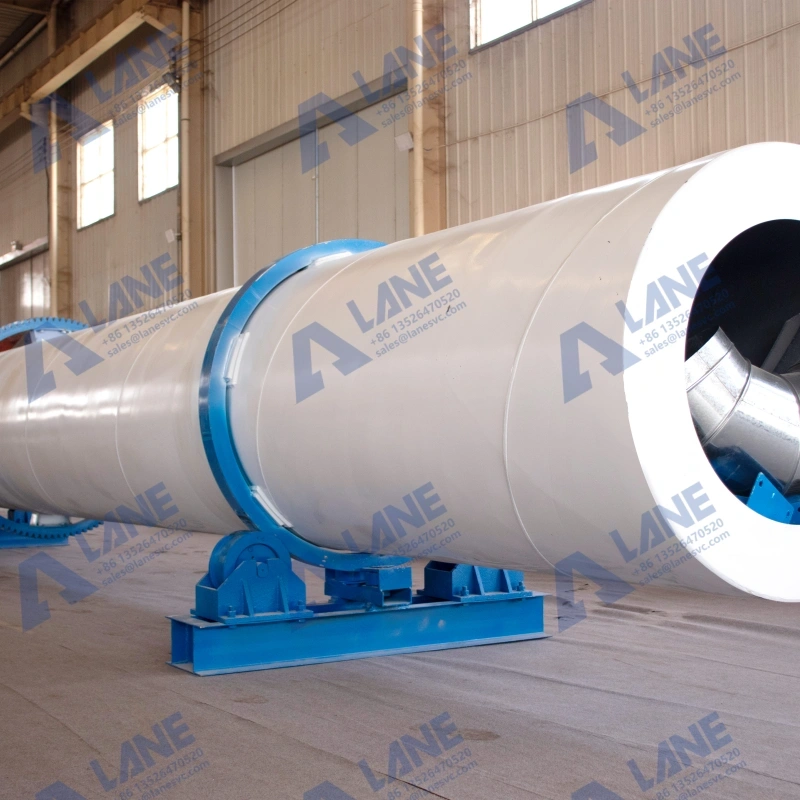
The bracket and transmission parts form the supporting and driving base of the whole machine. The bracket adopts medium carbon steel plate and channel steel welding structure.
Support wheels fixed on the bracket select anti-corrosion and wear-resistant materials. The transmission system uses motor, belt pulley and reducer to deliver stable power to the cylinder.
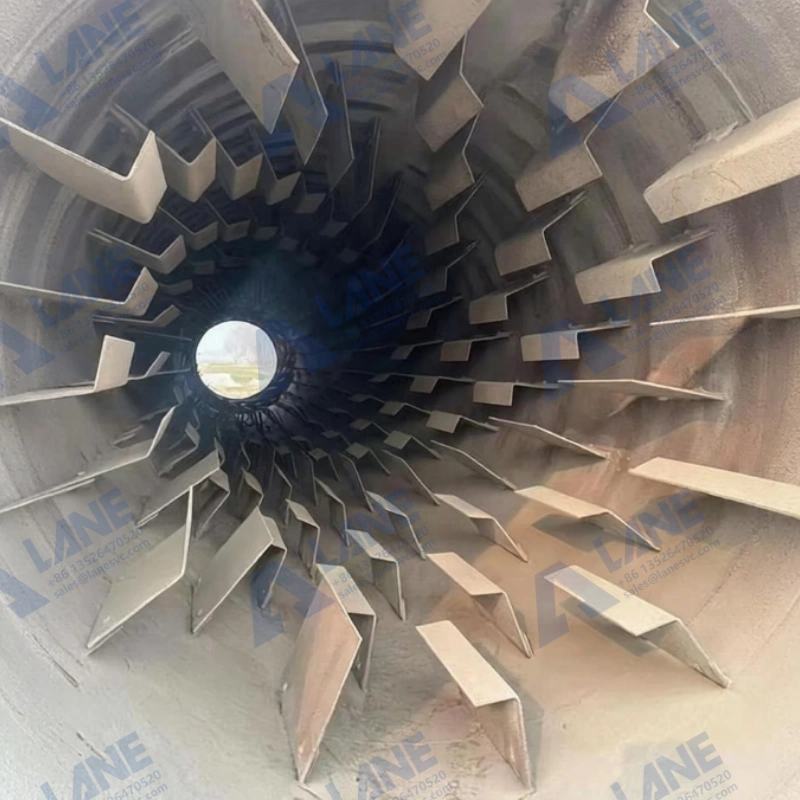
Rolling belts, large gear ring, cylinder body and built-in lifting plates constitute the core working section. Rolling belts on two sides support the full weight of rotating cylinder.
The large gear ring connects with driving pinion to push cylinder rotation. The cylinder body is welded by thick medium carbon steel, and internal lifting plates use wear-resistant plates to flip materials evenly.
> Heat Convection Mode Realises Continuous Drying
Wet fertilizer raw materials enter the rotary cylinder through the feeding device. Heated hot air flows into the cylinder and forms thermal convection with slowly turning materials.
Lifting plates lift raw materials repeatedly as the cylinder rotates. Materials fully contact hot air so internal water evaporates steadily to achieve qualified material moisture control.
> Matching Equipment You Need for Complete Material Moisture Control
A hot air furnace works together with the rotary drum dryer to supply stable hot air source. After drying, hot fertilizer particles need a rotary cooler for cooling treatment.
High-temperature dried particles are easy to absorb ambient moisture directly. Cooling before packaging avoids secondary moisture absorption and guarantees long-term storage.
| Model | Capacity(tph) | Drum Size(mm) | Rotation Speed(r/min) | Steel Plate Thickness(mm) | Lift Plate Thickness(mm) | Power(kw) |
|---|---|---|---|---|---|---|
| LARD0808 | 1-2 | Φ800*8000 | 5 | 8 | 4 | 5.5 |
| LARD1010 | 2-3 | Φ1000*10000 | 5 | 10 | 6 | 5.5 |
| LARD1212 | 3-5 | Φ1200*12000 | 5 | 10 | 6 | 7.5 |
| LARD1515 | 5-8 | Φ1500*15000 | 5 | 12 | 6 | 15 |
| LARD1616 | 8-12 | Φ1600*16000 | 5 | 12 | 6 | 18.5 |
| LARD1818 | 12-15 | Φ1800*18000 | 4 | 14 | 6 | 22 |
| LARD2020 | 20-25 | Φ2000*20000 | 4 | 14 | 6 | 37 |
| LARD2222 | 25-30 | Φ2200*22000 | 4 | 16 | 6 | 37 |
| LARD2424 | 30-35 | Φ2400*24000 | 4 | 16 | 6 | 45 |
| LARD2626 | 35-40 | Φ2600*26000 | 3 | 18 | 6 | 55 |
| LARD2828 | 40-45 | Φ2800*28000 | 3 | 18 | 6 | 75 |
| LARD3028 | 45-50 | Φ3000*28500 | 3 | 18 | 6 | 90 |
Practical Methods to Optimise Material Moisture Control on Rotary Drum Dryer
Many operators only adjust one single parameter and cannot get stable material moisture control effect. Synchronized adjustment of multiple parameters matches different raw material conditions.
All adjustments should be carried out slowly within the safe operating range of the rotary drum dryer. Operators record moisture test data to find the most suitable parameter combination.
> Adjust Feeding Speed According to Raw Material Status
If incoming materials carry higher humidity, slow down feeding speed properly. Longer retention time inside the cylinder helps remove excessive water steadily.
When raw material moisture stays low, the team can raise feeding speed within equipment rated capacity to lift overall production efficiency.
> Tune Rotary Speed to Achieve Uniform Material Heating
Excessively fast cylinder rotation stops materials from fully contacting hot air. Too low rotation speed leads to partial material overheating and uneven drying.
Adjust rotary speed to match feeding quantity. Lifting plates can flip materials continuously so every fertilizer particle gets even heat exchange.
> Adjust Hot Air Temperature Based on Target Moisture Value
Operators set hot air temperature according to the target finished moisture index. Do not blindly increase temperature to pursue faster dehydration speed.
Over-high hot air temperature may damage organic fertilizer active ingredients. Steady temperature setting helps realize consistent material moisture control for finished products.
Core Advantages of LANE Rotary Drum Dryer in Material Moisture Control
Many rotary dryers on the market face uneven drying and low heat utilization problems. Our equipment is developed based on years of compound fertilizer manufacturing experience.
LANE rotary drum dryer solves common dehydration pain points and supports stable long-term material moisture control for various fertilizer production lines.
> Reasonable Lifting Plate Design Boosts Heat Utilisation Rate
We optimize the layout and inclination angle of internal lifting plates. Materials can be fully scattered inside the cylinder instead of sliding at the bottom.
Better contact between materials and hot air improves heat utilization rate. It achieves uniform drying and reduces frequent internal cleaning work.
> Wear-resistant Carbon Steel Structure Adapts to Wet Fertilizer Raw Materials
The cylinder uses high-quality medium carbon steel welding. Wet manure and high-humidity compound raw materials will not cause quick corrosion to the main body.
Key moving parts adopt wear-resistant materials. The whole machine runs stably under long-term continuous working conditions for material moisture control.
> Flexible Operation Fits Multiple Types of Fertilizer Production Lines
Operators adjust feeding speed, cylinder rotation speed and hot air temperature freely. The dryer handles organic fertilizer, compound fertilizer and other granular fertilizer raw materials.
Whether small-scale new production lines or large-capacity mature factories, the equipment can be configured to meet customized material moisture control requirements.
FAQ
Q1: What is the range of initial moisture content that this rotary drum dryer can handle?
A1: It can process fertilizer raw materials with an initial moisture content ranging from 25% to 60%. Specific results depend on the type of raw material and the hot air system.
Q2: How much moisture can be removed from the fertilizer material in a single drying cycle?
A2: Typically, the system can reduce the material’s moisture content by 15% to 30% during a single continuous drying process. The final moisture content of qualified fertilizer granules can reach 8%–12%
Q3: Is it necessary to adjust equipment parameters when switching between different raw materials?
A3: Yes. Since raw materials such as poultry and livestock manure and compound fertilizer powder have different physical properties, the hot air temperature and feed rate must be adjusted to maintain a stable moisture content in the material.
Q4: Why do dried fertilizer granules still clump together?
A4: The main causes include uneven moisture content in the material after drying or the absence of a rotary cooling device. If packaging is performed before the granules are sufficiently cooled, the high-temperature granules will reabsorb moisture from the air and clump together.
Q5: What is the service life of the wear parts inside the drum?
A5: Under normal operating conditions, the service life of the lift plates can reach 1.5 to 3 years. The actual service life depends on the abrasiveness of the raw materials and routine maintenance practices.
How to Choose a Suitable Rotary Drum Dryer for Your Production Scale
Selecting the appropriate dryer specification directly determines whether you can achieve stable moisture control within your target production range. Many customers encounter operational issues due to choosing equipment that is either too large or too small.
Before finalizing the equipment model, confirm three key factors: daily production capacity, heating fuel options, and available installation space.
Determine the drum specifications based on daily production capacity. Compact models are suitable for small-scale production lines, while larger fertilizer plants require drums with greater diameter and length.
Choose the corresponding hot air system according to locally available fuel types. Customers can opt for coal-fired, gas-fired, or biomass-fired hot air furnaces to reduce operating costs.
Allow sufficient space for equipment installation and routine maintenance. Leave clear access pathways around the dryer so personnel can easily inspect lifting plates and drive components.
Conclusion
Stable material moisture control is always the core goal of fertilizer production line. The adapted drum dryer can continuously and uniformly remove water, reduce stoppage faults, and improve the quality of fertilizer products.
Lane customizes the drum dryer plan for organic fertilizer and compound fertilizer manufacturers. If you can provide raw material conditions, target capacity, and moisture index requirements, we can plan a complete drying system configuration scheme for you.