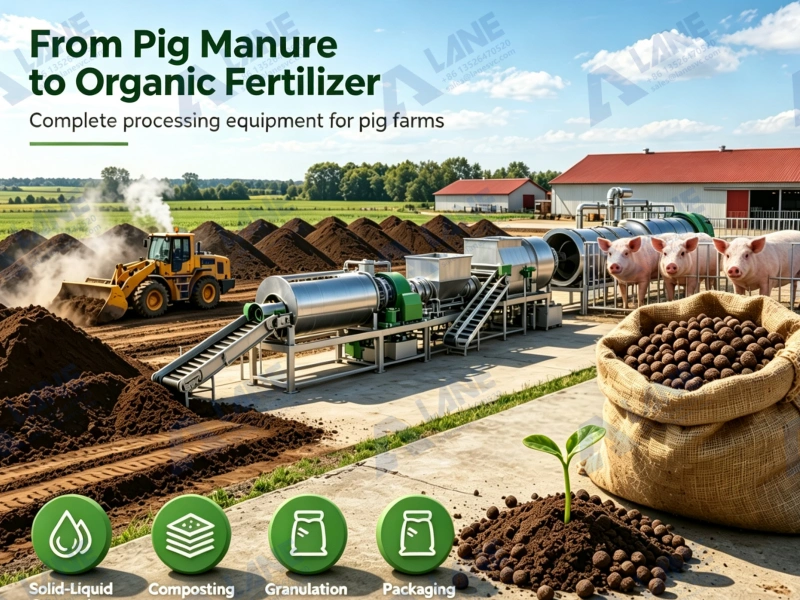
Pig Manure Fertilizer Granulation Problems: Causes and Solutions
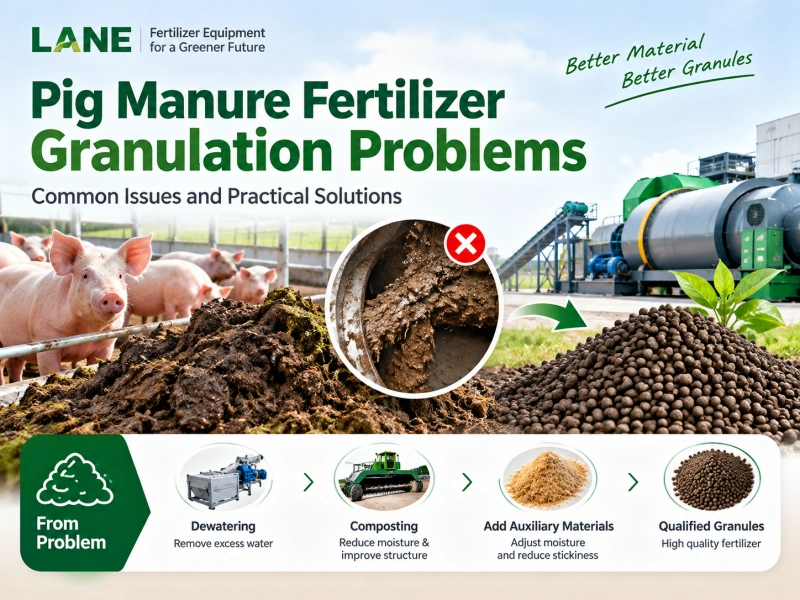
Pig manure can be used as a raw material for organic fertilizer, but turning fresh pig manure into qualified fertilizer granules is not simply a matter of adding a granulator.
In actual production, Pig Manure Fertilizer Granulation Problems usually occur at several very specific stages: excessive moisture, excessive stickiness, severe caking, insufficient granule strength, excessive moisture in the finished product, and interference from fibers and impurities.
These problems also have one thing in common:
When a granulator operates abnormally, it does not necessarily mean that the granulator itself has a problem.
In many cases, the real cause comes from material treatment before granulation, or from drying and cooling after granulation.
Therefore, when troubleshooting Pig Manure Fertilizer Granulation Problems, it is better to check the material condition in the same order that the material moves through the production line.
Problem 1: Excessive moisture causes material sticking and prevents granule formation
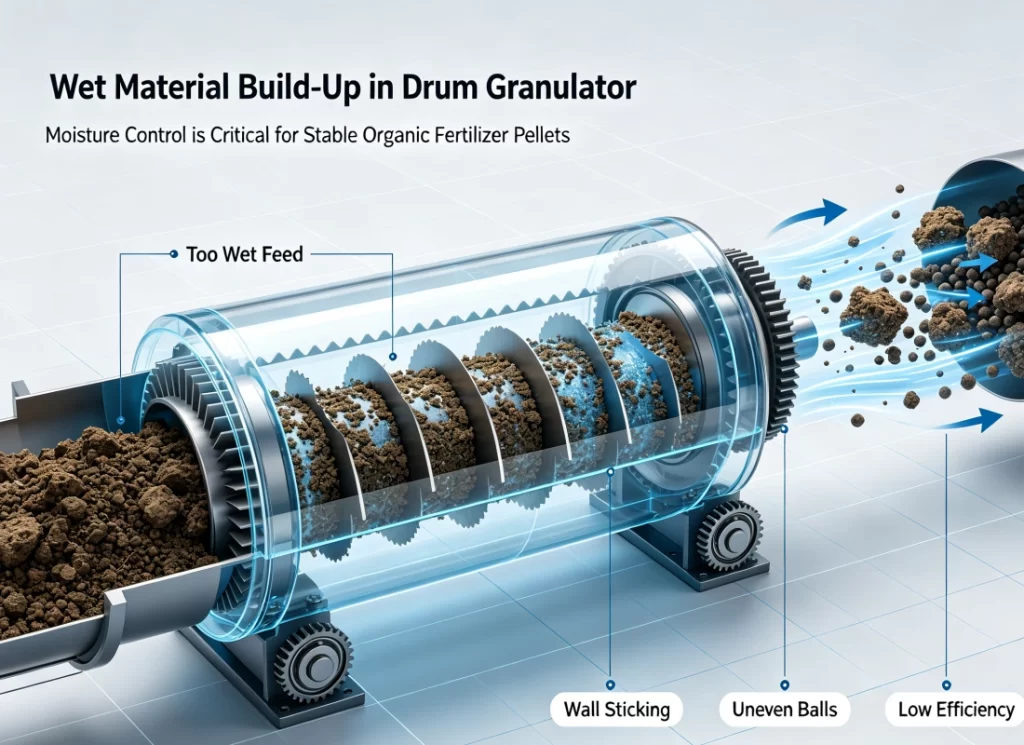
Fresh pig manure usually has a high moisture content. If it enters the granulator directly without proper dewatering and composting, the material can easily lose its flowability.
Several obvious symptoms may appear:
• Material sticks to the bottom of the pan or the inner wall of the drum;
• Material gradually builds up inside the granulator;
• Granules cannot form properly;
• A large amount of wet lumps appears in the discharge;
• Reducing the feeding rate improves the situation, but production capacity drops significantly.
The core reason is not that “pig manure cannot be granulated,” but that the material condition entering the granulator is unsuitable.
For many Pig Manure Fertilizer Granulation Problems, moisture should therefore be one of the first factors to check.
Solution: Three stages
1. Carry out mechanical dewatering first
Fresh pig manure should first have part of its free water removed.
Equipment: Solid-liquid separation equipment can be used to process pig manure from a high-moisture state into relatively stable wet material.
Common methods: Screw extrusion solid-liquid separation and screening-type solid-liquid separation.
Purpose: The goal is not to make pig manure extremely dry in one step, but to remove a large amount of free water and create better conditions for subsequent composting.
The basic process can be understood as:
Fresh pig manure → Solid-liquid separation → Wet material → Composting
2. Further reduce moisture through composting
After mechanical dewatering, pig manure should not automatically be considered suitable for granulation.
During composting, microbial activity generates heat while promoting moisture evaporation and organic matter decomposition.
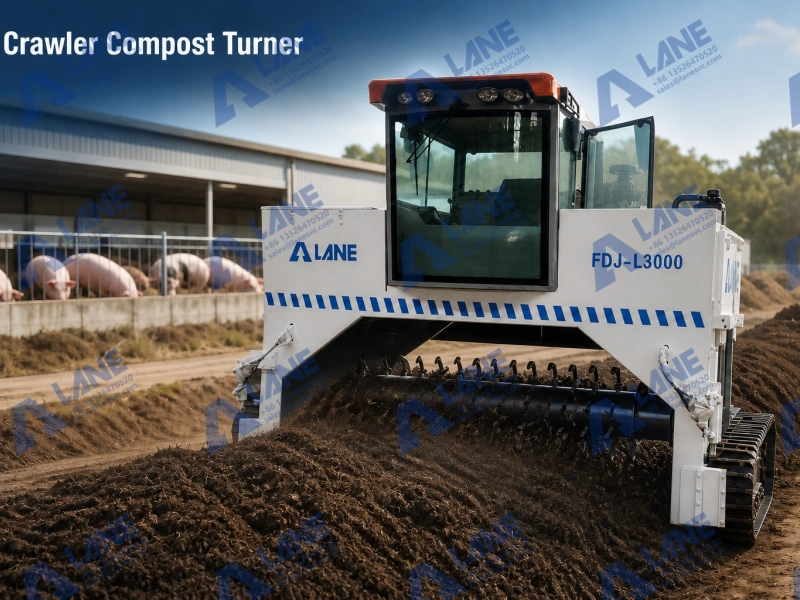
Proper ventilation and turning can help reduce moisture further and improve the loose structure of the material.
More importantly, the degree of decomposition directly affects material stickiness and granulation performance.
For Pig Manure Fertilizer Granulation Problems, this stage is particularly important because insufficient composting can make later granulation much more difficult.
Comparison:
Fresh pig manure → Easy to stick to the equipment
Fully composted pig manure → Much looser and less sticky
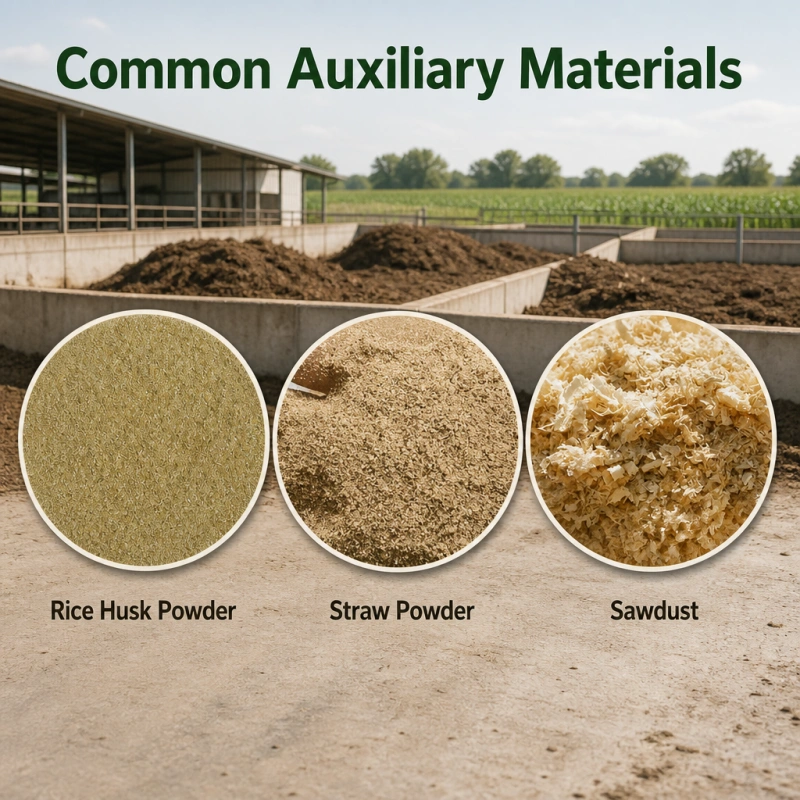
3. Make final adjustments with dry auxiliary materials
Suitable conditions:
• The material is still relatively wet after composting
• The moisture content has not reached the requirement for granulation
Common auxiliary materials:
• Rice husk powder
• Sawdust
• Straw powder
• Functions of auxiliary materials:
• Physical water absorption → Absorb excess free water from the material
• Structural adjustment → Create a stronger material framework and improve air permeability and looseness
• Reduce stickiness → Make originally sticky material looser and less likely to block the machine
However, auxiliary materials cannot be added without limits. Excessive addition can reduce the proportion of effective nutrients in the final fertilizer and may also change the granulation characteristics.
Therefore, a more reasonable approach is:
Measure initial moisture → Add a small proportion (such as 5%) for testing → Fully mix with a mixer → Allow the material to stand briefly for moisture balancing → Test moisture content again → Continue adding if the target is not reached
Instead of adding a large fixed amount immediately.
For Pig Manure Fertilizer Granulation Problems, moisture adjustment should be based on actual material conditions rather than a fixed formula.
Problem 2: Excessive stickiness causes material to adhere inside the equipment
Some pig manure has already been dewatered but still causes serious material sticking after entering the granulator.
This situation is not exactly the same as simply having “excessive moisture.”
Typical symptoms include:
Material enters the equipment → Material quickly sticks → Material buildup continues → Working components accumulate material → Motor load increases → Granulation becomes progressively worse
If severe sticking begins only after the equipment has been running for some time, the material’s stickiness and degree of decomposition should be checked carefully.
These are common Pig Manure Fertilizer Granulation Problems that cannot always be solved by simply reducing moisture.
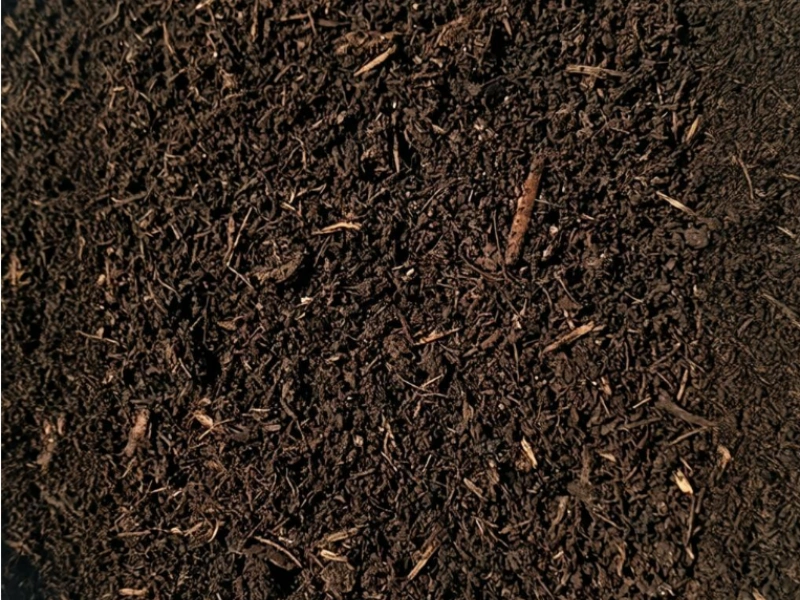
1. First check whether the pig manure is fully composted
Uncomposted pig manure contains more easily degradable organic matter and adhesive substances. The material remains wet and sticky, making it more likely to adhere to the equipment during granulation.
As composting continues, part of the easily degradable organic matter is further decomposed by microorganisms, and the material gradually changes from a wet, sticky state to a looser state.
Comparison:
Fresh pig manure → Easy to stick to the wall
Fully composted pig manure → Significantly looser and less sticky
Therefore, the problem should not automatically be attributed to the granulator.
First check the composting stage:
• Is the composting time sufficient?
• Is ventilation and turning sufficient?
• Has the required degree of decomposition been reached?
2. Use fibrous auxiliary materials to improve material structure
For pig manure with particularly strong stickiness, an appropriate amount of rice husk powder, sawdust, or straw powder can be added.
The purpose here is not only “water absorption.” More importantly, these materials create a certain fiber framework between the fine and sticky pig manure particles.
It can be understood as:
Sticky pig manure → Add fibrous material → Material is loosened → Contact area is reduced → Tendency to stick decreases
However, the fiber particle size cannot be too large. Long fibers can become entangled in the equipment, while excessively fine powder may lose some of its structural improvement effect.
Therefore, actual projects should conduct small-scale tests according to the condition of the pig manure rather than directly applying a fixed addition ratio.
This approach can also reduce Pig Manure Fertilizer Granulation Problems caused by unstable material structure.
3. Then check the anti-sticking structure of the granulator
If the material condition is already relatively stable but serious wall sticking still occurs, the equipment itself should be checked.
For example:
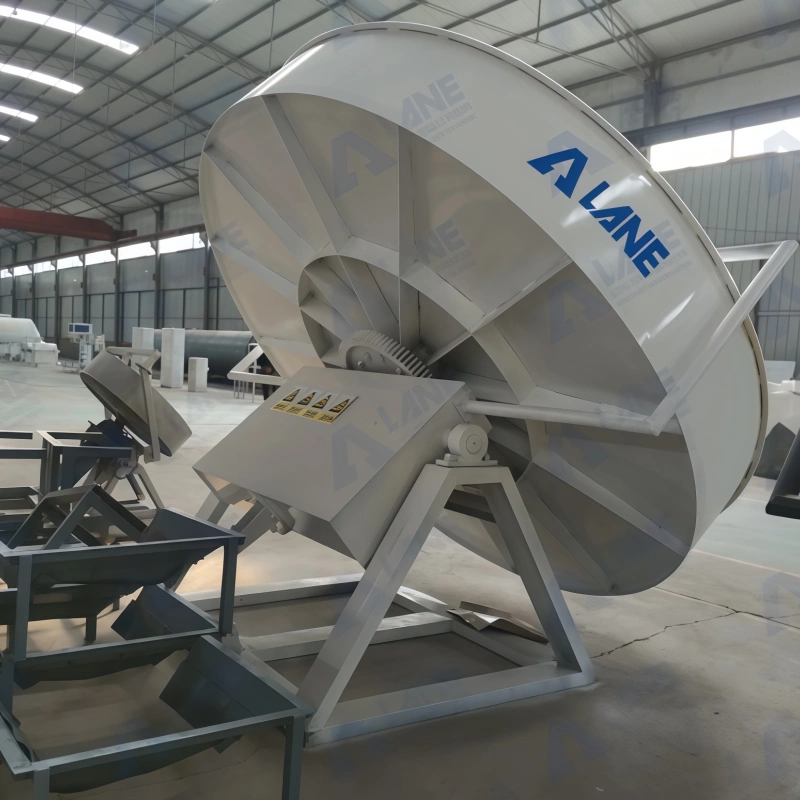
• A disc granulator can be equipped with a self-cleaning scraper structure to reduce continuous material accumulation on the bottom of the pan.
• For drum-type equipment, attention should be paid to the internal wall structure and the movement of material inside the drum.
At this stage, the troubleshooting logic should be:
• Is the material too wet?
• Is the composting insufficient?
• Is the auxiliary material structure unsuitable?
• Is the anti-sticking structure of the equipment properly matched?
This sequence is important when dealing with Pig Manure Fertilizer Granulation Problems, because changing machine parameters before stabilizing the material can only provide temporary improvement.
Problem 3: Material caking causes unstable feeding and large differences in granule size
Pig manure does not automatically become a uniform powder after composting.
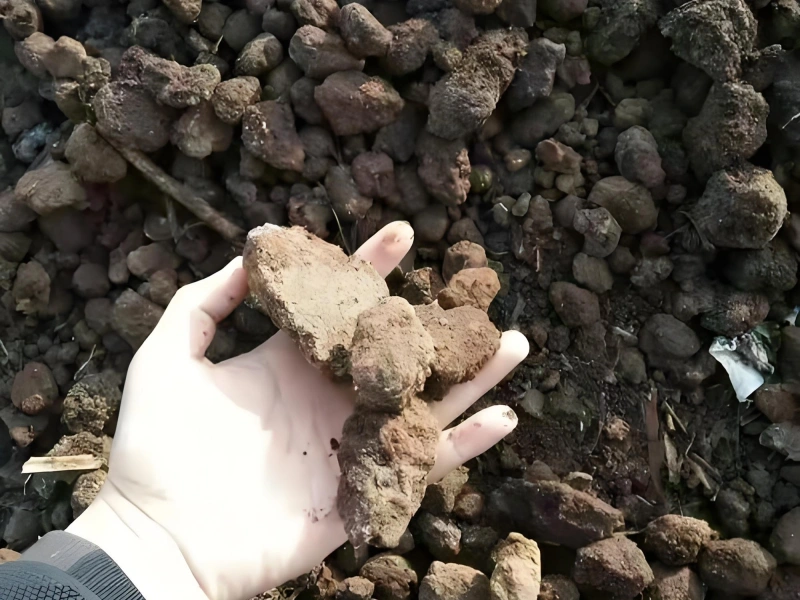
If composted material is stored for a long time after discharge, or if moisture is unevenly distributed during composting, lumps of different sizes can easily form.
Material that is already dry on the outside but remains wet inside is particularly likely to form hard lumps.
When it enters the granulator, the following can occur:
Large lumps → Uneven feeding → Local overfeeding → Fluctuation in granule size
This type of Pig Manure Fertilizer Granulation Problems should be addressed before granulation.
1. Break up the material after composting
After composting is completed, do not directly send large lumps into the granulator.
First, obvious large lumps should be broken apart.
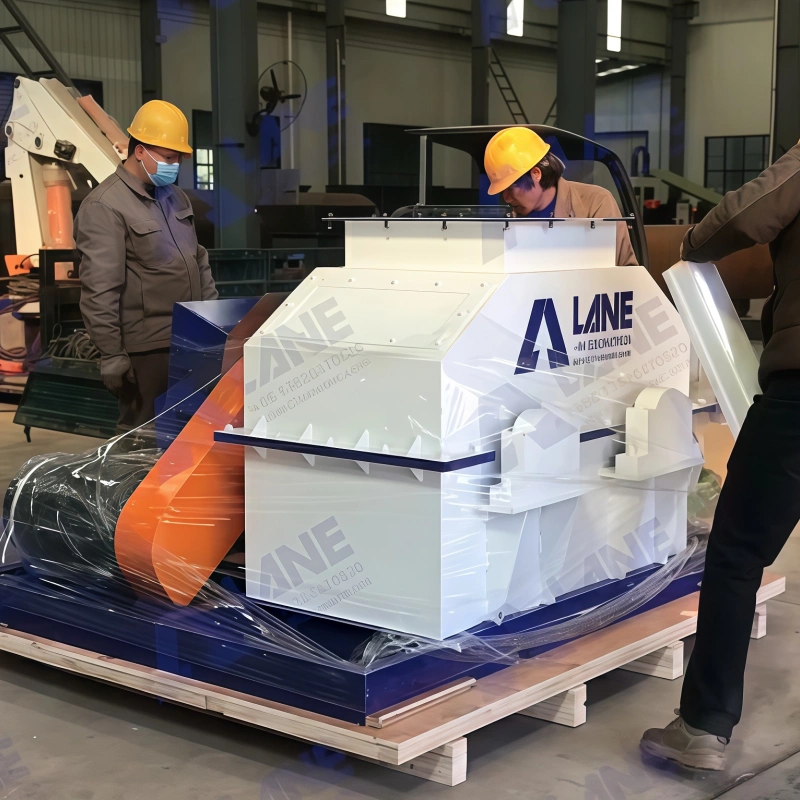
2. Use a semi-wet material crusher
If the pig manure still contains a certain amount of moisture, a semi-wet material crusher can be used.
Its purpose is not to make the pig manure as fine as possible, but to:
Remove large lumps → Uniform material size → Improve mixing → Stabilize granulator feeding
For organic materials such as pig manure, excessive crushing is not necessary.
What really needs to be controlled is:
There should be no obvious large lumps, while the material should remain suitable for uniform mixing.
This is another important control point for Pig Manure Fertilizer Granulation Problems.
3. Mix the material after crushing
If other organic materials or mineral nutrients need to be added to the pig manure, thorough mixing should be carried out after crushing.
A fertilizer mixer can be used .
Moisture distribution requires particular attention here.
For example, the average moisture content of one batch of pig manure may appear suitable, but if the batch contains obvious wet lumps, the granulator can still produce some granules that are too wet and others that are too dry.
Therefore, what really needs to be controlled is:
Average moisture content + Uniformity of moisture distribution.
For this reason, Pig Manure Fertilizer Granulation Problems should be evaluated based on both average moisture and material uniformity.
Problem 4: Granules form successfully but have low strength and break during transportation
This is a relatively easy type of Pig Manure Fertilizer Granulation Problems to overlook.
The granules may look completely normal immediately after leaving the granulator.
The real problem often appears later during conveying, drying, screening, packaging, and transportation.
For example:
Freshly discharged granules are intact
↓
Enter the dryer
↓
Granules are turned and collide with each other
↓
Weak granules begin to break
↓
The proportion of powder increases significantly after screening
Therefore, seeing that granules have “formed” does not necessarily mean the granulation process is successful.
1. First check the moisture before granulation
Moisture directly affects the bonding strength and internal structure of granules.
Moisture too low:
• There is insufficient bonding force between particles
• Powder cannot bind together effectively, resulting in a low granulation rate
Moisture too high:
• Material can easily form lumps, but the internal structure of the granules may remain loose
• Granules can shrink and crack during drying and break easily under impact
Correct approach:
• Determine the optimum moisture range for the specific formula through actual testing
• If the material is too dry, add water through spraying during mixing
Key points for water addition:
• Add water while mixing
• Add small amounts multiple times and distribute water evenly
• Do not pour in a large amount of water at once → This can easily create local wet lumps
When troubleshooting Pig Manure Fertilizer Granulation Problems, water should therefore be distributed evenly instead of being added all at once.
2. Check the residence time and forming conditions of the granulator
If material moisture is already stable but the granules are still loose, the operating parameters of the granulator should be checked.
For example:
• Is the feeding rate too high?
• Is the equipment speed appropriate?
• Is the residence time of the material inside the equipment sufficient?
• Are granules discharged too early after they have just started forming?
For a disc granulator, the disc inclination angle, rotational speed, and spraying amount should also be adjusted together.
Do not directly copy one fixed rotational speed or inclination angle. Different pig manure formulas have different moisture levels, particle sizes, and stickiness, so the same parameters cannot be applied to every project.
This is why parameter adjustment should be treated as part of the overall solution to Pig Manure Fertilizer Granulation Problems, rather than as a universal setting.
3. Check whether the drying process is breaking weak granules
If granules have acceptable strength immediately after leaving the granulator but powder increases significantly after entering the dryer, the drying stage should be checked.
The problem may not be:
“The granulator cannot produce granules.”
It may instead be:
“The granules are not strong enough to withstand the drying process.”
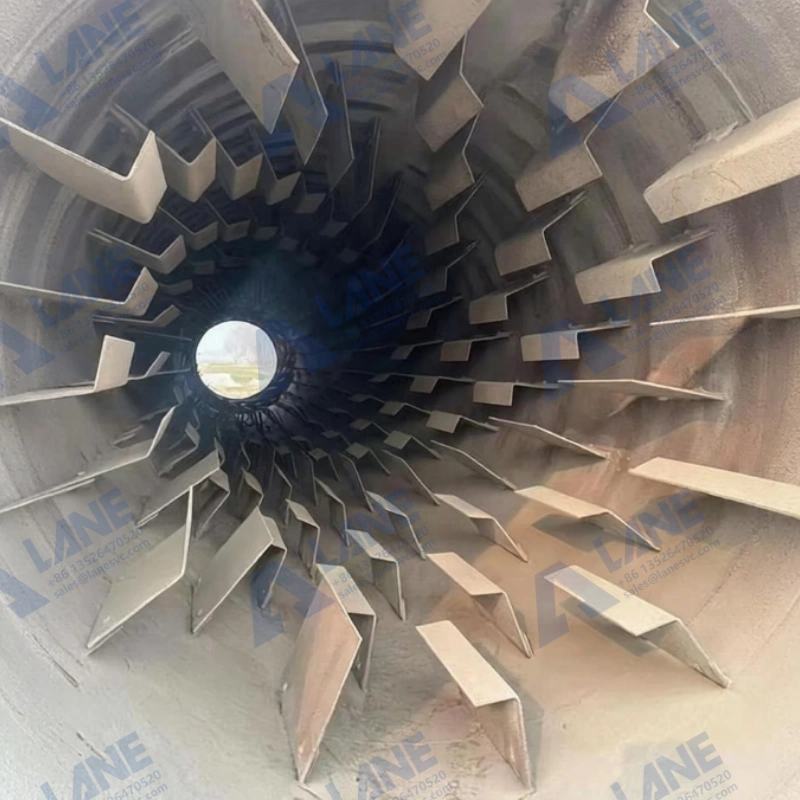
Turning inside the dryer, friction between materials, and hot-air impact can all damage the granules.
Possible solutions:
• Adjust the dryer speed to reduce the intensity of material movement
• Optimize the drying temperature curve to avoid cracking caused by rapid heating
• Reduce the angle and height of lifting plates inside the dryer
• If severe breakage continues after adjustment, return to the front-end process and improve granule strength
For Pig Manure Fertilizer Granulation Problems, the granulator and dryer should therefore be considered as one connected process rather than two completely independent machines.
Problem 5: Discharged granules are too wet and become caked during storage
After granulation is completed, the granules still contain a certain amount of moisture.
If they are packaged directly, especially under high-temperature conditions, moisture migration and caking can occur inside the bags.
Therefore:
Granulation completed ≠ Finished product completed.
This is another frequently overlooked category of Pig Manure Fertilizer Granulation Problems.
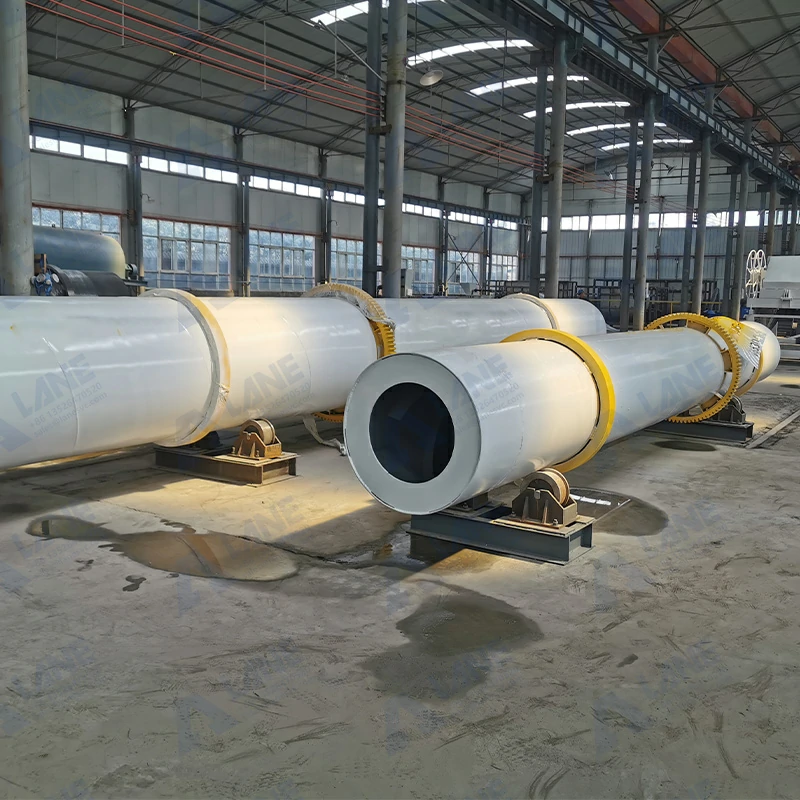
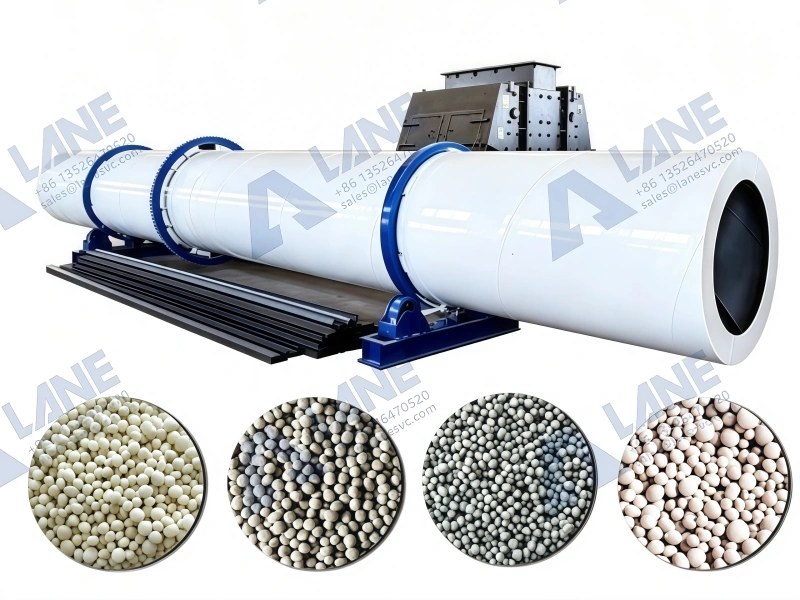
1. Use a rotary drum dryer to reduce final moisture
The wet granules after granulation can enter a rotary drum dryer .
The purpose of drying is not simply to pursue a high temperature, but to:
Reduce internal moisture steadily while minimizing granule breakage.
Therefore, the following factors need to be considered together:
• Feeding rate;
• Hot-air temperature;
• Drum rotational speed;
• Material residence time;
• Initial moisture content of the granules;
These parameters should be adjusted according to actual conditions.
If the drying intensity is too high, the surface of the granules may harden quickly while internal moisture cannot escape in time, which can lead to cracks later.
When solving Pig Manure Fertilizer Granulation Problems, the drying process should therefore focus on both moisture removal and granule protection.
2. Cooling is required after drying
The temperature of the fertilizer granules remains relatively high after drying.
If hot granules enter the packaging bags directly, condensation can occur as the product temperature falls.
Therefore, the material should enter a rotary cooler.
Cooling has two purposes:
• Reduce product temperature
• Further stabilize granule structure
After cooling is completed, the material can proceed to screening and packaging, which can significantly reduce the risk of caking during storage.
This post-granulation treatment is an important part of controlling Pig Manure Fertilizer Granulation Problems.
3. Screening should not be skipped
After drying and cooling, a rotary screener should be used to classify the granules.
Screening mainly solves three problems:
• Large granules;
• Qualified granules;
• Powder and undersized granules.
• Qualified granules enter packaging.
Oversized and undersized material can be returned to the appropriate previous stage for further processing.
This helps maintain stable final product size and reduces Pig Manure Fertilizer Granulation Problems related to inconsistent particle size.
Problem 6: Excessive fibers and impurities cause equipment wear and unstable granulation
Fibers and impurities in pig manure can come from many sources.
For example:
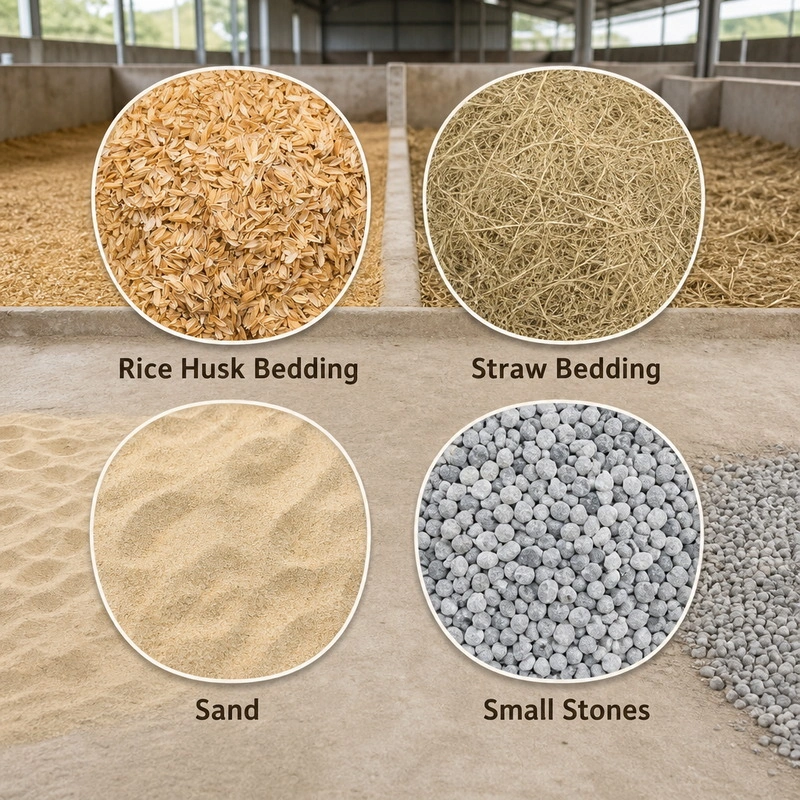
• Rice husk bedding;
• Straw bedding;
• Undigested coarse fibers;
• Sand;
• Small stones;
• Other foreign materials from livestock housing.
Among them, long fibers and hard impurities generally have the greatest impact.
1. Long fibers can become entangled
If pig manure contains long straw or bedding fibers, they may become entangled during crushing and granulation.
The result can be:
Fiber entanglement → Increased equipment resistance → Abnormal feeding → Unstable granulation
If the fiber content is high, cutting and crushing should be carried out at the front end.
This can prevent another common category of Pig Manure Fertilizer Granulation Problems before the material reaches the granulator.
2. Sand and stones increase equipment wear
Sand and stones may not directly cause wall sticking like excessive moisture does, but they increase wear on crushers and granulation equipment.
Especially when they enter critical working components such as rollers and dies, hard impurities can cause significant damage.
Therefore, pig manure projects with high sand content should include an impurity-removal stage.
3. Coarse screening should be placed at the front end
For obvious large foreign materials, coarse screening can be added at the front end.
Separate:
Large foreign materials → Remove
Qualified material → Continue to composting and crushing
This reduces the load on downstream equipment and helps prevent Pig Manure Fertilizer Granulation Problems caused by unwanted materials.
How should Pig Manure Fertilizer Granulation Problems be systematically investigated?
If the granulator suddenly develops a problem, it is not recommended to immediately adjust the machine parameters.
A better troubleshooting sequence is:
First step: Check moisture
Is the material too wet? Are there local wet lumps?
↓
Second step: Check decomposition
Has the pig manure been fully composted? Is the material still obviously sticky?
↓
Third step: Check particle size
Are there large lumps? Is crushing sufficient?
↓
Fourth step: Check mixing
Are the pig manure and auxiliary materials actually mixed evenly?
↓
Fifth step: Check feeding
Is the material entering the granulator continuously and steadily?
↓
Sixth step: Check the granulator
Then adjust rotational speed, inclination angle, spraying amount, feeding rate, and other parameters.
↓
Seventh step: Check post-treatment
Are the granules being broken during drying, cooling, or screening?
This sequence is very important.
If the raw material itself has problems, simply adjusting the granulator parameters may only provide temporary relief and cannot truly solve Pig Manure Fertilizer Granulation Problems.
How should a pig manure fertilizer granulation process be configured?
A complete pig manure fertilizer granulation process can be configured step by step according to the material condition:
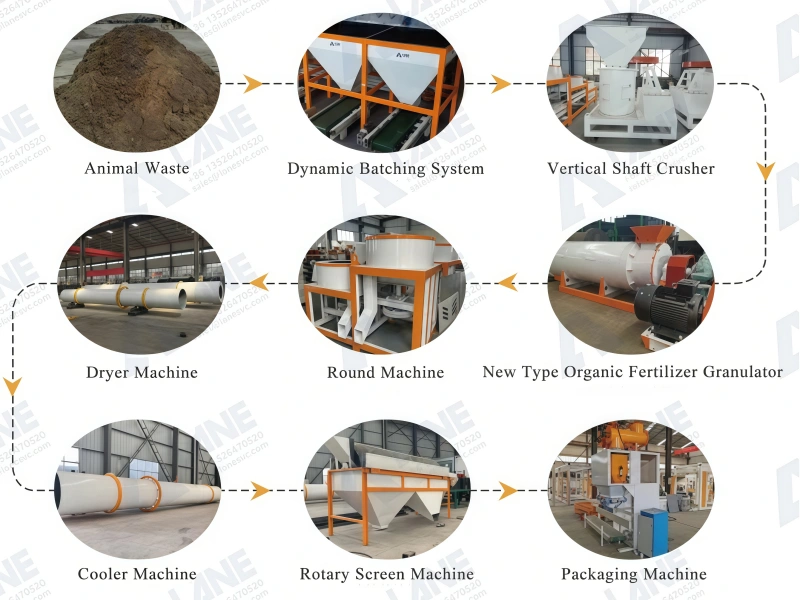
Fresh pig manure → Solid-liquid separation / Dewatering (Dewatering removes excess free water) → Composting and decomposition (Composting improves the decomposition degree and material condition of pig manure)
→ Crushing (Crushing solves caking and particle-size problems) → Batching and mixing (Mixing solves formula and moisture-distribution problems) → Moisture adjustment
→ Fertilizer granulation (Granulation is responsible for forming the granules) → Rotary drum drying (Drying further reduces moisture) → Cooling (Cooling reduces product temperature) →
Screening (Screening controls final particle size) → Packaging
This complete process is important because Pig Manure Fertilizer Granulation Problems can originate from almost any stage before or after granulation.
How does LANE configure pig manure fertilizer granulation equipment?
For pig manure fertilizer projects, LANE Machinery is more suitable for matching equipment according to the actual raw material conditions rather than directly applying one fixed configuration.
For example:
• Pig manure has a high moisture content
→ First consider dewatering and composting
• Large lumps appear after composting
→ Configure a fertilizer crusher
• Auxiliary materials or other nutrients need to be added
→ Configure a fertilizer mixer
• Material condition becomes stable before granulation
→ Configure a fertilizer granulator
• Granules still have high moisture content
→ Configure a rotary drum dryer
• Granules remain hot after drying
→ Configure a rotary cooler
• Final granule size is inconsistent
→ Configure a rotary screener
The final equipment configuration should be determined by the actual condition of the pig manure.
If the raw material is particularly wet, front-end dewatering becomes more important.
If pig manure contains a large amount of bedding, crushing and impurity removal require greater attention.
If the final product requires a relatively uniform granule size, screening and the return-material system should not be omitted.
In other words, solving Pig Manure Fertilizer Granulation Problems is not about finding a “universal granulator,” but about allowing every stage to handle the problem it is designed to solve.
FAQ
Why does pig manure easily stick to the wall after entering the granulator?
The most common causes are excessive moisture, insufficient composting, or an excessive proportion of sticky material. For Pig Manure Fertilizer Granulation Problems, the front-end material condition should be checked first before deciding whether the formula or equipment structure needs adjustment.
Why should pig manure be crushed before granulation?
The main purpose is to break up large lumps formed after composting and make the particle size more uniform, which helps stabilize feeding and granulation. This can prevent Pig Manure Fertilizer Granulation Problems caused by uneven material size.
Why are pig manure granules normal immediately after granulation but break significantly during drying?
The granules may have insufficient strength, or the heat, residence time, or mechanical movement inside the dryer may be too strong. Both the granulation and drying stages should be checked when dealing with these Pig Manure Fertilizer Granulation Problems.
Can pig manure fertilizer be packaged directly after granulation?
Usually, this is not recommended. After granulation, the material normally needs to be dried according to the required final moisture content, then sufficiently cooled and screened before packaging. This helps prevent Pig Manure Fertilizer Granulation Problems related to caking and breakage during storage.
Should the granulator be adjusted first when Pig Manure Fertilizer Granulation Problems occur?
No.
A more reasonable troubleshooting sequence is:
Moisture → Composting → Particle size → Mixing → Feeding → Granulation parameters → Drying → Cooling → Screening
Only after confirming that the front-end material condition is stable will adjusting the granulator parameters be more meaningful.
Conclusion
Anyone involved in organic fertilizer production knows a common phenomenon: pig manure is more difficult to granulate than other raw materials. Many production lines operate smoothly with the same equipment when processing cow or chicken manure, but frequently shut down when handling pig manure. This isn’t due to poor equipment quality, but rather because pig manure has unique characteristics—such as high moisture content, excessive viscosity, fiber composition, and impurities—that easily lead to a series of pig manure fertilizer granulation problems.
LANE Company has specialized in organic fertilizer granulation equipment for over a decade and has been involved in numerous pig manure granulation projects. The most frequently reported pig manure fertilizer granulation issues from customers fall into six main categories: excessively high moisture, excessive stickiness, material clumping, loose pellets, overly wet discharge, and interference from fibers and impurities. Below, we analyze each issue in detail and provide practical solutions.