Cow dung is free, abundant, and nutrient-rich. In its raw form, however, it is bulky, wet, fibrous, and hard to handle as a commercial fertilizer product. For farms and fertilizer producers, the real challenge is not simply how to dispose of cow dung. It is how to turn an inconsistent manure stream into a stable product that can be processed, packed, transported, and sold.
Pelletizing changes that. A well-designed
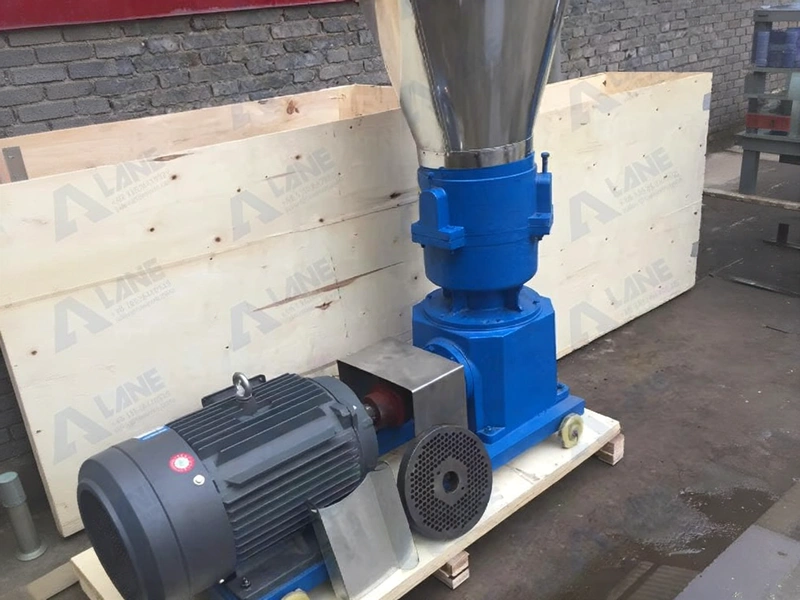
Cow Dung Pellet Making Machine can turn prepared cow dung into uniform organic fertilizer pellets with controlled size and moisture.
But do not pick the machine first and think about the raw material later. Moisture, fermentation status, particle size, fiber content, production capacity, and target pellet specifications should all determine the equipment configuration. This guide covers what cow dung needs before pelletizing, which pellet specifications to plan for, how the process works, how to choose a machine and a complete production line, what the project actually costs, and how to keep it running reliably.
Why Pelletize Cow Dung into Organic Fertilizer Pellets?
Cow dung has fertilizer value. But loose manure is not always convenient for commercial handling.
The main problems with loose cow dung:
• High moisture makes storage and transport more difficult.
• Irregular material size makes continuous feeding less stable.
• Fibrous material can affect crushing and pellet formation.
• Loose manure is hard to package into a standardized product.
• Different batches often have different moisture and physical characteristics.
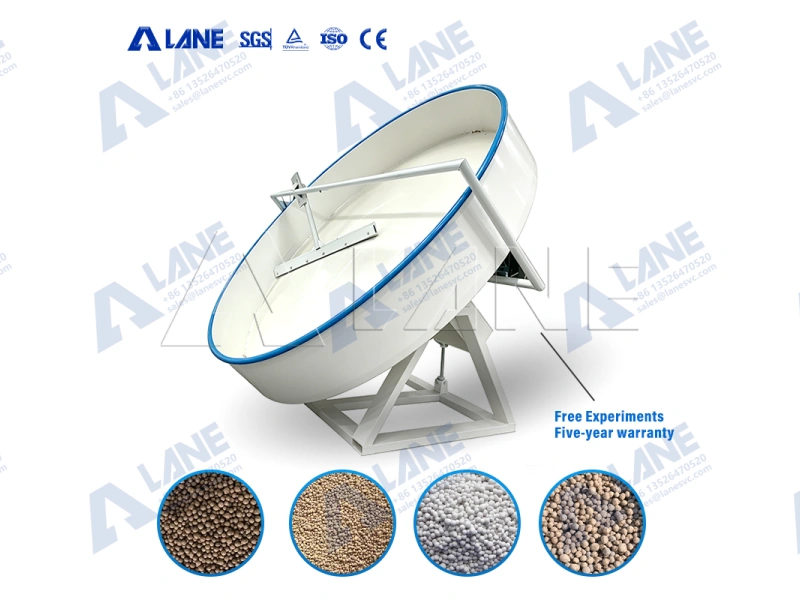
Pelletizing addresses the physical form of the material. A Cow Dung Pellet Making Machine compresses loose manure into a uniform fertilizer product that is easier to convey, screen, weigh, pack, store, transport, and apply. The goal is not simply to make cow dung round, but to turn a difficult-to-handle raw material into a consistent organic fertilizer product.
What Raw Material Condition Is Required Before Pelletizing?
Before choosing a Cow Dung Pellet Making Machine, check the actual condition of the cow dung. The four most important factors are moisture, fermentation status, particle size, and fiber content.
Moisture
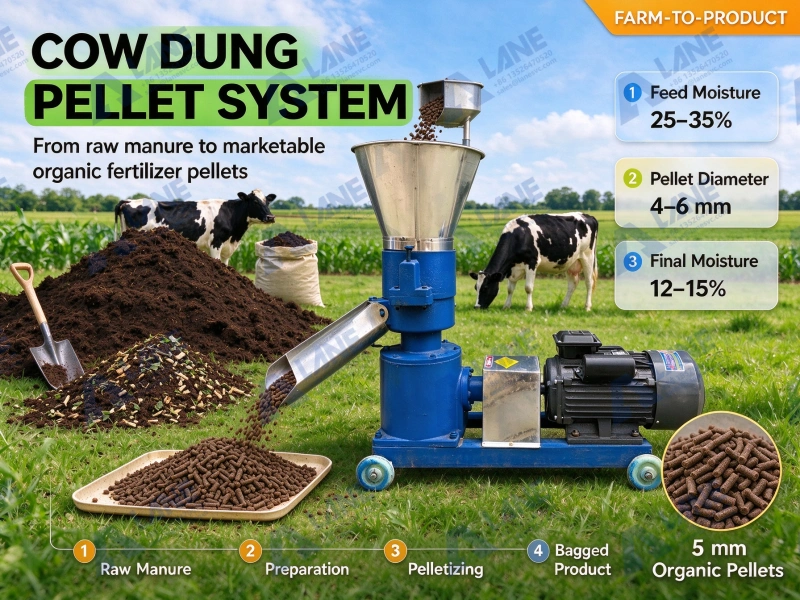
Moisture has a direct effect on feeding and pellet formation. For many organic fertilizer pelletizing processes, material entering the granulation section may be conditioned to roughly 25–35% moisture, although the suitable range depends on the selected granulation technology and formulation.
• Too much moisture can cause sticking, poor feeding, unstable pellet formation, and higher drying requirements.
• Material that is too dry can also struggle to form stable pellets.
So test moisture rather than estimate it from appearance, and confirm the reading fits the feed range your Cow Dung Pellet Making Machine can accept.
Fermentation status
Fresh cow dung and mature composted cow dung behave differently. Fresh manure may have excessive moisture and an unstable physical structure. Fermentation or composting can make the material more suitable for later processing.
The key question is not “How many days should cow dung be fermented?” It is “What condition does the material need to reach before it enters the pelletizing section?” The answer depends on the raw material, the production process, the final fertilizer, and the selected equipment. Reaching this condition decides whether fresh manure can be fed directly to a Cow Dung Pellet Making Machine.
Particle size
Large lumps and long fibers can interfere with continuous feeding. As a general project reference, material may be crushed to around 3–5 mm or smaller before pelletizing, depending on the machine and formulation.
The objective is not to make every particle extremely fine. It is to produce a sufficiently uniform feed so the Cow Dung Pellet Making Machine can form stable pellets.
Fiber content
Cow dung naturally contains fibrous material. If straw, rice husk, or crop residues are added, the fiber content increases further. This affects crushing requirements, mixing, feeding, compression, pellet strength, and pellet uniformity.
This is why a Cow Dung Pellet Making Machine selected for pure composted cow dung may not perform the same way on a high-fiber cow dung and straw mixture.
Can Fresh Cow Dung Be Pelletized Directly?
In most commercial fertilizer projects, fresh cow dung should not simply be fed straight into the Cow Dung Pellet Making Machine without checking its moisture and physical condition first.
• Fresh cow dung, moisture above 70%: not directly pelletizable — requires dewatering/fermentation + drying or moisture adjustment + crushing.
• Composted cow dung, around 30–40% moisture: depends on the process — crushing + moisture adjustment.
• Cow dung + straw: usually not directly — crushing + mixing + moisture adjustment.
• Prepared commercial organic fertilizer material: possible after testing — screening + moisture adjustment if required.
The exact process should be determined by the actual material. A producer working with fresh manure may need far more preparation than a fertilizer plant receiving mature compost. The Cow Dung Pellet Making Machine should be matched to the material entering the machine, not to the original manure collected from the farm. This is a common mistake in project planning: teams order a pelletizer for the manure they collect, then struggle to feed it the material they actually have.
What Size Should Cow Dung Fertilizer Pellets Be?
Pellet diameter is one of the first specifications to confirm before equipment selection, because it fixes the die and forming system of the Cow Dung Pellet Making Machine. Common commercial requirements include 4–6 mm, 5 mm, and 6–8 mm. Some pelletizing systems can produce a wider range, but the suitable diameter depends on the application and machine configuration.
Pellet size follows the application method, spreading equipment, packaging, customer preferences, target market, and formulation. A product for mechanical field application may differ from a retail organic fertilizer packed into small bags.
Pellet diameter is only one part of final product quality. As project reference values, many organic fertilizer processes aim for approximately 12–15% final moisture, while powder or fines may be controlled to a low level, often around <5% when a clean commercial pellet is required. Treat these figures as target ranges rather than universal standards.
As common project references: pellet diameter is typically 4–6 mm or 5 mm (or 6–8 mm for other applications), set by application, packaging, and market requirements; final moisture is about 12–15% for storage and product stability; powder/fines is often controlled below 5% for appearance and handling; and pellet uniformity means a consistent size distribution for packaging and application.
Confirm the final specification before choosing the Cow Dung Pellet Making Machine, cooling system, and screening equipment.
Pelletizing Technology Comparison: Which Machine Type Fits Your Project?
There is more than one way to form cow dung pellets, and the right Cow Dung Pellet Making Machine configuration depends on your material and target capacity. The table below compares the main options.
|
Technology
|
Typical capacity
|
Suitable feedstock
|
Die/pellet size
|
Investment
|
Best for
|
|
|
Small, below 1 t/h
|
Composted, drier material
|
Small diameters, flexible
|
Lower
|
Small farms, startups
|
|
Ring-die pelletizer
|
Medium to high, 1–5+ t/h
|
Continuous commercial feed
|
Stable medium sizes
|
Higher
|
Commercial lines
|
|
|
Medium, 1–3 t/h
|
Moist, sticky organic mixes
|
3–8 mm, round pellets
|
Medium
|
Wet granulation routes
|
|
Extrusion granulator
|
Small to medium
|
Wet mixtures, wide feedstock
|
Broad size range
|
Low–medium
|
Organic compost mixes
|
Do not choose on capacity alone. The flat-die system is commonly used for smaller-scale production, while the ring-die system is often considered for higher-throughput continuous production. Both are common configurations of a Cow Dung Pellet Making Machine. The decision should be based on the actual fertilizer material, capacity, pellet size, and operating requirements.
How Does a Cow Dung Pellet Making Machine Work?
The pelletizer is the forming section of the process, but a Cow Dung Pellet Making Machine does not operate independently. A typical production route is:
Cow dung preparation → Crushing → Mixing → Pelletizing → Cooling → Screening → Packaging
Preparation
Fresh manure may require fermentation, dewatering, drying, or other conditioning before pelletizing. Mature compost may require less preparation.
Crushing
The crusher breaks up large lumps and reduces the material to a more consistent particle size. This is particularly important when the cow dung contains dried lumps, long fibers, crop residues, or uneven compost particles.
Mixing
If cow dung is combined with straw, rice husk, other manure, or additional fertilizer ingredients, a mixer distributes the materials more evenly. A consistent mixture gives the pelletizer a more stable feed.
Pelletizing
The prepared material enters the Cow Dung Pellet Making Machine. Mechanical pressure compacts the prepared material and forms it through the selected die or forming system. The actual operating conditions depend on moisture, particle size, fiber content, formulation, pellet diameter, machine type, and required capacity.
Cooling
Fresh pellets may leave the forming section warmer than the surrounding environment. A cooling system reduces product temperature and prepares the pellets for screening and packaging. For commercial production, aim to cool the product close to ambient conditions before final packing rather than relying on one universal temperature number.
Screening
Screening separates qualified pellets from oversized particles, broken pellets, and fines. Depending on the process, off-size material can be returned to the production system.
Packaging
Once the pellets meet the required specifications, they can be weighed and packed. Packaging capacity should match the actual finished-product output rather than only the theoretical capacity of the pelletizer.
How to Choose the Right Cow Dung Pellet Making Machine
Equipment selection is a project decision, not a simple product purchase. Choose the right Cow Dung Pellet Making Machine according to raw material + capacity + pellet specification + complete process.
Start with the raw material
First determine: fresh or fermented cow dung? Moisture content? Fiber content? Particle size? Pure cow dung or mixed materials? Any additional fertilizer ingredients?
Determine the required capacity
Do not select a machine simply because the model has a large T/H number. Commercial pelletizing systems can cover small capacities below 1 t/h as well as several tons per hour, but actual output depends heavily on the raw material and operating conditions. Calculate the production target from available raw material → operating hours → required finished-product output.
Confirm the pellet diameter
If the target is 5 mm, the selected machine and die should be tested for that specification. If the customer requires 6–8 mm, the forming system needs to support that size consistently.
Check the upstream preparation
A powerful pelletizer cannot compensate for badly prepared cow dung. If the material is too wet, too coarse, or excessively fibrous, adjust the upstream equipment before changing the pelletizer.
Consider the downstream equipment
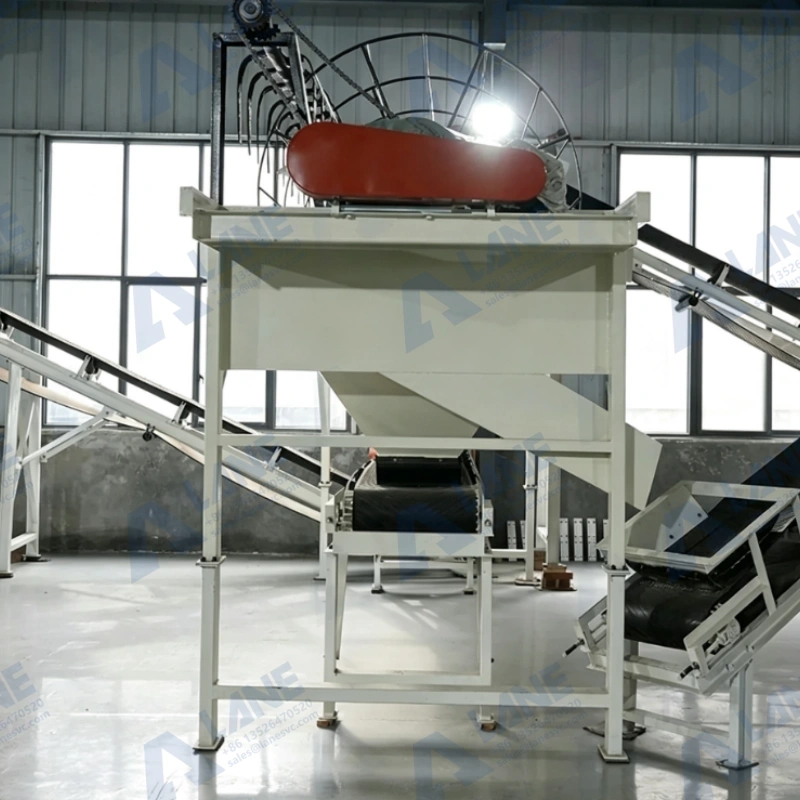
Match the pelletizer with the cooler, screen, return conveyor, coating system (if required), and packaging machine. For larger projects, dust collection, automatic weighing, conveying, and palletizing may also become necessary.
Machine selection by project scale
|
Project scale
|
Approx. target capacity
|
Typical pelletizing route
|
Main supporting equipment
|
|
Small farm
|
<1 t/h
|
Small-scale pelletizer
|
|
|
Medium project
|
1–3 t/h
|
Project-specific pelletizer
|
Fermentation + crushing + mixing + cooling + screening
|
|
Commercial project
|
3–5 t/h
|
Ring-die or other suitable commercial system
|
Complete preparation + pelletizing + cooling + screening
|
|
Large commercial plant
|
>5 t/h
|
Higher-capacity pelletizing system
|
Automated preparation + cooling + screening + packaging
|
These capacity ranges are for equipment-planning reference, not fixed machine classifications. Select the actual machine after raw-material testing.
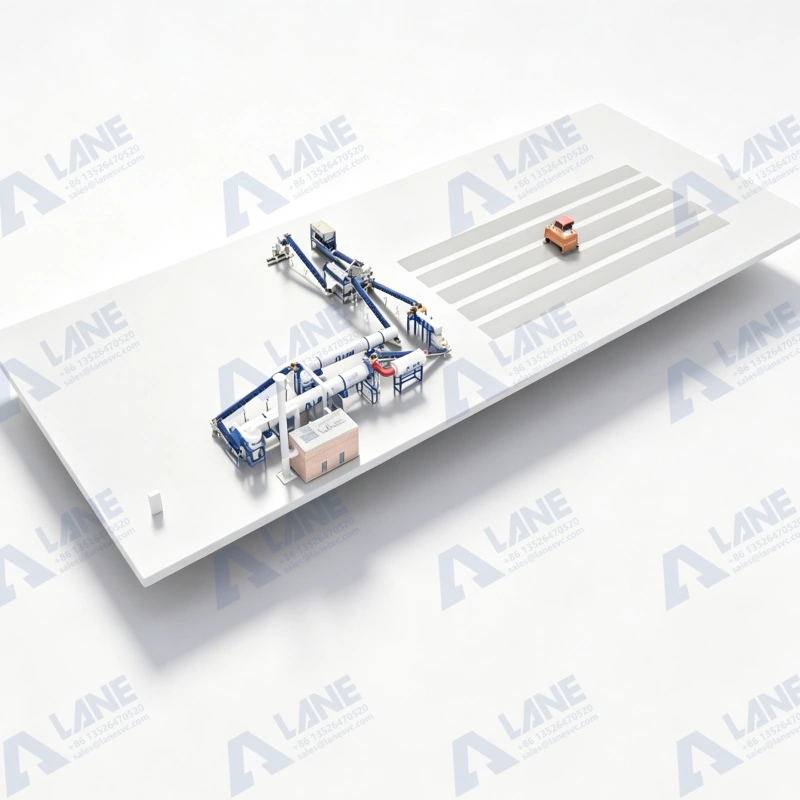
What Equipment Is Needed for a Complete Cow Dung Pellet Production Line?
A commercial project normally needs more than a Cow Dung Pellet Making Machine.
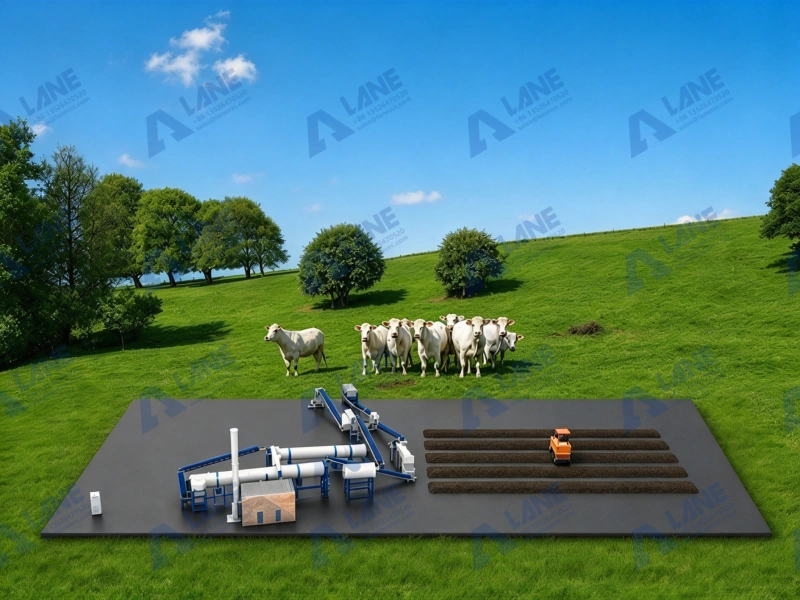
Upstream: prepare the cow dung. Depending on the raw material, this includes a fermentation system, dewatering equipment, crusher, screening equipment, mixer, and dryer or moisture-conditioning equipment.
Middle: form the fertilizer pellets. This includes the feeding system, pelletizing machine, and conveyors.
Downstream: stabilize and grade the product. This includes the cooler, screening machine, return system for fines, coating system (if required), and packaging machine.
The exact configuration depends on whether you process fresh manure, mature compost, mixed organic materials, or a formulated organic fertilizer. Design a complete line around the Cow Dung Pellet Making Machine from the raw material forward rather than selecting individual machines one by one.
Can Cow Dung Be Pelletized With Straw or Rice Husk?
Yes, but adding another organic material changes the processing conditions.
• Cow dung + straw: Straw can increase fiber content and may require additional crushing. The mixture should be sufficiently uniform before entering the pelletizer.
• Cow dung + rice husk: Rice husk can change the physical characteristics of the feedstock and therefore affect pellet formation. Its proportion should be determined according to the fertilizer formulation and target product.
• Cow dung + other organic materials: Other materials may be added to adjust organic matter, nutrient content, moisture, carbon-to-nitrogen balance, and physical pelletizing characteristics.
Adding more material does not automatically produce better pellets. Evaluate the final mixture for moisture, particle size, fiber content, formulation, and pellet quality before finalizing the production line and the Cow Dung Pellet Making Machine.
Finished Product Quality: Standards and Testing
Good pellets are the result of the entire process rather than the pelletizer alone:
Raw material (moisture + fermentation + fiber + particle size) → Process (crushing + mixing + conditioning + pelletizing + cooling) → Finished product (pellet diameter + moisture + uniformity + powder content).
A problem at the beginning of the process can appear as a problem at the pelletizer. Excessive moisture → unstable feeding or weak pellets. Excessive fiber → poor forming. Large particles → uneven pellets. Poor mixing → inconsistent product. Insufficient cooling → difficult packaging. Poor screening → excessive fines in the finished product.
To sell pellets commercially, define the quality target before production and test against it. The following indicators are common in organic fertilizer markets, though exact values depend on local standards and customer requirements.
• Organic matter content: 30–45%+ (check local rules) — reflects fertilizer value and grade.
• Total N-P-K: varies by formulation — nutrient content and labeling.
• Final moisture: about 12–15% — storage stability and weight.
• Powder/fines: below 5% for clean pellets — appearance and handling.
• Heavy metals: within local limits — safety and market access.
If you plan to export, check whether the product needs to meet an organic fertilizer standard or certification in the destination market. Prepare the product label with the guaranteed nutrient content, organic matter, moisture, and origin before you start selling.
Troubleshooting Common Cow Dung Pellet Problems
Most problems come from upstream material condition, not from the Cow Dung Pellet Making Machine itself. Use the table below as a starting point for diagnosis.
|
Problem
|
Likely cause
|
What to do
|
|
Machine blocks or stops feeding
|
Material too wet or too coarse
|
Reduce moisture, crush more, check feed rate
|
|
Pellets fall apart
|
Material too dry or lacks binder
|
Adjust moisture upward, test a binder
|
|
Too many fines/broken pellets
|
Poor mixing or excessive fiber
|
Improve crushing/mixing, adjust formulation
|
|
Uneven pellet size
|
Variable feed or worn die
|
Stabilize feed, inspect die/roller wear
|
|
Pellets hot or sticky after forming
|
Insufficient cooling
|
Check cooler capacity and airflow
|
|
Finished product has excess powder
|
Poor screening
|
Add/adjust screen, return fines to process
|
Keep a simple test record: feed moisture, pellet diameter, pellet strength, and fines percentage for each production run. This makes problems easier to trace back to the cause.
Investment, Operating Cost, and ROI
A Cow Dung Pellet Making Machine alone is not the full investment. The complete line, site, utilities, and labor all add up. Budget at the project level, not the machine level.
Typical cost components:
• Equipment: pelletizer, crusher, mixer, cooler, screen, conveyors, packaging line
• Site: building, concrete floors, power supply upgrade, ventilation
• Utilities and labor: electricity, water, fuel/drying energy, operators
• Running inputs: spare dies/rollers, maintenance, packaging bags
• Consumables: binder or additives if the formulation requires them
Costs and prices vary widely by region. If cow dung is available at low cost and there is a stable local market for organic fertilizer pellets, the economics can differ sharply from a project that must collect, transport, dry, and process manure from multiple farms. A reliable ROI calculation for a Cow Dung Pellet Making Machine line should use actual project data rather than a generic industry estimate.
Maintenance and Spare Parts
The die and rollers are the highest-wear parts on a Cow Dung Pellet Making Machine. Plan for their replacement from day one.
• Die: inspect for wear and blocked holes regularly; replace when pellet quality drops.
• Rollers: check clearance and wear; adjust or replace as needed.
• Bearings and gearbox: follow the manufacturer’s lubrication schedule.
• Screen: clean or replace worn mesh to keep fines under control.
• Spare parts: keep a set of common wear parts in stock to avoid long downtime.
Also check the raw material feed: a consistent, well-conditioned feed reduces wear on the forming parts. Maintenance cost per ton is often lower when moisture and particle size are controlled properly.
Environmental and Regulatory Considerations
Manure-based fertilizer projects often face environmental and regulatory requirements, especially in commercial settings.
• Odor and gas: fermentation and drying can produce ammonia and odor. Ventilation, biofilters, or covered fermentation can help.
• Wastewater: dewatering and washing produce liquid that may need treatment or controlled disposal.
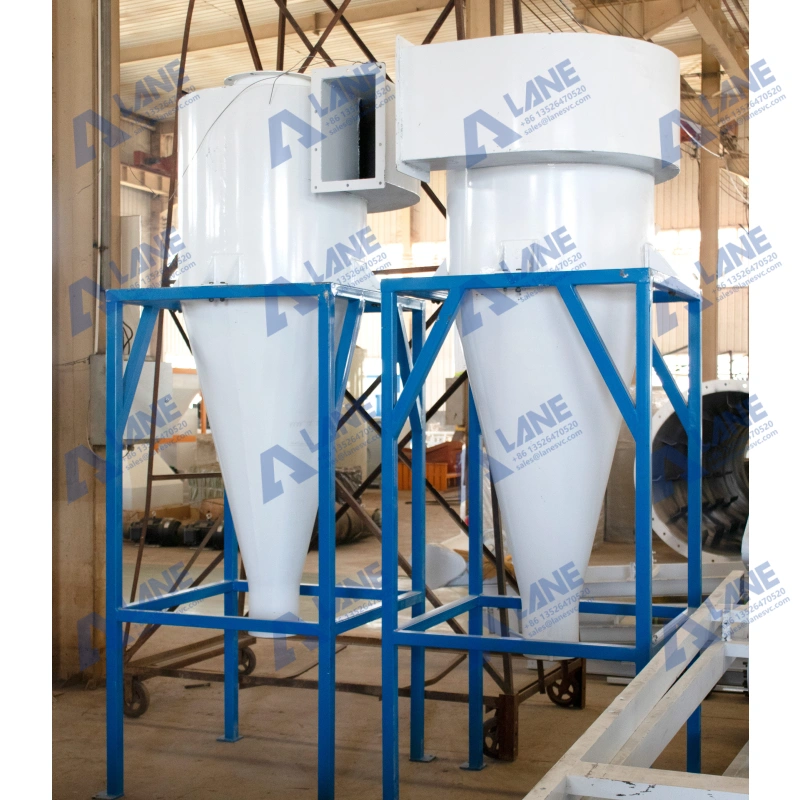
• Dust: crushing, conveying, and screening generate dust. A dust collection system protects workers and equipment.
• Manure resource utilization: in some regions, turning manure into fertilizer qualifies for policy support or subsidies. Check local incentives before committing.
Handle these items early, because they affect site layout, equipment selection, and the operating cost of a Cow Dung Pellet Making Machine line.
Frequently Asked Questions
How much does a cow dung pellet making machine cost?
There is no single price because the configuration depends on capacity, pellet diameter, raw-material condition, and whether upstream and downstream equipment are included. The Cow Dung Pellet Making Machine itself is only one cost item. A small standalone machine and a complete 3–5 t/h production line can have very different investment requirements.
What is the ideal moisture for cow dung pelletizing?
For many organic fertilizer processes, material entering the granulation section may be conditioned to around 25–35% moisture, but the suitable range depends on the selected technology and formulation. Test the material before final equipment selection.
Can I pelletize fresh cow dung without fermentation?
Fresh cow dung should not be assumed to be directly pelletizable. If it has excessive moisture or an unsuitable physical structure, fermentation, dewatering, drying, crushing, or other conditioning may be required first.
What is the difference between flat-die and ring-die pellet machines?
Flat-die systems are commonly used for smaller-scale production, while ring-die systems are often considered for higher-throughput continuous production. Base the choice on the actual fertilizer material, capacity, pellet size, and operating requirements rather than capacity alone.
How many tons per hour can a small cow dung pellet line produce? Small projects can range from below 1 t/h upward, while commercial systems can reach several tons per hour. Actual finished output depends on raw-material preparation, pellet diameter, moisture, machine configuration, and operating conditions.
Do I need a binder to make cow dung pellets?
Not necessarily. Some formulations can form pellets without an additional binder, while others may require additives depending on the raw material and desired pellet strength. Whether the Cow Dung Pellet Making Machine needs a binder depends on the material test rather than the machine model.
What is the ROI of a cow dung pellet production line?
ROI depends heavily on raw-material cost, production capacity, energy consumption, labor, packaging, fertilizer selling price, and equipment investment. Use actual project data rather than a generic industry estimate.
Conclusion: From Cow Dung to Marketable Organic Fertilizer Pellets
A Cow Dung Pellet Making Machine can turn prepared cow dung into a more uniform and commercially manageable organic fertilizer product. But the pelletizer itself is not the starting point.
The correct sequence is:
• Analyze the cow dung.
• Determine moisture and fermentation requirements.
• Control particle size and fiber content.
• Define the target pellet diameter.
• Determine the required production capacity.
• Select the pelletizing system.
• Configure cooling, screening, and packaging.
• Set the quality standards and testing plan.
• Budget the investment and operating cost.
• Calculate the project economics from actual operating data.
The most important point is simple: do not choose a machine from a capacity chart alone. The right configuration depends on the cow dung you actually have and the fertilizer pellets you actually want to sell.
Not sure which configuration fits your cow dung? Send us your raw material details — moisture, daily volume, fermentation status, and target pellet size — and we can recommend a suitable machine and production-line configuration based on your actual conditions rather than a generic capacity chart.