

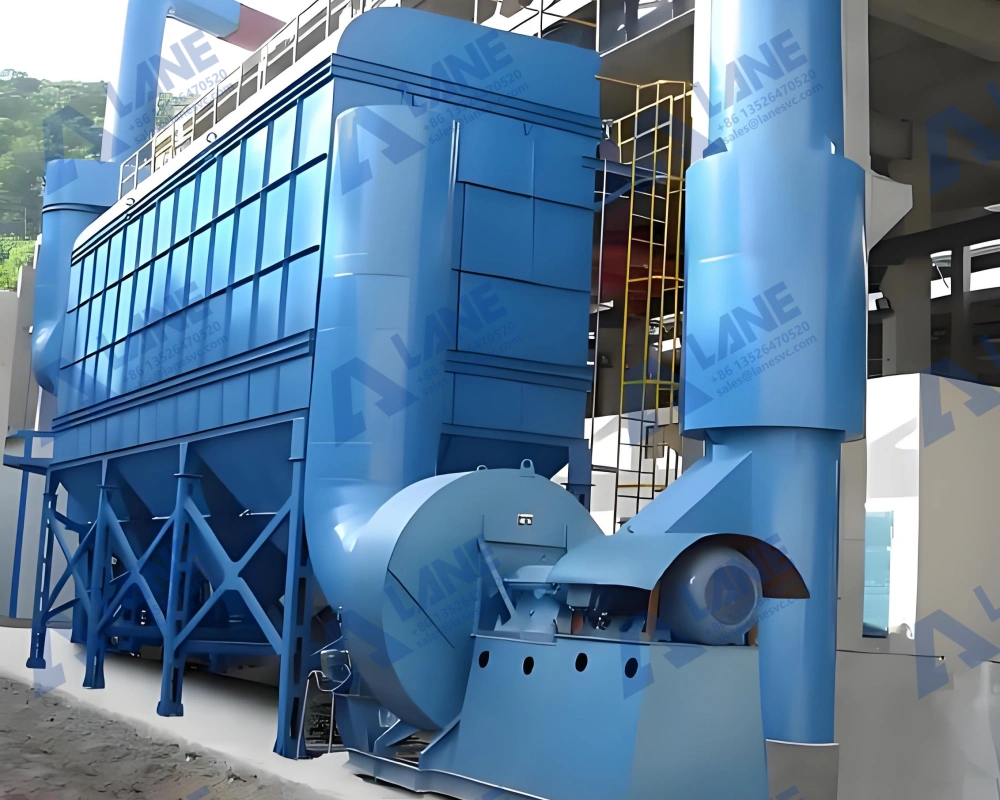
Fertilizer Baghouse Dust Collector
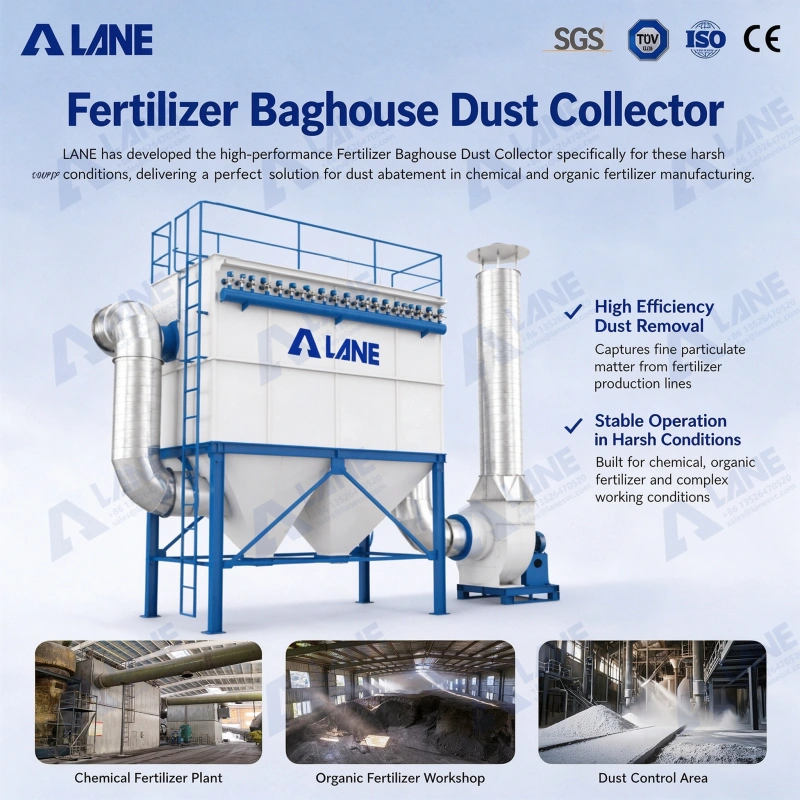
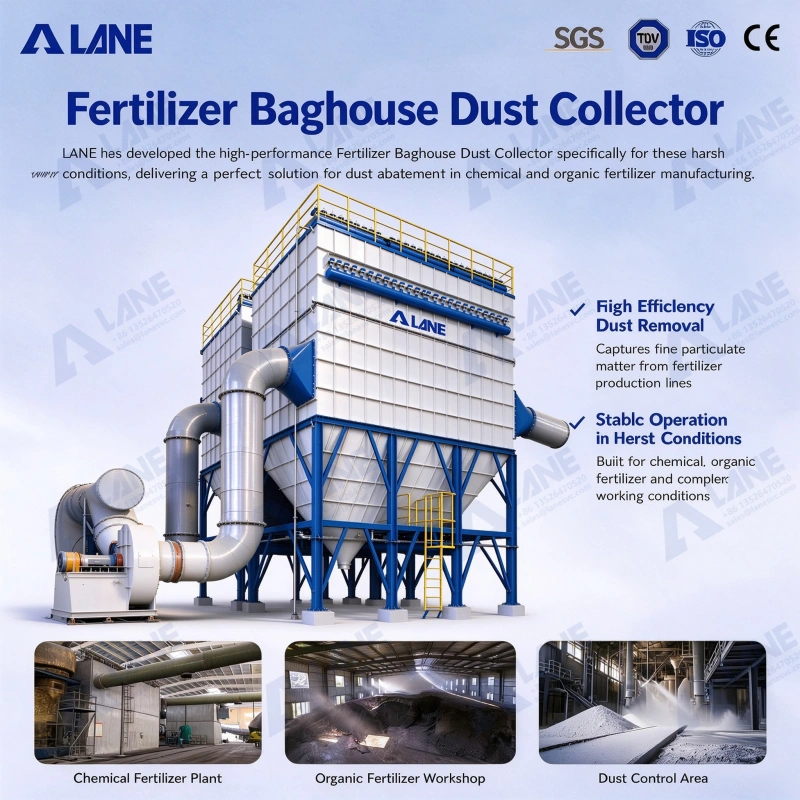
On modern fertilizer production lines, from material crushing, granulation to the final drying and packaging stages, dust control is not only essential for environmental compliance but also directly impacts plant operational efficiency. Fertilizer dust is highly hygroscopic, prone to caking and strongly corrosive, so conventional dust collectors frequently shut down due to bag blinding and corrosion.
LANE has developed the high-performance Fertilizer Baghouse Dust Collector specifically for these harsh operating conditions, delivering a perfect solution for dust abatement in chemical and organic fertilizer manufacturing.
Integrating advanced anti-caking pulse cleaning technology and a specially engineered corrosion-resistant structure, the Fertilizer Baghouse Dust Collector achieves a purification efficiency of up to 99.9%. It helps plants consistently meet strict environmental emission standards, significantly extends filter bag service life, and delivers a low-maintenance, high-return purification solution for fertilizer flue gas and dust.
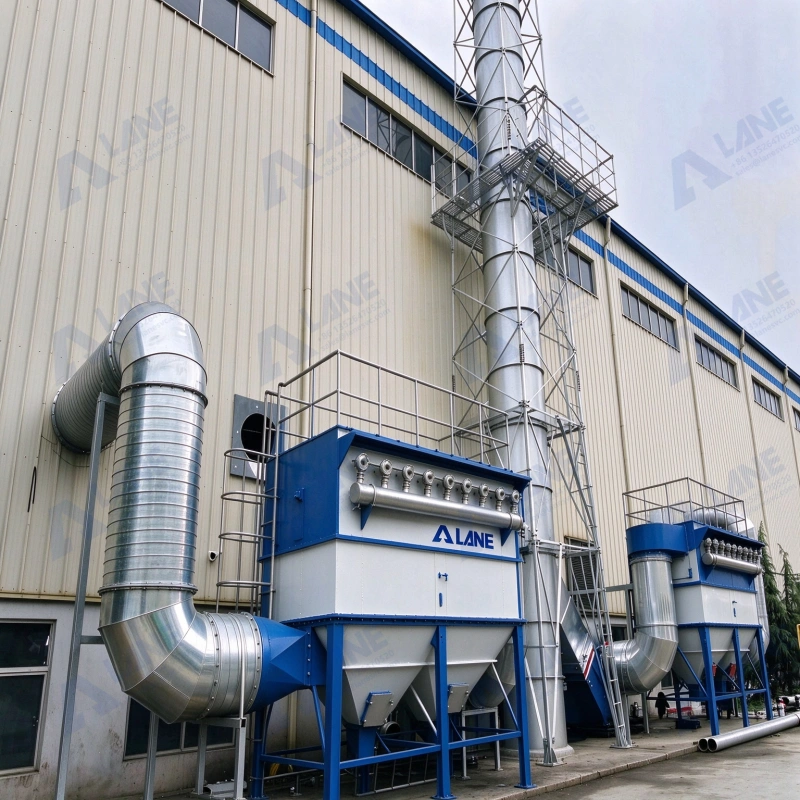
Pain Points in Fertilizer Working Conditions
Ordinary dust removal equipment tends to fail rapidly in fertilizer plants. Our Fertilizer Baghouse Dust Collector is engineered to address three critical industry challenges:
❌ Pain Point 1: Dust absorbs moisture and cakes up, blinding filter bags and disabling the dust collector instantly.
• ➔ Our Solution: Full-time anti-condensation thermal balance system
• [Block cold air externally] The entire unit is wrapped with high-density rock wool insulation jackets to completely eliminate cold bridge effects.
• [Stabilize internal temperature] Electric or steam tracing belts are installed on hoppers and housings, maintaining internal temperature at least 20 ℃ above the dew point.
• [Forced offline cleaning] Compartmentalized offline pulse jetting cuts off airflow to forcibly peel off sticky dust.
❌ Pain Point 2: Sulfur and phosphorus components create heavy corrosion; ordinary steel plates rust and perforate within 1–2 years.
• ➔ Our Solution: Dual industrial-grade corrosion protection
• [Upgraded materials] Critical contact surfaces are optionally available in SS304 / SS316L stainless steel to resist acid and alkali corrosion from the source.
• [Special coating] Carbon steel components are finished with sandblasting, zinc-rich epoxy primer and high-temperature-resistant silicone topcoat as standard.
• [Corrosion-resistant cages] Filter bag cages receive a special silicone treatment to prevent material adhesion and erosion.
❌ Pain Point 3: Ultra-fine fertilizer particles clog filter media, raising operating resistance and increasing fan energy consumption.
• ➔ Our Solution: High-permeability microporous membrane filtration technology
• [Surface filtration] PTFE microporous membrane filter media delivers 99.9% capture efficiency while enabling easy dust release.
• [Triple-function modified treatment] Filter bags are waterproof, oil-repellent and antistatic, resisting adhesion even for oil-wet particles.
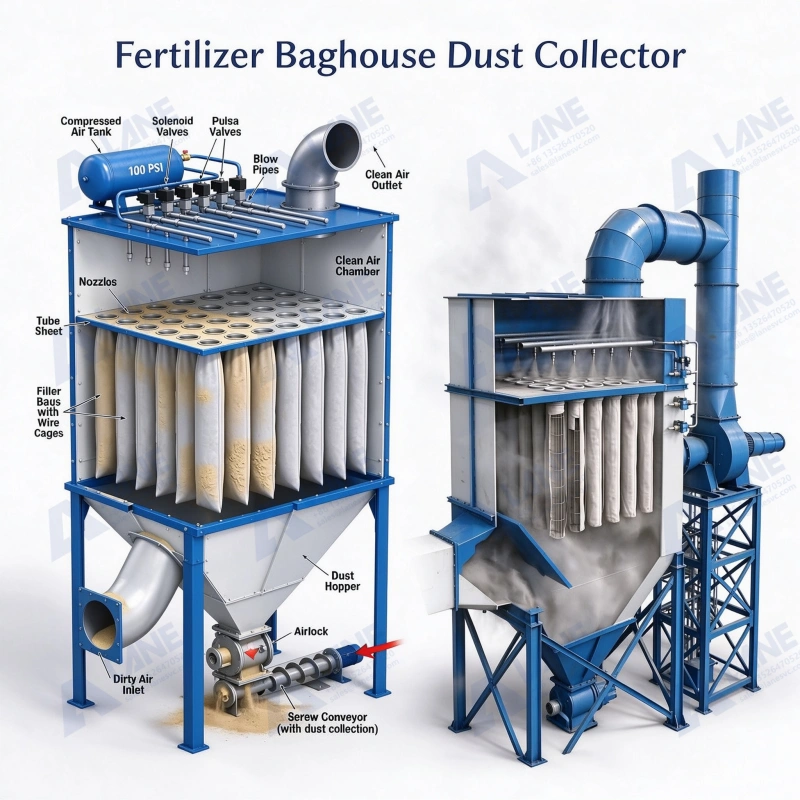
Fertilizer Baghouse Dust Collector Model Specifications & Precise Selection Guide
To match fertilizer production lines of different capacities, our Fertilizer Baghouse Dust Collector covers a full range of specifications from small standalone units to large centralized dust collection systems.
💡 Step 1: Three core factors for quick selection Before contacting our engineers, please confirm these three key site parameters:
Air Volume ➔ Determines the size of the dust collector (typically ranging from 3000 to 100000 m³/h).
Gas Temperature ➔ Determines filter bag material selection (ambient, medium temperature or high temperature above 120 ℃).
Dust Properties ➔ Determines whether explosion relief valves, heating tracing or specialized stainless steel construction are required.
Step 2: Configuration Selection Table
| CORE PARAMETERS | INDUSTRIAL STANDARD SPECIFICATIONS | SPECIALIZED FEATURES FOR FERTILIZER CONDITIONS |
|---|---|---|
| Equipment Name | Fertilizer Baghouse Dust Collector | Custom-built for chemical and organic fertilizer processes. |
| Efficiency | ≥ 99.9% | Stack outlet emission concentration controlled below 10 mg/m³. |
| Filter Media | PTFE membrane / PPS / Waterproof-Oil Repellent-Antistatic PET needle felt | Water-repellent, oil-repellent and antistatic properties. |
| Housing | Q235B carbon steel with heavy-duty anticorrosive coating / SS304 / SS316L | Customizable according to sulfur and phosphorus corrosion concentrations. |
| Cleaning Method | Intelligent automatic pulse jet cleaning (Online / Offline) | Compressed air supply with dual precision filtration and drying. |
| Safety Protection | Optional: Explosion relief door, explosion-proof motor, spark detector | Safety features can be configured according to process conditions and explosion risk assessment. |
Step 3: Technical Data Sheet
| MODEL | AIR VOLUME | POWER | INLET SIZE (MM) | OUTLET SIZE (MM) | DIMENSION (MM) |
|---|---|---|---|---|---|
| LAMC-800 | 800 m³/h | 0.75 kW | φ100 | 300 × 150 | 1420 × 500 × 500 |
| LAMC-2200 | 2200 m³/h | 2.2 kW | φ150 | 400 × 200 | 1700 × 640 × 640 |
| LAMC-2700 | 2700 m³/h | 3 kW | φ200 | 600 × 300 | 2000 × 800 × 800 |
| LAMC-3600 | 3600 m³/h | 4 kW | φ250 | 600 × 300 | 2000 × 800 × 800 |
| LAMC-4500 | 4500 m³/h | 5.5 kW | φ300 | 700 × 350 | 2100 × 950 × 950 |
| LAMC-6000 | 6000 m³/h | 7.5 kW | φ350 | 700 × 350 | 2100 × 950 × 950 |
| LAMC-10000 | 10000 m³/h | 11 kW | φ400 | 800 × 400 | 2400 × 1700 × 1700 |
Full-Line Dust Removal Solutions for Fertilizer Production
We reject generic one-size-fits-all equipment. Along your production line, the Fertilizer Baghouse Dust Collector provides targeted dust control for key process sections:
Section 1: Raw Material Crushing & Screening
• On-site Pain Points: Mechanical impact of phosphate rock and potassium salt generates high-hardness, high-concentration dust that rapidly abrades filter bags.
• Core Configuration: Fertilizer Baghouse Dust Collector with pre-installed gravity settling wear protection system
• Treatment Outcome: Coarse particles are intercepted before entering the baghouse, greatly extending filter bag service life.
Section 2: Granulation, Drying & Cooling
• On-site Pain Points: Exhaust gas from drums and granulation towers carries large volumes of high-humidity, sticky compound fertilizer particles, which easily condense and blind bags.
• Core Configuration: Fertilizer Baghouse Dust Collector full-time anti-condensation thermal balance system (rock wool insulation + electric tracing)
• Treatment Outcome: Combined with PTFE microporous membrane media, the system resists bag adhesion even for highly hygroscopic dust such as urea.
Section 3: Finished Product Automatic Packaging
• On-site Pain Points: Dust escapes during automatic weighing and filling, endangering worker health and causing product loss.
• Core Configuration: Fertilizer Baghouse Dust Collector high-negative-pressure multi-point local dust extraction system
• Treatment Outcome: Captures fugitive dust precisely. Collected fertilizer particles can be recycled directly, cleaning the workshop and recovering economic losses.
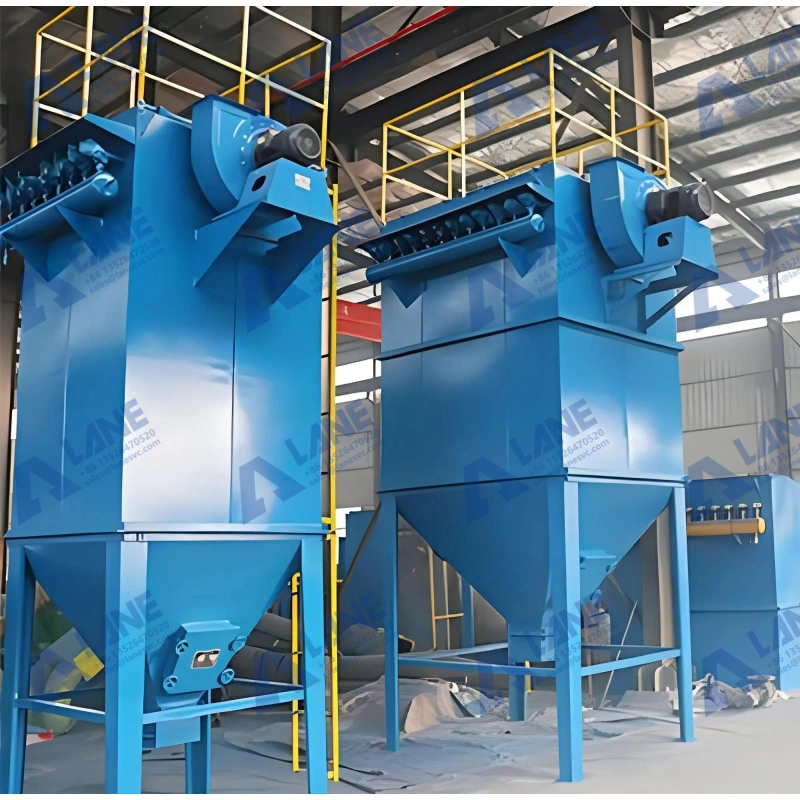
Energy Consumption Calculation & Core FAQ
Before procurement, plant finance directors and chief engineers focus heavily on daily energy costs and long-term maintenance. We provide transparent cost analysis so every unit of energy consumed by your Fertilizer Baghouse Dust Collector delivers tangible environmental benefits.
⚡ 1. Transparent real operating energy consumption
· No inflated nominal data Operating costs of the dust collection system mainly come from the fan, compressed air and hopper heating. Taking a typical fertilizer line with a treatment capacity of 50,000 m³/h as an example:
• Main Fan Power Consumption ➔ At an operating pressure of 2,500 Pa, the main exhaust fan motor draws a stable power of 55 to 75 kW. • Compressed Air for Cleaning ➔ Pulse jet compressed air consumption is only 1 to 3 m³/min at 6 bar operating pressure.
• Hopper Tracing Power ➔ For moisture-prone materials, each hopper’s electric tracing consumes just 2 to 5 kW, eliminating caking with minimal power input.
❓ 2. Top 3 FAQ for Plant Managers and Chief Engineers
• Q: What emission level can our facility achieve?
• A: With a properly sized pulse jet dust collector fitted with PTFE membrane filter bags, emissions can be reliably kept below 10 mg/Nm³. EU IED standards generally require below 20 mg/Nm³, while some regions in China enforce limits below 10 mg/Nm³. Designs are strictly aligned with your local permit limits.
• Q: Fertilizer plant environments are harsh; how long can filter bags last?
• A: Under stable operation at ambient temperature for crushing dust, polyester bags last 24 to 36 months. For dryer exhaust at 180 ℃, Nomex bags achieve 18 to 24 months of service life. PPS bags handling acidic urea dust typically last 24 to 30 months. Correct pulse pressure settings and stable inlet temperature control are critical to maximizing bag life.
• Q: Does our fertilizer plant require explosion protection?
• A: Yes, if you process organic fertilizer (manure, compost, straw-based), ammonium nitrate dust or any material with a Kst value greater than zero. The question is not whether explosion protection is needed, but the required vent area. We calculate explosion venting areas strictly in accordance with EN 14491 or NFPA 68, and include these calculations in every quotation.
LANE Delivery Assurance · From Drawing Design to Lifelong After-Sales Support
A single day of shutdown on a fertilizer production line incurs substantial losses. When you select LANE’s Fertilizer Baghouse Dust Collector, you purchase not only the equipment itself but also full-lifecycle industrial-grade service.
🛠️ 1. One-on-One Engineer Customization · Zero-error On-site Installation
• [Site Survey & Airflow Simulation] Our technical team develops 3D layout designs based on the actual space of your crushers, granulators and workshop layout.
• [Global Installation Guidance] Every Fertilizer Baghouse Dust Collector undergoes modular pre-assembly before shipment. Detailed installation videos and real-time remote engineer support are supplied with each unit to guarantee successful commissioning on the first attempt.
🛠️ 2. International Standard Quality Inspection · 100% Rigorous Factory Testing
• [Laser-cut Tube Sheets] Ultra-precision laser cutting ensures perpendicularity and sealing of every bag hole, preventing dust leakage at the source.
• [Pressure Holding & Air Tightness Testing] All housing welds undergo penetrant testing and full-unit air tightness pressure testing to ensure stable long-term operation under 2,500 Pa negative pressure without deformation.
🛠️ 3. 24-Hour Response · Lifelong Supply of Consumables and Spare Parts
• [Rapid After-Sales Support] Dedicated technical files are created for each customer. Technical solutions are provided within 2 hours for reported issues, and expert remote or on-site support is available within 24 hours.
• [Genuine Filter Bags Direct from Factory] Original Nomex, PPS, PTFE membrane bags and pulse valve spare parts are supplied to existing customers at factory cost for the whole service life of the equipment, removing long-term operational worries.