High-Capacity Vermicompost Processing Equipment & Turnkey Plants
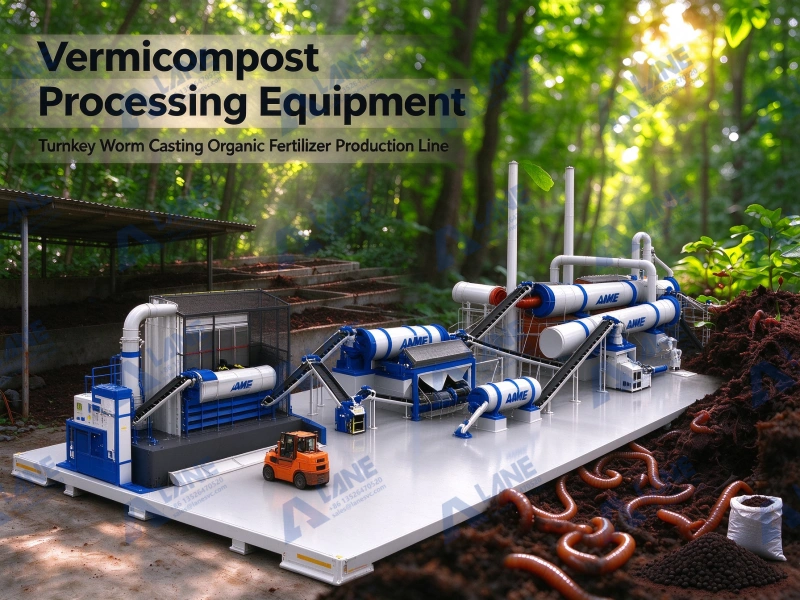
Global demand for organic fertilizer is surging rapidly, turning raw worm castings into highly profitable “black gold” for commercial agriculture. That said, scaling up from small-scale worm breeding to full industrial production requires professional engineering expertise. If you want to purify, standardize and commercialize your organic waste output, investing in efficient vermicompost processing equipment is the decisive step.
As a leading Chinese fertilizer machinery manufacturer, Lane designs and builds robust commercial systems tailored specifically to this sector. Our advanced vermicompost processing equipment handles the high-moisture, sticky texture of pure worm castings while keeping nutrient loss to an absolute minimum. Whether you plan to expand production on a large farm or upgrade a professional fertilizer plant, picking the right vermicompost processing equipment directly determines your market value and long-term return on investment.
Technical Specifications & Equipment Matrix
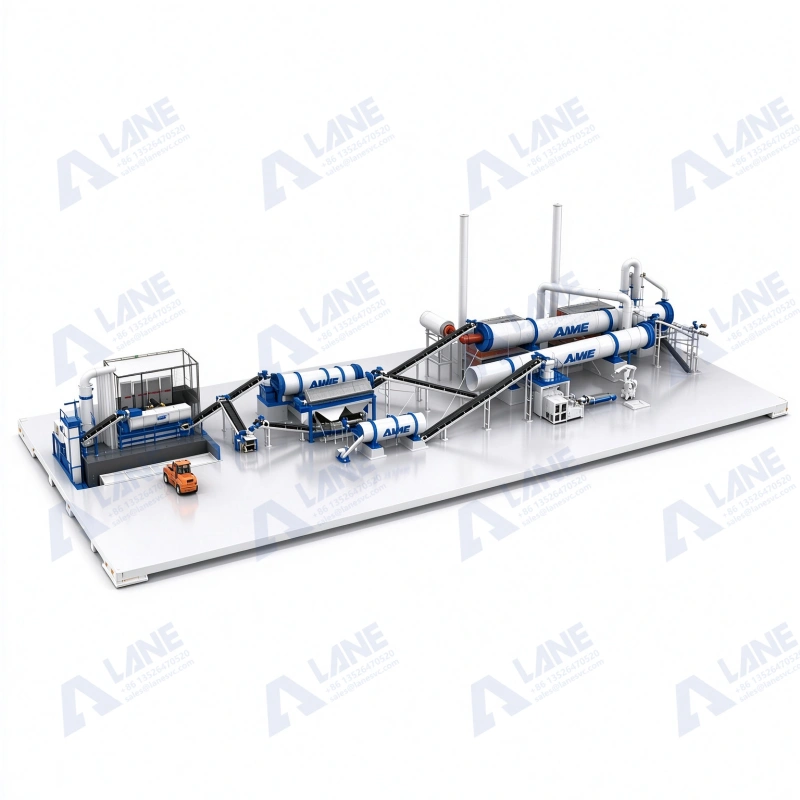
Complete Industrial Workflow
Forklift Hopper → Anti-Slip Conveyor → Trommel Screening → Low-Temp Rotary Drying → Vertical Chain Crushing → Dynamic Mixing → Pellet Granulating → Particle Polishing → Rotary Cooling → Cyclone Dust Collection → Smart Weight Bagging
Below is the extended technical summary for all machinery included in our automated vermicompost processing equipment lines:
| WORKFLOW CATEGORY | EQUIPMENT NAME | KEY DRIVING FUNCTIONS | PROCESSING CAPACITY | CRITICAL ROLE IN LANE’S TURNKEY SOLUTIONS |
|---|---|---|---|---|
| Material Input | Bulk Feeding Hopper with Agitator | Breaks blockages; feeds sticky castings evenly | 2.0–30 Tons/Hour | The intake portal of our complete vermicompost processing equipment lines. |
| Separation Stage | Heavy-Duty Rotary Trommel Screen | Separates fine manure from live worms and stones | 1.0–20 Tons/Hour | First refinement unit inside the vermicompost processing equipment chain. |
| Moisture Control | Bio-Safe Low-Temperature Dryer | Drops water content from 45% down to 20% | 1.0–15 Tons/Hour | Preserves volatile micro-organisms within our vermicompost processing equipment. |
| Size Reduction | Vertical Chain Crusher | Grinds damp fiber lumps into premium micro-powder | 1.5–30 Tons/Hour | Guarantees homogenous material texture for the vermicompost processing equipment. |
| Transit Network | Skirted Rubber Belt Conveyors | Moves bulk materials safely between different stages | 2.0–50 Tons/Hour | The continuous lifeline bonding our vermicompost processing equipment together. |
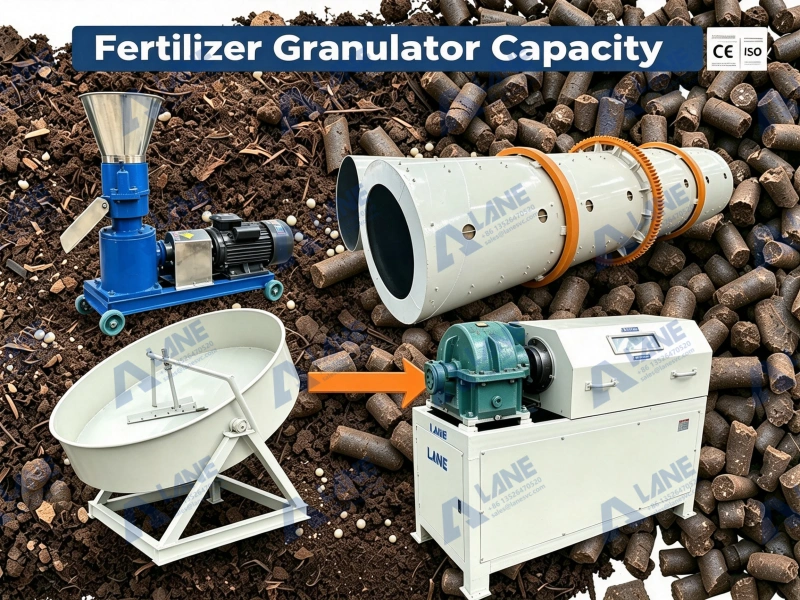
| Granulation Stage | New Type Organic Fertilizer Granulator | Converts raw powder into high-density round pellets | 1.0–10 Tons/Hour | Upscales standard vermicompost processing equipment into a commercial-grade line. |
| Pellet Finishing | Organic Fertilizer Polishing Machine | Rolls organic pellets twice for spherical perfection | 1.0–8.0 Tons/Hour | Elite finishing module for premium vermicompost processing equipment outputs. |
| Eco-Protection | Cyclone & Jet Bag Dust Collector | Extracts airborne powder; meets global factory laws | Custom Air Volume | Protects workforce and eco-rating of the vermicompost processing equipment plant. |
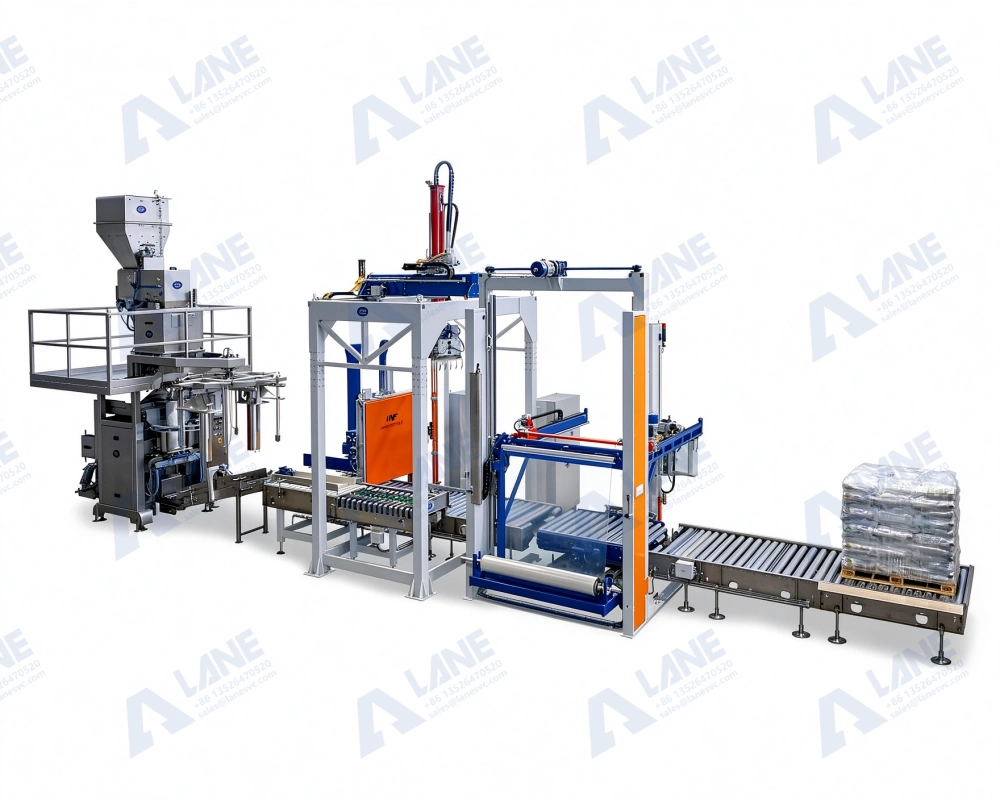
| Final Bagging | Smart Computerized Packaging Scale | Fills bags from 5 kg to 50 kg automatically | 2.0–40 Tons/Hour | The automated exit gate of the custom vermicompost processing equipment pipeline. |
Ultimate Guide to Raw Input Materials & Commercial Application Scenarios
To build a high-profit organic fertilizer plant, you need to master the processing of diverse feedstocks and secure high-end buyers. The industrial-grade vermicompost processing equipment manufactured by Lane is fully engineered to handle raw biological waste, and it also works seamlessly with high-value custom blended formulas.
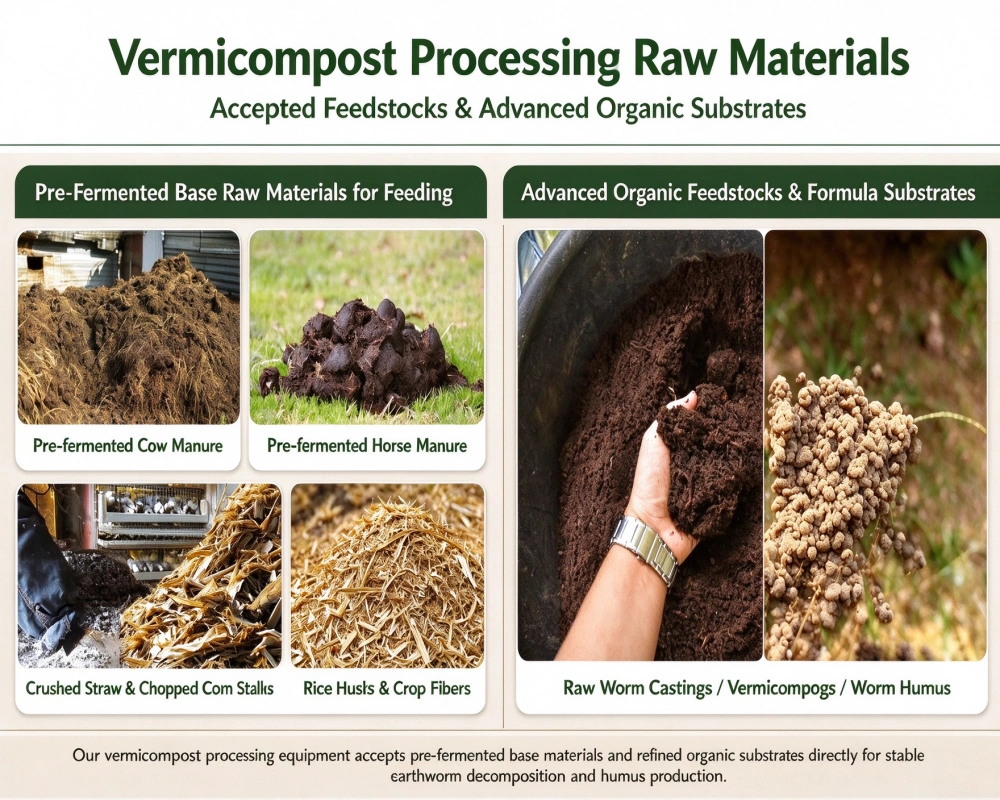
1. Pre-Fermented Base Raw Materials for Feeding
Our full production line of vermicompost processing equipment readily accepts these raw materials straight out of the worm breeding stage:
• Pre-fermented cow manure
• Pre-fermented horse manure
• Pre-fermented poultry litter
• Crushed crop straw
• Chopped corn stalks
• Rice husks
• Coconut coir bedding
• Fruit pulp residues
• Brewery spent grain
• Vegetable market waste
2. Advanced Organic Feedstocks & Formula Substrates
Your factory can feed any of these professional organic substrates directly into our vermicompost processing equipment without modification:
• Vermicompost
• Raw worm castings
• Worm humus
• Organic worm compost
• Mature worm castings
• Pre-screened worm castings
3. Nutrient Boosting Ingredients & High-Grade Bio-Additives
To lift your retail selling price, you can blend the following formula components into the processing flow of your vermicompost processing equipment:
• Humic acid
• Biochar
• Peat
• Organic mineral additives
• Beneficial microbes
Organic nutrients
• Essential trace elements
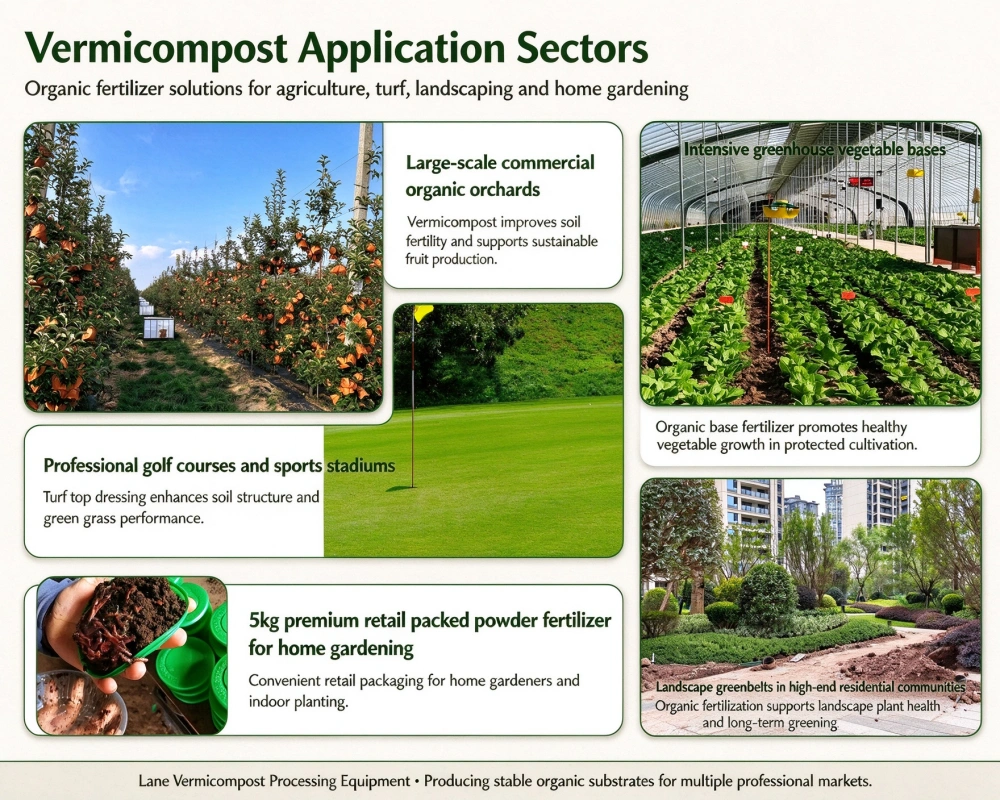
4. Downstream Commercial Application Scenarios
Investing in custom vermicompost processing equipment from Lane allows your plant to supply premium fertilizer products for the following sectors:
• Large-scale commercial organic orchards
• High-end agricultural vineyards
• Intensive greenhouse vegetable bases
• Professional golf courses and sports stadiums
• Turf for urban public parks and sports fields
• Landscape greenbelts in high-end residential communities
• 5kg premium retail packed powder fertilizer for home gardening
• Heavy 1-ton bulk jumbo bags for agricultural distributors
Case Study: 10 Ton Per Hour Commercial Factory in Australia
To demonstrate the operational reliability of our vermicompost processing equipment in real-world projects, let’s review a complete turnkey project delivered to an agricultural enterprise in Queensland, Australia. The plant needed to convert bulk organic cattle bedding into premium organic pellet fertilizer for the retail export market.
1. Project Background & Customer Challenges
Before partnering with our engineering team, the customer faced severe production bottlenecks with their existing screening system:
• Extremely high raw material moisture: The average water content of incoming feedstock reached 52%, causing widespread screen mesh clogging.
• Severe impurity contamination: Raw material was heavily polluted by undecomposed straw bedding, small stones and live worm cocoons.
• Low efficiency from manual weighing: Reliance on manual weighing scales led to significant weight errors in finished bags.
2. Integrated Solution Configured by Lane
We deployed a high-capacity setup of heavy-duty fully automatic units for this plant, consisting of tailored vermicompost processing equipment:
• Anti-clog rotary trommel screening: Custom rotary screens fitted with automatic nylon cleaning brushes perfectly separate live earthworms in one pass.
• Bio-safe low-temperature drying: Excess moisture is safely reduced to 18% while fully preserving the activity of beneficial soil microorganisms.
• Dynamic pellet polishing: Raw organic powder is upgraded into high-density, glossy spherical pellets ideal for high-end retail export.
3. Measurable Operational Results at the Australian Plant
After twelve consecutive months of running our custom vermicompost processing equipment line, the customer achieved outstanding efficiency gains:
• Fertilizer purity up to 99%: All undecomposed straw fiber impurities were completely removed from final retail bags.
• Wholesale profit increased by 300%: Low-cost farm-grade powder was successfully upgraded into export-quality spherical pellets with much higher margins.
• 75% reduction in labor costs: Full automation of material transfer was achieved with a network of synchronized intelligent belt conveyors.
4. Exclusive Project Benefits for New B2B Clients
To help you replicate this commercial success in your local biofertilizer market, Lane offers these limited-time incentives:
• Free custom CAD layout drawings: Send us your factory floor area, and we will produce layout blueprints at zero cost.
• Complimentary financial ROI forecasting report: We calculate your equipment payback period precisely based on your local raw material costs.
• Itemized price quotation delivered within 24 hours: A full transparent cost breakdown for all core machinery.
Vermicompost Processing Equipment On-Site Troubleshooting
1. Repeated thermal overload tripping of the electric motor
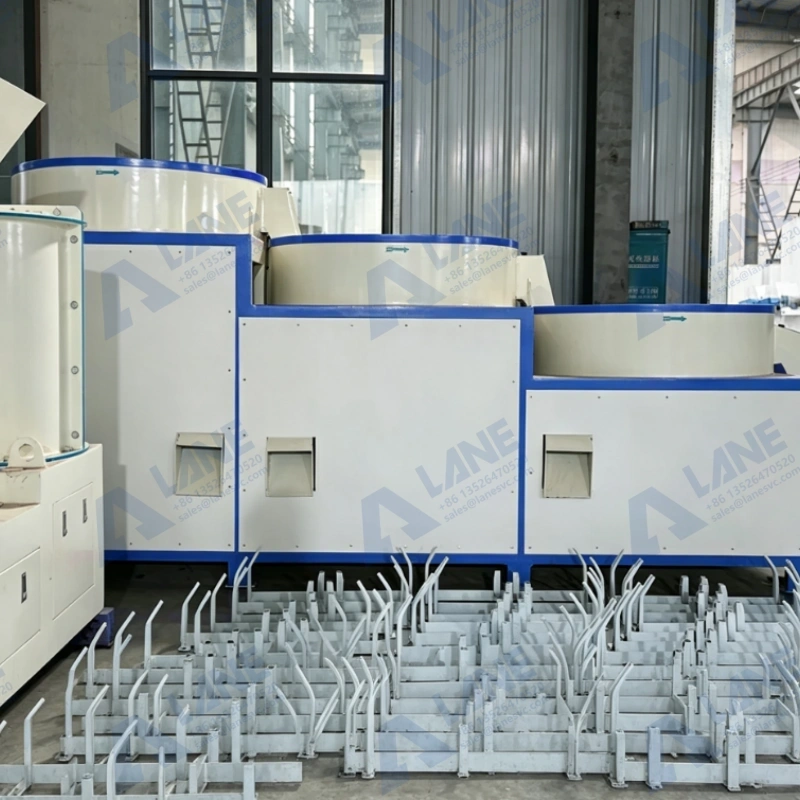
• On-site issue: When processing mature organic worm castings, the main vertical chain crusher motor trips repeatedly or suffers severe overheating.
• Root cause: Large, densely compacted mud clumps and hard fertilizer lumps surge into the crushing chamber at the same time, spiking input current far above the safety threshold.
• Engineering remedy: Upgrade your vermicompost processing equipment line with variable-frequency speed-controlled screw feeders. The PLC control system will automatically slow down feeding before motor torque exceeds the safety limit.
2. Brittle, fractured pellets with poor roundness and hardness
• On-site issue: Finished pellets discharged from the new organic fertilizer granulator break down into fine powder during long-distance belt conveying due to friction and impact.
• Root cause: Imbalanced physical formulation; the wet mixed material lacks sufficient viscous binders such as humic acid or fibrous agents.
• Engineering remedy: Adjust the input formula within the control matrix of your vermicompost processing equipment. Inject sodium humate liquid or fine peat at a concentration of 5% to 8% to tightly bind the organic micro-powder together.
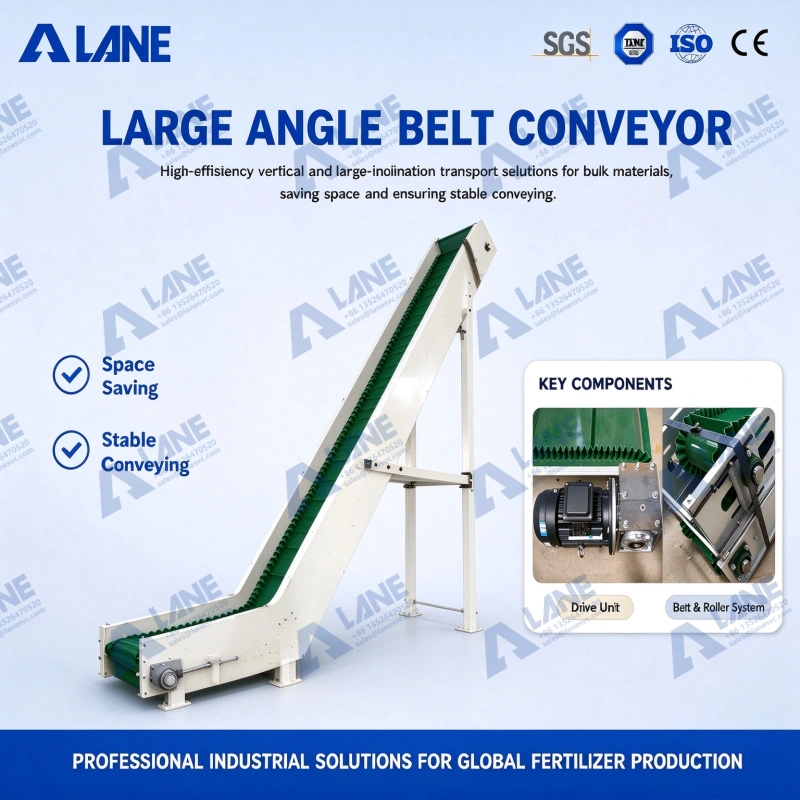
3. Conveyor belt slippage, deviation and severe material spillage
• On-site issue: Heavy-duty rubber belt conveyors transporting sticky worm castings drift sideways, causing costly raw material to spill extensively across the factory floor.
• Root cause: Sticky organic residue accumulates layer by layer on the tail drive drum, completely eliminating mechanical friction between the belt and drum surface.
• Engineering remedy: Lane installs self-cleaning rotary scrapers on every conveyor node of your vermicompost processing equipment. These scrapers remove sticky buildup automatically without requiring an unplanned production shutdown.
Frequently Asked Questions
Question 1: Can your engineering configuration directly process worm castings with moisture content above 50%?
• Engineering answer: No industrial machine can carry out effective screening or granulation without severe material jamming at such high moisture levels.
• Before feeding bulk material into the fully automatic vermicompost processing equipment line, your fertilizer plant must implement pre-drying treatment or adopt windrow natural air drying and ventilation.
• Lane recommends lowering the moisture content of base feedstock to a reasonable range of 30% to 35% before starting production.
• This specific moisture range guarantees maximum volumetric throughput and perfect screening purity for our custom vermicompost processing equipment.
• It also optimizes material surface tension to ensure flawless pellet forming rates inside our heavy-duty vermicompost processing equipment.
Question 2: What is the optimal technical design to resist the strong abrasion and corrosion of humic acid?
• Engineering answer: Humic acid compounds are highly corrosive and rapidly wear out standard carbon steel under continuous friction.
• To secure your heavy capital investment, Lane equips all machinery in the line with premium high-manganese alloy steel or hardened SUS304 stainless steel lining plates.
• This superior metallurgical barrier withstands persistent chemical abrasion during 24/7 heavy-duty factory operation.
• It prevents thinning of internal machine structures and extends component service life by more than 200% compared with standard alternatives.
• This advanced heavy-duty design ensures your professional vermicompost processing equipment line retains high residual asset value even after ten years of continuous operation.
Question 3: Can we integrate custom fully automatic bagging scales for different bag capacities?
• Engineering answer: Yes. Flexibility is a core built-in feature of our modern fully automatic engineering setup.
• The intelligent weighing system installed at the end of our modular production line can be recalibrated instantly via the computer control panel.
• Local operators can seamlessly switch between small 5kg retail bags for organic gardening markets and heavy 50kg woven bulk sacks for agricultural distributors.
• The integrated automatic bag-sewing machine automatically adapts to different bag heights to effectively prevent material leakage during logistics and transportation.
Summary
Don’t let raw, unprocessed biological raw materials limit the revenue potential of your enterprise. Contact Lane Company today to learn how our professional vermicompost processing equipment can standardize your industrial output. Now apply for your exclusive consultation and let our technical experts create a high-capacity vermicompost processing equipment system tailored for your project. Submit your site dimensions within this week and you will receive a customized quotation list for your heavy-duty vermicompost processing equipment within 24 hours!